

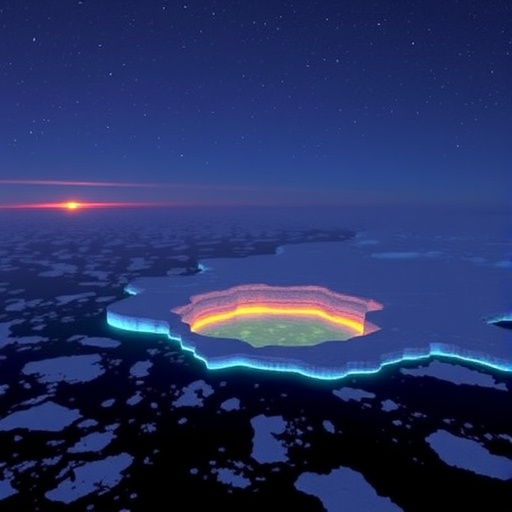
In a groundbreaking study soon to be published in Nature Communications, a team of climate scientists has unveiled new insights into the complex interplay between oceanic warming and polynya formation off Dronning Maud Land during the last glacial period. This research illuminates previously hidden aspects of subsurface ocean dynamics on millennial to orbital timescales, revealing how these processes contributed to regional climate variability in one of the most remote and climatically sensitive regions on Earth. By extracting and analyzing ocean sediment cores, the researchers reconstructed subsurface temperature changes with unprecedented resolution, offering a vital window into the past behavior of Southern Ocean systems that influence global climate regulation.
The study focuses on the area off the coast of Dronning Maud Land in Antarctica, a critical zone where polynyas—persistent open-water areas surrounded by sea ice—form. Polynyas play a pivotal role in ocean-atmosphere interactions by regulating heat exchange, sea ice production, and deep water formation. Despite their importance, the drivers behind the formation and persistence of these features during glacial periods have remained poorly understood. The research team, led by T.M.L. Pinho and colleagues, integrated geochemical proxies and sedimentological data to identify periods of intensified polynya occurrence concomitant with episodes of subsurface warming, thereby outlining a nuanced picture of ocean dynamics under glacial climate conditions.
One of the key findings of this study is the identification of millennial-scale fluctuations in subsurface ocean temperatures off Dronning Maud Land. These temperature anomalies, occurring over thousands of years, corresponded with phases of enhanced polynya activity. This correlation implies a mechanistic link between subsurface warming of intermediate waters and the surface processes that promote polynya formation. The warming likely originated from changes in ocean circulation patterns and heat advection linked to broader climatic oscillations, including shifts in the Atlantic Meridional Overturning Circulation and Southern Westerly Winds. Such interactions highlight the interconnectedness of high-latitude oceanographic systems on both regional and global scales.
Analyzing the sediment cores also allowed the team to distinguish between orbital-scale and millennial-scale climate influences. Orbital forcing, which relates to variations in Earth’s position relative to the sun, exerts a profound effect on Antarctic temperature and ice extent. During colder glacial maxima, subsurface waters exhibited marked warming episodes that triggered localized polynya formation, which in turn influenced sea ice dynamics. The polynyas acted as sensitive indicators of shifts in ocean heat content and ocean-atmosphere feedback mechanisms, suggesting that even subtle changes in subsurface conditions could have magnified impacts on regional climate.
The study’s technical approach combined stable isotope analysis with trace metal geochemistry to infer past water mass properties. For instance, variations in oxygen isotopes of benthic foraminifera allowed the team to reconstruct temperature changes at different water depths. Complementary measurements of neodymium isotopes helped trace shifts in ocean circulation sources. Together, these data sets unveiled a stratified ocean system wherein warmer intermediate waters undercut colder surface layers, creating conditions conducive to polynya maintenance. This stratification was dynamically modulated by glacial-interglacial cycles, underscoring the complexity and sensitivity of Antarctic marine systems.
Pinho et al.’s research challenges previous assumptions that glacial periods were universally characterized by uniform cooling of all ocean layers. Instead, their results reveal episodic subsurface warming events that could destabilize ice shelves and modify sea ice extent locally. By connecting these warming episodes with polynya formation, the study reshapes our understanding of the Southern Ocean’s role as a driver of climate variability rather than merely a passive responder to atmospheric changes. The existence of polynyas in a colder overall climate further complicates projections of future Antarctic climate scenarios under global warming.
Crucially, the study emphasizes the feedback mechanisms involving polynyas and ocean heat flux. Polynya formation contributes to increased sea ice production, which enhances brine rejection and subsequent bottom water formation. These processes are critical components of the global thermohaline circulation. By demonstrating how subsurface temperature anomalies influenced polynya dynamics during the last glacial, this work suggests that similar feedback loops may operate today, potentially modulating Antarctic contributions to global ocean circulation and sea level rise.
The implications of this research extend beyond paleoclimatology. Understanding the historical behavior of polynyas and subsurface ocean warming is vital for predicting how the Antarctic margin will respond to ongoing climate change. Current observations already show increasing subsurface ocean warming beneath floating ice shelves, leading to thinning and collapse events. The link established between ocean temperature variability and polynya formation during the glacial period offers a valuable analogue for interpreting modern changes and improving climate model predictions.
Moreover, the high-resolution temporal framework established by this study enables the disentanglement of rapid climate events from slow orbital trends. The identification of millennial-scale pulses of subsurface warming suggests that they may have acted as triggers or amplifiers for abrupt climatic shifts recorded in Antarctic ice cores. These findings open new avenues for integrated multi-proxy studies combining marine sediment cores, ice core data, and climate modeling to capture the full complexity of Antarctic climate evolution.
The interdisciplinary nature of this research stands out, incorporating expertise in oceanography, geochemistry, paleoceanography, and climate dynamics. The team’s rigorous methodological design in collecting and analyzing sediments from such an inaccessible part of the world is a testament to technological advances in deep-sea drilling and analytical techniques. Their work sets a benchmark for future studies aiming to uncover the detailed internal workings of polar ocean systems over geological time.
Future research inspired by these findings will likely focus on expanding spatial coverage to understand regional variation in polynya behavior around Antarctica. Additionally, improving model representations of subsurface warming and ice-ocean interactions will be necessary to faithfully reproduce observed patterns. This will not only enhance our paleoclimate interpretations but also provide more reliable projections for Antarctic ice sheet stability and global sea level trajectories.
In summary, the study by Pinho, Nürnberg, Meckler, and colleagues ushers in a new understanding of how millennial- and orbital-scale subsurface ocean warming influenced polynya formation during the last glacial period off Dronning Maud Land. Their integrative approach reveals intricate feedbacks between ocean dynamics and cryospheric processes that have profound implications for interpreting past, present, and future Antarctic climate variability. As climate change accelerates, insights from Earth’s coldest regions will be crucial for informing mitigation and adaptation efforts worldwide.
Subject of Research:
Millennial- to orbital-scale subsurface ocean warming and polynya formation off Dronning Maud Land during the last glacial period.
Article Title:
Millennial-to-orbital-scale subsurface ocean warming and Polynya formation off Dronning Maud Land during the last glacial.
Article References:
Pinho, T.M.L., Nürnberg, D., Nele Meckler, A. et al. Millennial-to-orbital-scale subsurface ocean warming and Polynya formation off Dronning Maud Land during the last glacial. Nat Commun (2026). https://doi.org/10.1038/s41467-026-70498-w
Image Credits:
AI Generated


