

The Institute of Intelligent Medical Research (IIMR) of BGI Genomics, in collaboration with Sweden’s Uppsala University, has published the largest multi-omics study of colorectal cancer (CRC) to date. The study aimed to understand the functional and prognostic impact of cancer-causing somatic mutations, revealing new genetic alterations and developing a new molecular classifier of tumor variants. This research was published in the journal Nature on August 7th, 2024.

Credit: BGI Genomics
The Institute of Intelligent Medical Research (IIMR) of BGI Genomics, in collaboration with Sweden’s Uppsala University, has published the largest multi-omics study of colorectal cancer (CRC) to date. The study aimed to understand the functional and prognostic impact of cancer-causing somatic mutations, revealing new genetic alterations and developing a new molecular classifier of tumor variants. This research was published in the journal Nature on August 7th, 2024.
Unveiling New Genetic Landscapes
The researchers analyzed the whole genomes and transcriptomes of 1,063 primary colorectal cancers within a population-based cohort, with 94% of the patients completing a 5-year clinical follow-up. This extensive analysis identified 96 mutated driver genes, 9 of which were previously unknown in CRC, and 24 that were new to any form of cancer.
Several specific mutation patterns that are unique to CRC were identified. Mutations in specific pathways (WNT, EGFR, TGFβ), a mitochondrial gene (CYB), three regulatory elements, 21 copy-number variations (alterations in the number of copies of a particular gene), and a specific mutation signature (COSMIC SBS44) were linked to patient survival rates.
New Molecular Classifier System
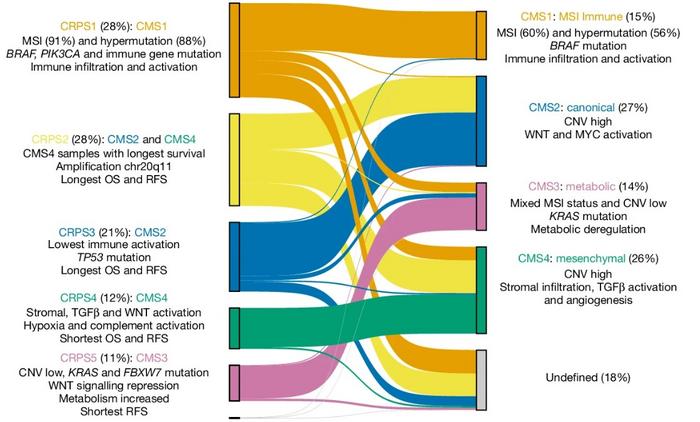
Building on these findings, the researchers developed a new strategy to molecularly classify colorectal cancer. Through an integrated analysis that combined mutated genes with gene expression levels, they identified five distinct CRC prognostic subtypes (CRPSs), each with unique molecular characteristics. This new classification system is poised to revolutionize the way CRC is diagnosed and treated.
A Comprehensive Understanding of Disease Progression
Through timing analysis, the study uncovered that specific genetic alterations, such as those in APC, TP53, KRAS, BRAF, ZFP36L2, TCF7L2, FBXW7, BCL9L, and SOX9, tend to occur early in the cancer’s progression. Meanwhile, other mutations, particularly in TRPS1, GNAS, and CEP170, are more likely to appear during the later stages of cancer development.
Beyond identifying critical molecular changes linked to tumor invasion and metastasis, the study uncovered disease-related mutations in the mitochondrial genome and non-coding regions, offering a comprehensive summary of mutations that play a significant role in disease progression.
A Collaborative Effort
The collaboration between BGI Genomics and Uppsala University dates back to 2018. Dr. Lin Cong, Specialized Scientist from IIMR and co-corresponding author of the study, highlighted the significance of this partnership, stating, “Since 2018, Uppsala University and BGI have carried out in-depth cooperation on the U-CAN cohort.”
Dr. Lin adds, “This time, BGI’s advanced genomics technology and data analysis resources were applied to a large-scale colorectal cancer population. Not only were the significant predictive effects of multiple mutation events on prognosis found, but the newly constructed fine typing of expression profiles will also play an important role in guiding individualized diagnosis and treatment of colorectal cancer in the future.”
Dr. Tobias Sjöblom, Professor at the Department of Immunology, Genetics and Pathology at Uppsala University, noted that the study achieved the largest comprehensive analysis of colorectal cancer with genomes and transcriptomes to date and combined molecular features with high-quality clinical data.
Looking ahead, co-first author Dr. Li Fuqiang, Specialized Scientist from IIMR suggested that “In the future, a multi-omics technology platform that integrates regularization, standardization, automation, informatization, intelligence, and scale will empower large-scale genomic research cooperation and facilitate the research and application of big data for large groups of people.” This vision underscores the potential for future advancements in genomic research and personalized medicine.
About BGI Genomics
BGI Genomics, headquartered in Shenzhen, China, is the world’s leading integrated solutions provider of precision medicine. Its services cover more than 100 countries and regions, involving more than 2,300 medical institutions and 10,000 employees worldwide. In July 2017, as a subsidiary of BGI Group, BGI Genomics (300676.SZ) officially began trading on the Shenzhen Stock Exchange.
Journal
Nature
Method of Research
Meta-analysis
Subject of Research
People

