

CHAMPAIGN, Ill. — A new paper co-written by a University of Illinois Urbana-Champaign urban and environmental economics expert shows that social networks can play a significant role in influencing the financial behaviors and perception of catastrophic risks brought about by climate change.

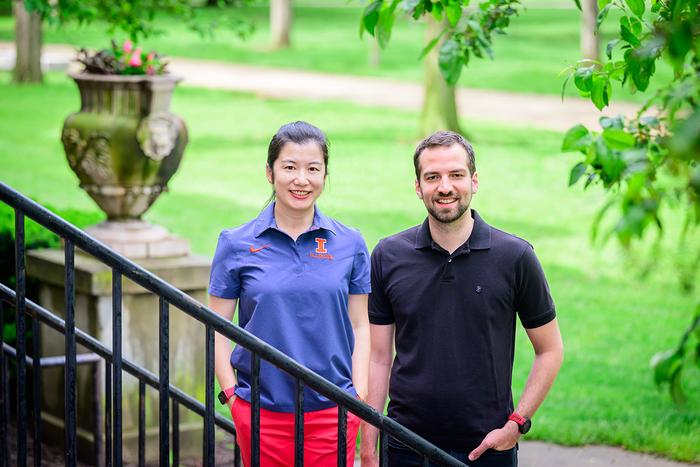
Credit: Photo by Fred Zwicky
CHAMPAIGN, Ill. — A new paper co-written by a University of Illinois Urbana-Champaign urban and environmental economics expert shows that social networks can play a significant role in influencing the financial behaviors and perception of catastrophic risks brought about by climate change.
New research from Yilan Xu (“E-Lan SHE”), a professor of agricultural and consumer economics at Illinois, found that short but severe episodes of flooding from hurricanes in Texas and Florida triggered an increase in flood insurance sign-ups nationwide depending on how socially connected a county was to the flooded counties.
Xu and co-author Sébastien Box-Couillard, a U. of I. graduate student, published the findings in the journal Economic Inquiry.
The researchers also found regional climate disasters such as flooding can have a ripple effect on climate change behaviors and beliefs throughout an entire social network for up to three years afterwards.
“During natural disasters such as hurricanes, tornadoes and flooding, disaster information spreads fast through social media feeds, lighting up with first-hand evidence such as pictures and video about the event,” Xu said. “Ultimately, that information informs people outside of the immediate disaster area and prompts them to change their views about the risks of climate change.”
For example, when there’s bad storms that result in flooding, “people see images of flooding through their social connections on their Facebook feed and think ‘Hey, this could happen to me, too,’” Xu said. “The exposure to that risk signal then prompts them to update their previous perceptions about whether climate change can affect them, which subsequently transforms their views on local flood risks and decisions regarding signing up for flood insurance.”
To measure climate adaptation behavior informed by changes in climate risk perception, the researchers investigated the uptake in flood insurance policies from the National Flood Insurance Program in the aftermath of two major hurricanes: Hurricane Harvey, which made landfall in Houston in August 2017; and Hurricane Irma, which made landfall in Florida in September 2017. Between the two storms, nearly 80,000 homes in the two regions found themselves with at least 18 inches of floodwater.
Using the Facebook Social Connectedness Index as a measure of social network adjacency that mediates social learning behaviors, the researchers were able to attribute an additional 250,000 policy sign-ups in flooded counties and an additional 81,000 policy sign-ups in unflooded counties over three years, according to the paper.
“Those numbers are fairly robust because flood insurance is not cheap,” Xu said. “At the same time, we find no evidence of an overreaction by homeowners to peer flooding, resulting in over-insurance.”
The increase in the number of flood insurance policies nationwide corresponded to the extent of each county’s social network proximity to the flooded areas, Xu said.
“The social network may facilitate social learning about climate risks in that when you see family or friends experiencing a disaster, you start to think outside of your own bubble,” she said. “Our study sheds light on how social networks can be leveraged to promote timely updates on climate risk perceptions and help correct the underestimation of climate risks.”
The implications of the research point to leveraging social networks to design educational programs and communication vehicles to promote disaster preparedness, adaptation and loss mitigation, Xu said.
“Communication strategies can be designed to enhance information dissemination to the less socially connected communities so that they can be better informed about climate risk and be engaged in climate risk management,” she said.
Climate change is similar to COVID-19 in that “we’re all in this together and what happens in one place can affect others far away,” Xu said.
“In economics, we call that externality,” she said. “A lot of times, a disaster can negatively impact nearby places, which we call a negative externality. But when we learn from a disaster, that’s actually a positive externality. Basically, some people unfortunately experience a disaster, but their friends and family who aren’t in that area can learn from it and prepare better before a similar disaster hits their own area.
“I see that as particularly important in the context of climate change because it’s a very politically fraught issue for some people. Even though it can be really difficult for you to convince someone else that climate change is real, if they see their friends and family experiencing its negative consequences, that’s a prime opportunity for the skeptics to update their thinking about climate change.”
Journal
Economic Inquiry
Method of Research
Data/statistical analysis
Subject of Research
Not applicable
Article Title
Social learning about climate risks
Article Publication Date
1-Mar-2024

