

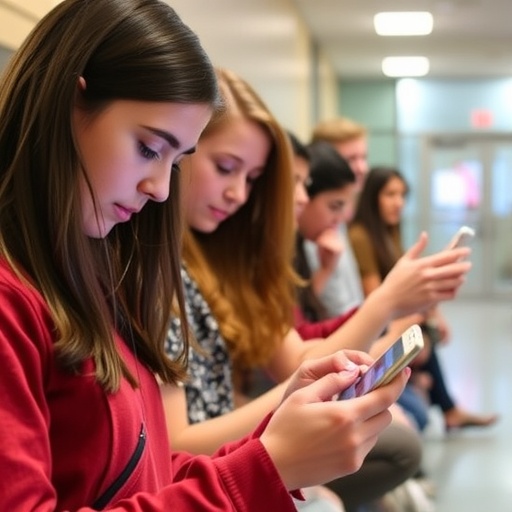
In a groundbreaking study emerging from the University of North Carolina at Chapel Hill, researchers have unveiled the astonishing extent of smartphone use among middle and high school students during school hours — a revelation that paints a complex picture of adolescent engagement with digital technology and its cognitive repercussions. Contrary to previous assumptions that smartphones serve merely as occasional distractions, this study identifies these devices as a near-constant presence in the modern classroom. By deploying objective, hourly tracking measures over a two-week span, the research meticulously chronicled thousands of data points, enabling an unprecedentedly granular view of how smartphones infiltrate the school day and impact essential cognitive faculties such as attention and impulse control.
The empirical assessment found that students devote nearly one-third of their school day to interacting with their smartphones. This extensive engagement occurs across every hour of instructional time, shattering traditional views that device usage is confined to breaks or isolated moments. Most strikingly, this smartphone interaction often involves habitual checking behaviors, defined by frequent, repetitive glances at the device that fragment attention streams and threaten the integrity of sustained focus. These interruptions were predominately driven by social media platforms and entertainment applications, which together accounted for over seventy percent of smartphone use during class.
Cognitive control, a foundational skill integral to academic success, appears to be especially vulnerable in students with high frequencies of phone checking. This dimension of control encompasses the ability to maintain attention, inhibit distractions, and exercise self-regulation — capacities that are fundamental for learning and executive function. The study’s lead author, Eva Telzer, a professor specializing in psychology and neuroscience, emphasized that frequent smartphone checking undermines these very faculties. Her insights shine a light on the paradox of modern schooling: while technology offers educational promise, unregulated smartphone use may erode the cognitive skills students critically require to thrive.
The methodology employed in this study is notable both for its scale and precision. Instead of relying on retrospective self-reports, which are vulnerable to bias and inaccuracies, the research harnessed real-time data capture technology to monitor students’ smartphone behavior continuously. This approach provided a dynamic perspective on usage patterns hour by hour, revealing nuanced trends and pinpointing critical windows during which phone use surges. Such rigorous data acquisition represents a significant advancement in digital behavior research, presenting a model for future studies aiming to disentangle complex interactions between technology and cognition.
Co-author Kaitlyn Burnell expressed particular astonishment at the volume of smartphone use concentrated within the school’s temporal boundaries. The sheer magnitude of time drained by screen interaction underscores the pervasive allure of digital content in youths’ lives, especially during moments traditionally reserved for directed cognitive engagement. Burnell underscored the implications — beyond academic performance — pointing to a broader psychological footprint whereby social media’s reinforcing properties fuel continuous engagement cycles that fragment attention and disrupt concentration.
The distinction between total screen time and the frequency of phone checking behaviors emerges as a pivotal contribution of the study. While previous research has often focused on aggregate time spent on devices, this investigation highlights how recurrent, brief interruptions commandeer cognitive resources far more deleteriously than continuous usage. These frequent lapses create a pattern of attention fragmentation, leading to diminished self-control and compromised learning efficacy. The differentiation calls for a more nuanced understanding of digital distraction, wherein the timing and nature of use potentially exert greater cognitive impact than duration alone.
Such insights arrive amid growing debates around school policies regulating smartphone access. Evidence presented here lends empirical weight to efforts advocating for limitations on phone usage during instructional time. Telzer advocates for policies that specifically target the restriction of access to highly addictive platforms like social media and entertainment apps. By curbing exposure to these highly reinforcing digital stimuli, schools could create an environment more conducive to maintaining students’ cognitive engagement and improving academic outcomes.
Beyond policy implications, the findings also have profound significance for designing digital literacy programs. Rather than advocating for blanket bans on technology, the data suggest a more calibrated strategy — one that fosters intentional and purposeful use of smartphones within educational settings. Educators and policymakers could leverage this evidence to balance the undeniable benefits of technological integration with the need to protect attentional resources, cultivating digital habits that support rather than undermine cognitive control.
Neuroscientific perspectives enrich the interpretation of these results. The adolescent brain undergoes substantial development in regions associated with executive function, including the prefrontal cortex. This maturation process involves enhancing mechanisms of attention regulation and impulse control, processes that repeated attentional disruptions may destabilize. The habitual interruption patterns identified could interfere with neurodevelopmental trajectories, potentially contributing to longer-term cognitive vulnerabilities. This developmental context underscores the urgency of addressing smartphone use as a matter not only of academic performance but also brain health.
Attention fragmentation caused by smartphone checking can be conceptualized through the lens of cognitive load theory. Each interruption imposes an extraneous cognitive load, taxing working memory and attentional systems. This not only impedes the assimilation of instructional material but also saps mental energy required for problem-solving and critical thinking. Frequent switching between classroom tasks and device interaction compromises the depth and quality of learning, reinforcing a cycle of distraction detrimental to intellectual growth.
The study also encourages reflection on the motivational dynamics driving such entrenched phone use among youths. Social media platforms are meticulously engineered to capture and hold attention through personalized content, intermittent reinforcement schedules, and social validation mechanisms. When these stimuli intrude into academic settings, they compete vigorously with educational content for cognitive priority. Understanding this competitive interaction is vital for devising effective interventions that can recalibrate attentional priorities back towards classroom engagement.
While this research spotlights risks, it also offers a hopeful pathway by advocating for evidence-based solutions. By precisely identifying habits that impair cognitive control, educators and caregivers are better equipped to implement strategic frameworks that mitigate harm while embracing the educational potential of digital technology. This dual focus on harm reduction and empowerment reflects a sophisticated approach to the challenges posed by ubiquitous smartphones in the lives of young learners.
Overall, this landmark study pushes the frontier of knowledge on adolescent smartphone use, revealing that the repetitive micro-interruptions caused by frequent phone checking more acutely impair cognitive control than previously understood. By providing a robust empirical foundation, it galvanizes the conversation around how education systems must evolve to accommodate the digital realities of today’s youth, ensuring that technological integration supports rather than sabotages their cognitive development and academic success.
Subject of Research: Smartphone use during school hours and its association with cognitive control in adolescents aged 11 to 18 years.
Article Title: Smartphone Use During School Hours and Association With Cognitive Control in Youths Aged 11 to 18 Years
News Publication Date: 9-Mar-2026
Web References: https://jamanetwork.com/article.aspx?doi=10.1001/jamanetworkopen.2026.1092
References: DOI 10.1001/jamanetworkopen.2026.1092, JAMA
Keywords: Smartphones, Cognitive control, Attention, Adolescents, Youth, Social media, Entertainment apps


