

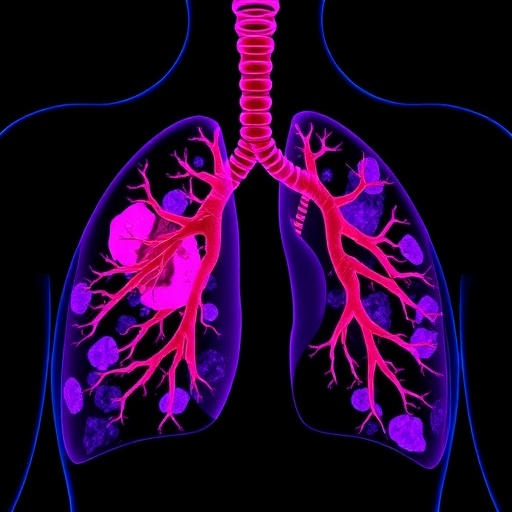
Researchers at the CU Anschutz Cancer Center have uncovered a groundbreaking mechanism by which breast cancer cells metastasizing to the lungs exploit the organ’s intrinsic healing processes. This discovery highlights how the normal repair systems of lung tissue, which are typically engaged to mend damage and restore function, inadvertently nurture and support the growth of secondary breast tumors in the pulmonary environment. The study, recently published in the journal Cancer Research Communications, provides new molecular insights that could signal transformative therapeutic strategies aimed at metastatic breast cancer notoriously difficult to treat once it infiltrates the lungs.
When breast cancer spreads or metastasizes, the lungs are a frequent step in its progression. The typical state following such metastasis involves damage to the delicate alveolar structures—the key microscopic air sacs essential for gas exchange in respiration. Under physiological conditions, alveolar type II epithelial cells play a crucial reparative role, secreting surfactant and regenerating damaged alveolar epithelium to restore lung integrity. However, the presence of cancer cells appears to co-opt this natural reparative process. The research team, led by first author Dr. Jessica L. Christenson, identified that metastatic breast cancer cells instigate a prolonged alveolar repair response, characterized by sustained activation of alveolar type II cells and chronic inflammation, conditions which inadvertently foster a pro-tumorigenic milieu.
This aberrant interaction establishes a pathological feedback loop. Tumor cells interact with alveolar epithelial cells, triggering these lung cells to release trophic factors and chemokines that bi-directionally communicate with cancer cells, enhancing their proliferative and survival capacities. The research delineated a complex signaling cascade within this crosstalk, revealing that inflammatory mediators and growth signals released by lung epithelial cells potentiate oncogenic pathways in metastatic tumor cells. Such dynamic interplay sustains tumor growth while simultaneously impairing the lung’s ability to resolve inflammation effectively, thereby turning an otherwise beneficial healing mechanism into a driver of disease progression.
In a particularly compelling aspect of their work, the researchers evaluated the efficacy of roflumilast, a phosphodiesterase-4 (PDE4) inhibitor widely used as an anti-inflammatory agent for managing Chronic Obstructive Pulmonary Disease (COPD). Utilizing mouse models of breast cancer lung metastasis, the team demonstrated that roflumilast significantly impeded the expansion of metastatic lesions within lung tissue. Rather than exerting direct cytotoxicity on tumor cells, the drug modulated the lung microenvironment by curtailing the chronic inflammatory state and disrupting the malignant dialogue between lung epithelial cells and metastatic cancer cells. This mechanism represents an innovative approach to metastasis management that targets the host tissue environment rather than the tumor cells alone.
The implications of these findings extend beyond the preclinical model. Analysis of patient-derived breast cancer tissue samples indicated molecular signatures consistent with those observed in their experimental models, suggesting that similar pathological processes are operative in human disease. The possibility of repositioning an already FDA-approved pharmacological agent such as roflumilast for metastatic breast cancer could expedite translational efforts, offering a practical adjunct or alternative to conventional therapies which often have limited impact on metastatic lesions in the lung.
Metastatic breast cancer presents a formidable challenge in oncology, accounting for a substantial proportion of cancer-related mortality. Lung metastases occur in roughly one-third of patients with advanced breast cancer and are associated with poor prognosis. The lung’s inherently regenerative environment and its critical role in systemic oxygenation underscore the need for therapies that can control metastatic growth while preserving pulmonary function. Targeting the pathological interplay between metastatic cells and the lung repair machinery opens a novel avenue for therapeutic intervention that may also minimize collateral damage incurred by aggressive treatment strategies.
Further research is underway to examine how roflumilast might be integrated with standard chemotherapy regimens and emerging immunotherapies. The research team is investigating combinatorial approaches that could enhance anti-tumor efficacy while potentially mitigating common adverse effects experienced during cancer treatment. Moreover, innovative delivery methods, including inhaled formulations of PDE4 inhibitors or analogous agents, are being explored to provide targeted therapy directly to the lungs, potentially increasing local drug concentrations and therapeutic index while reducing systemic side effects.
The prospect of modifying the tumor microenvironment to prevent metastatic outgrowth represents a paradigm shift in cancer biology and treatment strategy. Traditional cancer therapies have predominantly focused on targeting tumor cells directly; however, this study underscores the significance of stromal and organ-specific cellular interactions in cancer progression. By decoupling the pathological communication between lung alveolar cells and metastatic breast cancer cells, roflumilast and similar compounds may effectively transform the lung from a permissive niche into a hostile milieu for tumor survival.
These findings are particularly relevant for triple-negative breast cancer (TNBC), a subtype lacking expression of estrogen, progesterone, and HER2 receptors, which often metastasizes aggressively to the lungs and currently has limited targeted treatment options. As expressed by Dr. Jennifer R. Diamond, who is directing clinical components of the research, clinical trials assessing the efficacy of roflumilast in preventing lung metastasis recurrence in TNBC patients are anticipated. This represents an exciting convergence of molecular oncology and clinical therapeutics aimed at improving long-term outcomes for one of the most challenging breast cancer subtypes.
The study was made possible through support from multiple prestigious funding agencies, including the National Institutes of Health, the University of Colorado Cancer Center, the American Cancer Society, and METAvivor, an organization dedicated to metastatic breast cancer research. Their contribution has enabled rigorous preclinical experimentation combined with translational research efforts intended to swiftly move promising therapeutic candidates into clinical evaluation.
The University of Colorado Anschutz Medical Campus, renowned for its excellence in medical research and healthcare delivery, provided an ideal interdisciplinary environment for this research. Leveraging state-of-the-art laboratories, an extensive biobank of patient samples, and a collaborative network of oncologists, pathologists, and molecular biologists, the investigators could perform integrative studies that span from cellular mechanistic insights to potential clinical applications.
In summary, this innovative research reveals a sophisticated mechanism by which breast cancer cells hijack lung tissue repair systems, establishing a false repair-inflammation cycle that promotes metastatic tumor growth. The repositioning of roflumilast offers a promising strategy not only to interrupt this malignant feedback loop but also to pioneer a new class of therapies aimed at the tumor microenvironment rather than cancer cells alone. As metastatic breast cancer remains a leading cause of cancer-related death worldwide, advances like these signify a critical step toward more effective and less toxic interventions for patients facing lung metastases.
Subject of Research: Breast cancer metastasis; lung tumor microenvironment; alveolar epithelial cell interaction; metastasis therapeutic strategies.
Article Title: Breast Cancer Cells Exploit Lung Repair Mechanisms to Facilitate Metastatic Growth: Implications for Novel Therapeutics
News Publication Date: 2024
Web References:
- CU Anschutz Cancer Center: https://medschool.cuanschutz.edu/colorado-cancer-center
- Cancer Research Communications DOI: https://doi.org/10.1158/2767-9764.CRC-25-0459
References: Study supported by NIH, University of Colorado Cancer Center, American Cancer Society, METAvivor
Keywords: breast cancer metastasis, lung repair system, alveolar type II cells, tumor microenvironment, roflumilast, PDE4 inhibition, chronic inflammation, metastatic breast cancer, lung metastases, cancer therapeutics


