

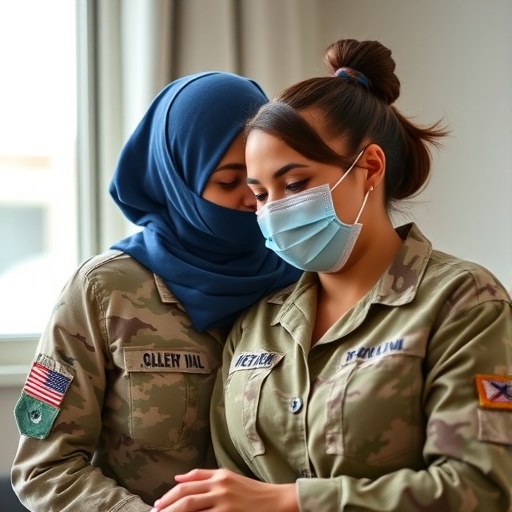
In the wake of the COVID-19 pandemic, the transition from military to civilian life has posed unprecedented challenges for veterans worldwide. New empirical evidence stemming from an extensive longitudinal study conducted by the Clearinghouse for Military Family Readiness at Penn State reveals a stark contrast in how post-9/11 female veterans have coped compared to their male counterparts. While all veterans have navigated turbulent waters, the pandemic exacerbated pre-existing disparities, particularly magnifying the strain experienced by women in multiple facets of their lives, leading to a pronounced decline in overall well-being.
This comprehensive research, recently published in the journal Chronic Stress, employs rigorous data-centric methodologies to capture the nuanced impact of pandemic-induced disruptions on employment, relationships, social dynamics, and parenting among veterans. The data emanate from two synergistic initiatives: the Veterans Metrics Initiative and the Veterans Engaging in Transition Studies. These projects collectively tracked over 5,200 service members before the pandemic and a subsequent cohort of over 3,100 veterans following the onset of COVID-19, thereby enabling a robust comparative framework over a 6.5-year post-separation period.
Among the most compelling findings is the stark divergence in work-related outcomes. Prior to the pandemic, female veterans already exhibited lower job satisfaction and higher levels of underemployment relative to male veterans. Post-pandemic analyses reveal that while both genders experienced declines in work satisfaction, the escalation of work strain disproportionately affected women. This reflects broader societal trends where women, regardless of veteran status, disproportionately absorbed increased childcare, educational oversight for children, and household responsibilities during lockdowns, thus severely straining their professional and personal equilibrium.
The concept of social support — an essential buffer against stress — manifested different trajectories in this veteran cohort. Instrumental support, defined as tangible assistance such as help with daily activities or caregiving during illness, climbed modestly for both female and male veterans. Contrarily, emotional support, the perceived availability of empathy and understanding, declined for both groups. Crucially, these emotional support deficits translated into steeper reductions in social satisfaction among female veterans, revealing that quantitative increases in aid cannot fully compensate for qualitative emotional connection.
Parenting, traditionally a domain where female veterans have excelled, presented a more complex picture. Despite reporting superior parenting functioning and satisfaction relative to males both before and after the pandemic, female veterans still endured notable declines in these areas. This paradox illustrates a form of resilience in parental roles amid rising external pressures, underscoring that while women effectively managed childcare tasks, the cumulative psychological toll eroded overall parenting satisfaction.
Relational dimensions were equally impacted but showed particularly acute deterioration among female veterans. Relationship satisfaction and functioning — measures of interpersonal stability and quality — diminished for veterans across the board, with a significantly sharper decline for women. Analysts attribute this to the compounded effect of multifaceted stressors: the imbalance of domestic labor, constrained emotional resources from partners, and increased economic pressures. Gendered expectations around household and caregiving responsibilities may amplify strains, thus entrenching disparities in relational health.
These results collectively challenge the monolithic approach often employed in veteran support services. Kimberly McCarthy, the study’s lead author, emphasizes the demand for responsive systems attuned to the gender-specific realities faced by veterans. The pandemic, she suggests, functions as an accelerant, exposing latent vulnerabilities and urging a recalibration of policies to encompass more than clinical symptoms, instead addressing structural inequities in employment, childcare, and social engagement networks.
Keith Aronson, director of the Clearinghouse and a research professor specializing in biobehavioral health, contextualizes these findings within a broader public health framework. He articulates that large-scale disruptions such as the COVID-19 pandemic “do not affect all veterans in the same way,” reinforcing the necessity for intersectional policy development that incorporates gender, family status, and occupational contexts as core variables in tailoring assistance.
Methodologically, the study’s strength lies in its longitudinal design and utilization of validated survey instruments measuring stress across multifaceted domains including work, social relations, parenting, and partnerships. However, the researchers acknowledge limitations in sample representativity. Compared to Department of Defense demographic data, participants skewed older, potentially underestimating stress levels prevalent among younger post-9/11 veterans, particularly those newly transitioning from service.
The chronic stress associated with underemployment and workplace dissatisfaction mirrors societal disparities but reveals heightened intensity within the veteran female population, suggesting systemic barriers such as gender bias, lack of equitable employment opportunities, and insufficient support for balancing work-family roles. Psychological stress in these domains may precipitate adverse mental health outcomes if unaddressed, indicating an urgent need for integrated support mechanisms encompassing both career development and family services.
Further compounding these challenges is the deterioration in emotional social support networks. This decline underscores a pernicious cycle wherein increasing work-family strain reduces capacity for nurturing interpersonal relationships, thereby diminishing protective emotional resources just when they are most critical. The data highlight a crucial gap in veteran services addressing the social and emotional facets of well-being, particularly for women.
In parenting, while female veterans maintained relative strength, the overall decline in satisfaction signals the pandemic’s broad impact on family dynamics. Increased parenting demands, disrupted routines, and the stress of managing remote schooling or childcare restrictions likely exacerbated pressures, challenging the adaptive capacities even of the most resilient parents.
The relationship domain’s marked decline for women reveals critical intersections between personal partnerships and broader socio-economic stressors. Unequal distribution of domestic labor, amplified during pandemic lockdowns, alongside reduced partner emotional support, seemingly deteriorated relational quality. This insight calls for veteran support policies that explicitly consider couple dynamics and caregiving roles as integral to mental health preservation.
Daniel F. Perkins, principal scientist at the Clearinghouse, posits that resilience and strain coexist, mandating policy frameworks that transcend individual clinical interventions to address systemic issues such as equitable employment and community support infrastructures. Virtual support communities and flexible childcare provisions are proposed as key elements in constructing a comprehensive support ecosystem responsive to female veterans’ lived experiences.
The study’s implications stretch beyond the veteran community, shedding light on the gendered dimensions of stress exacerbated by societal crises like the pandemic. Policy architects and healthcare providers are urged to recalibrate interventions to more holistically encompass social determinants of health, familial responsibilities, and gender-specific challenges to foster sustainable well-being.
While the pandemic introduced novel stressors, it functioned primarily as a magnifier of pre-existing inequities, revealing entrenched patterns of gender bias and socio-economic marginalization within the veteran population. Addressing these layered challenges demands multidimensional strategies integrating employment equity, relationship support services, and parenting resources tailored to the unique needs of female veterans.
Continued research is essential to refine understanding of these dynamics and to guide policy innovation. Equipping veteran service programs with granular data on gendered experiences facilitates precision in resource allocation and intervention design, promoting resilience and mitigating chronic stress in this vulnerable subset of the population.
In summary, this landmark investigation unfolds a complex portrait of female post-9/11 veterans’ well-being, illustrating that amidst adversity, resilience thrives yet is shadowed by disproportionate strain. As the veteran community inches toward recovery in a post-pandemic world, recognizing and rectifying these disparities will be pivotal in honoring their service and ensuring equitable integration into civilian life.
Subject of Research: People
Article Title: Employment, Relationship, and Parenting Stress Among Post-9/11 Veterans: Life Before and After the COVID-19 Pandemic
News Publication Date: 13-Mar-2026
Web References:
– Chronic Stress Journal: https://journals.sagepub.com/doi/10.1177/24705470261432617
– Clearinghouse for Military Family Readiness at Penn State: https://militaryfamilies.psu.edu/
– Veterans Metrics Initiative: https://www.hjf.org/tvmi
– Veterans Engaging in Transition Studies: https://veteranetwork.psu.edu/
References:
Henry M. Jackson Foundation for the Advancement of Military Medicine Inc., Pew Charitable Trusts.
Keywords: Mental health, Psychological stress, Chronic stress, Stress management, Adults, Parenting, Human relations, Gender bias


