

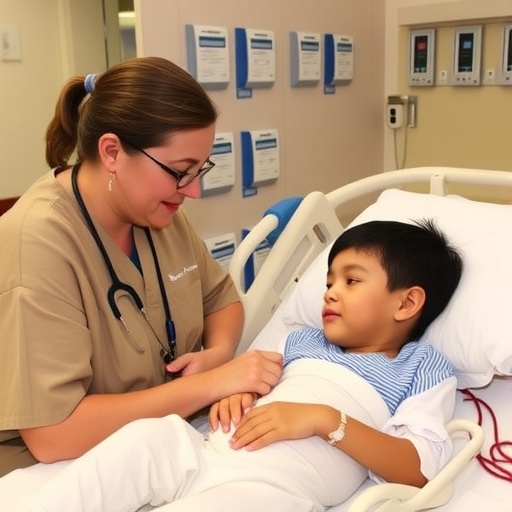
Language barriers have long posed significant challenges in healthcare settings, but their impact is profoundly magnified in highly sensitive environments such as Pediatric Intensive Care Units (PICUs). Here, families are thrust into making critical, often heart-wrenching decisions about their child’s health under immense emotional stress. Effective communication between medical teams and families is paramount in these circumstances; any breakdown could not only hinder familial understanding but also compromise patient outcomes. Recognizing these stakes, researchers at Ann & Robert H. Lurie Children’s Hospital of Chicago launched an innovative study to explore the effect of giving families direct access to interpreter technology on communication efficacy in the PICU.
Traditionally, clinical teams have controlled access to interpretation services, deciding when and how non-English speaking families receive linguistic assistance. This gatekeeping model inadvertently limits the frequency and spontaneous use of interpreters, despite recognition that professional interpretation significantly improves patient comprehension and healthcare outcomes. To overcome these hurdles, the Chicago-based team devised a simple yet ingenious intervention: a low-cost, family-empowering system that allows families to initiate video interpretation on-demand, via tablets stationed in each patient room. By decentralizing control and democratizing access to interpretation tools, the study aimed to enhance real-time communication, thereby fostering better collaboration and trust between families and clinicians.
The technological framework consisted of hospital-issued tablets equipped with video interpretation software, tailored with instructions in the family’s primary language to ensure usability. This approach leveraged existing telemedicine advances to mitigate linguistic and cultural barriers intrinsic to pediatric intensive care communications. Prior to this intervention, Families reliant on interpretation services experienced limited and often provider-mediated interactions, contributing to misunderstandings and missed nuances during critical care discussions. Through this direct access model, families could initiate communication with professional interpreters independently, increasing the dialogue opportunities during medical rounds, decision-making talks, and bedside updates.
Quantitative analysis comparing pre-intervention and post-intervention periods revealed transformative shifts in communication patterns. The study encompassed 429 families—158 prior to intervention and 271 afterward—enabling robust statistical assessment through billing data and video interpretation usage logs. Remarkably, results showed the average interpreter usage time per patient-day more than doubled, surging from 7 minutes to 16 minutes. This substantial increase underscores not only improved access but also heightened familial engagement in their child’s care, an essential consideration given the high-stress context of intensive care.
Beyond the numeric data, qualitative insights shed light on the intervention’s psychosocial benefits. Families reported a stronger sense of autonomy and inclusion in care processes when granted direct interpreter access, feelings that ripple into trust-building and compliance with treatment plans. Medical staff also noted smoother communication workflows, reduced delays in delivering crucial information, and a more collaborative atmosphere that alleviates misunderstandings common in multilingual clinical settings. Such improvements echo broader calls within healthcare for patient-centered models that respect cultural and linguistic diversity while fostering informed consent.
Crucially, this study navigates the intersection of medical technology, health communication, and pediatric critical care – fields that collectively influence clinical outcomes. The deployment of video interpreter tablets represents a scalable, implementable model adaptable across diverse hospital settings. It challenges entrenched practices of interpretation services managed solely by providers, suggesting that empowering families with direct technological tools can optimize not just communication quantity but also quality. These findings align with prior research emphasizing professional interpretation’s role in reducing medical errors, improving satisfaction, and narrowing health disparities among non-English-speaking populations.
The implications extend beyond pediatric intensive care to broader health equity concerns. Language barriers not only obstruct medical comprehension but exacerbate systemic disparities in access, quality of care, and patient safety. Innovations like the Lurie Children’s intervention signal pathways toward inclusivity, where technology acts as an enabler rather than a barrier. Furthermore, by prioritizing family agency and cultural competence, healthcare institutions can better honor the complex social and linguistic contexts patients navigate, thus advancing the ethical dimensions of care.
From a clinical perspective, enhanced communication supported by direct interpretation access facilitates more accurate histories, better symptom reporting, and patient-centered decision-making, vital factors in managing critically ill children. This is particularly pertinent in PICUs, where conditions evolve rapidly and treatment plans require frequent reassessment and nuanced discussions involving multidisciplinary teams. With improved interpreter access, families are positioned to participate meaningfully, ask clarifying questions, and express concerns without the constraints of limited language support.
The study also highlights the efficiency and cost-effectiveness of the intervention. Given its low-cost design, integrating video interpreter tablets into standard PICU rooms does not necessitate extensive financial burdens, promising wide-reaching applicability especially in resource-constrained healthcare systems. The use of billing data for evaluation further demonstrates pragmatic methodologies for assessing communication interventions, informing future quality improvement projects aiming to systematically enhance interpreter utilization.
Within the context of ever-expanding telehealth technologies, this research underscores the untapped potential of video interpretation as an accessible, patient-empowering tool. By situating interpretive services directly in the hands of families, it advances the paradigm from reactive to proactive communication support. This shift is particularly critical in pediatric settings, where emotional complexity and decisional urgency demand clarity, compassion, and cultural responsiveness.
In conclusion, the groundbreaking study at Ann & Robert H. Lurie Children’s Hospital has illuminated a pathway to substantially improve communication in the pediatric intensive care environment via family-initiated interpreter technology. Doubling interpreter use time signals a profound enhancement in dialogue between clinicians and non-English-speaking families, carrying promising implications for care quality, equity, and patient satisfaction. These insights encourage broader adoption of similar models and continued innovation that places family empowerment and technology integration at the forefront of pediatric critical care communication strategies.
Subject of Research: Impact of Family-Initiated Interpreter Technology on Communication in Pediatric Intensive Care Units
Article Title: Family-Driven Access to Video Interpretation Technology Dramatically Enhances Communication in Pediatric Intensive Care
News Publication Date: Not specified in the source content
Web References: https://www.luriechildrens.org/en/doctors/pilarz-mary/
References: Published in Hospital Pediatrics journal (specific citation not provided)
Keywords: Pediatric Intensive Care, Language Barriers, Medical Interpretation, Health Communication, Video Interpreter Technology, Family Empowerment, Pediatric Critical Care, Healthcare Equity


