

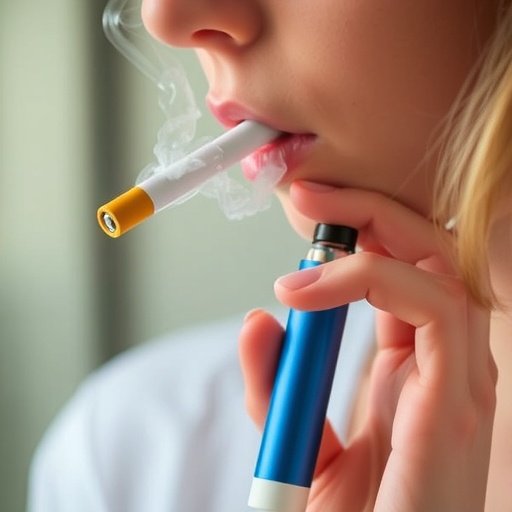
In a groundbreaking new study conducted by researchers at the University of Bristol, the impending UK ban on disposable vapes threatens to reshape the landscape of nicotine consumption among young adults in complex and potentially troubling ways. Set to take effect on June 1, 2025, this government-mandated prohibition aims to reduce the alarming surge in disposable vape usage among teenagers. Yet emerging qualitative data suggests that while the policy’s intentions are laudable, its real-world repercussions may be far more nuanced and could inadvertently propel some individuals toward traditional cigarette smoking.
Disposable vapes have surged in popularity due to their portability, affordability, and accessibility, especially among youth and young adults. However, the ease with which these devices can be used has raised public health alarms, prompting the government to legislate against their sale. Despite this, almost 2.5 million UK adults currently depend on disposables as their primary nicotine source, raising critical questions about how these users will navigate the new regulatory environment.
The study, recently published in PLOS Global Public Health, represents the first qualitative exploration into the anticipated behavioral shifts among young adult disposable vape consumers in response to the ban. Employing comprehensive semi-structured online interviews, researchers engaged 22 participants aged 18 to 30, encompassing never-smokers, former smokers, and dual-users of both cigarettes and vaping devices. This diverse sample provided invaluable insights into personal experiences, expectations, and concerns related to the forthcoming prohibition.
Among the key revelations was a marked dichotomy in attitudes. A majority of interviewees expressed unequivocal support for the ban, citing the necessity to curtail youth vaping, which has escalated rapidly in recent years. This approval underscores the participants’ recognition of the health risks associated with unregulated disposable vape consumption among minors. Yet, this support was tempered by pragmatic considerations around personal nicotine maintenance strategies post-ban.
The researchers uncovered a prominent trend: most young adults planned to transition from disposable to reusable or rechargeable vaping devices once disposables become unavailable. This behavioral adaptation reflects an underlying commitment to nicotine use via less disposable-dependent means. Such a pivot may preserve harm reduction choices for these users, aligning with public health objectives that favor vaping over conventional tobacco smoking.
However, beneath this optimistic shift lurks a concerning contingency. Some participants, particularly dual-users who oscillate between cigarettes and vapes, indicated a likelihood to revert fully or partially to smoking traditional cigarettes rather than adopt reusable vaping alternatives. Alarmingly, this potential backslide encompasses even a handful of never-regular smokers and former smokers who anticipate increasing their combustible cigarette intake if disposables are banned. This phenomenon could undermine decades of progress in reducing smoking prevalence and exacerbates risks associated with tobacco smoke exposure.
Moreover, viewpoints on the ban’s impact on illicit markets were polarized within the study group. Several interviewees hypothesized that eliminating disposable vapes might suppress illegal sales by cutting off a major demand channel. Conversely, others feared the restrictions could inadvertently fuel a black market boom, spawning unregulated, potentially hazardous disposable products. This duality highlights the complex dynamics present when restricting widely used consumer products without comprehensive enforcement and alternative harm reduction pathways.
The study’s findings emphasize the delicate balance policymakers must strike between curbing underage vaping and minimizing adverse unintended consequences among current users. While reducing youth access remains paramount, neglecting the needs and behaviors of young adult consumers risks fostering detrimental shifts toward more harmful nicotine delivery systems. Public health strategies should therefore intricately consider these diverse user trajectories to optimize outcomes.
Dr. Jasmine Khouja, a leading researcher formerly at the University of Bristol and now affiliated with the University of Bath, articulated the study’s cautionary message: the ban’s unintended encouragement of cigarette use or illicit product procurement was never the goal, yet some young adults appear poised to explore these options. This insight calls for more nuanced policies and supportive measures to prevent such regressions and promote safer nicotine alternatives.
Richie Carr, the study’s corresponding author, reinforced this viewpoint, underscoring the complexity inherent in nicotine use behaviors. He noted that while many young adults expect to switch to alternative vaping products post-ban, a significant minority foresee turning back to cigarettes. This outcome not only jeopardizes individual health but could also stall public health advances made by encouraging vaping as a smoking cessation or harm reduction aid.
Although the study provides rich qualitative insights, the authors counsel caution in generalizing results due to the participant demographic skew—predominantly white females aged 18 to 22, with approximately half from the University of Bristol. This limitation underscores an urgent need for broader, more inclusive studies incorporating diverse genders, ethnicities, and older age groups to comprehensively assess the ban’s impact across the population.
Future research avenues must include rigorous, quantitative measurements of behavioral changes triggered by the ban, such as rates of smoking initiation, frequency of tobacco use, uptake of other nicotine-containing products, and prevalence of illicit market consumption. Such data will be pivotal to fully understanding the ban’s efficacy and consequences, guiding evidence-based refinements in public health policy.
Ultimately, the study advocates for strategic interventions to mitigate unintended harms. These could encompass increased accessibility to reusable vaping devices, robust public education campaigns targeting young adults, and enhanced monitoring of illicit markets. Holistic, adaptive strategies will be critical to realizing the ban’s health-promoting potential without sacrificing harm reduction gains.
In sum, the University of Bristol’s qualitative inquiry reveals a multifaceted landscape surrounding the UK’s disposable vape ban. The anticipated shift away from disposable devices among young adults may be overshadowed by worrying tendencies toward re-embracing cigarette smoking and illicit product use. This paradox underscores the necessity for policymakers and health professionals to anticipate complex user responses and to tailor their approaches accordingly—ensuring that efforts to protect youth do not inadvertently imperil broader public health objectives.
Subject of Research: People
Article Title: Exploring the potential consequences of the disposable vape ban in the UK: a qualitative study with young adults who use disposable vapes
News Publication Date: 11-Mar-2026
Web References: http://dx.doi.org/10.1371/journal.pgph.0004686
Keywords: Behavioral psychology, Public health, Psychological science, Social psychology, Human health


