

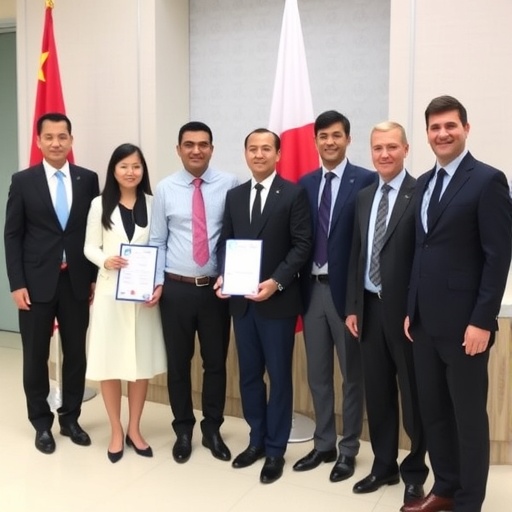
On March 23, 2026, Ruijin Hospital in Shanghai played host to an important assembly that marked a milestone in the advancement of international collaboration within the field of laboratory medicine. The event attracted the attention of global experts, notably featuring Professor Sergio Bernardini, the esteemed Secretary of the International Federation of Clinical Chemistry and Laboratory Medicine (IFCC). This gathering represented a confluence of innovation, academia, and international dialogue aimed at bridging laboratory medicine communities between China and Italy. Representatives from Shanghai Jiao Tong University School of Medicine and the editorial team of the journal LabMed Discovery (LMD) convened with a shared vision to create synergies that would elevate research, education, and dissemination of scientific knowledge on a worldwide scale.
Professor Bernardini’s visit was not merely ceremonial but anchored in a strategic discourse about the evolving landscape of clinical chemistry and laboratory medicine. The meeting underscored the importance of LabMed Discovery as a pivotal platform fostering international academic exchange. Over the course of multiple discussions, both Chinese and Italian delegates reflected on the journal’s role as a conduit for disseminating impactful research across borders. Efforts to amplify the journal’s reach through fostering global editorial partnerships and establishing overseas offices emerged as a cornerstone of future development strategies. These initiatives undoubtedly aim at enhancing the journal’s stature as an authoritative source within the global scientific community.
Innovation took center stage in this high-level exchange, with particular attention devoted to the integration of artificial intelligence (AI) into laboratory medicine. AI is heralded as a transformative technology, capable of revolutionizing diagnostic accuracy, workflow efficiency, and decision-making processes within clinical laboratories. The delegation discussed fostering joint research projects that leverage AI to streamline laboratory workflows, enhance biomarker discovery, and improve prognostic models. In doing so, they anticipated applying cutting-edge computational techniques such as machine learning algorithms, neural networks, and natural language processing to extract actionable insights from vast biomedical datasets.
Another salient topic was the pursuit of international funding opportunities to support collaborative research endeavors. Cross-border cooperation is increasingly recognized as vital for addressing complex biomedical challenges that surpass geographic limitations. Participants examined potential mechanisms for securing grants from multinational bodies and scientific consortia that prioritize innovation in laboratory diagnostics. Establishing shared research platforms—including online academic forums and workshops—was also identified as a key approach to sustain a vibrant scientific dialogue, promote data sharing, and accelerate translational research from bench to bedside.
The meeting further amplified the significance of talent cultivation as a foundational pillar for sustaining future advances in laboratory medicine. The parties acknowledged successful previous student exchange programs and stressed the importance of continuing and expanding these initiatives to nurture a new generation of globally competent scientists. Immersive international experiences were deemed crucial for young investigators to acquire diverse perspectives, cutting-edge methodologies, and interdisciplinary collaboration skills vital in today’s rapidly evolving biomedical landscape.
Within the broader thematic framework of research collaboration, participants delved into precision medicine applications and biomarker discovery as priority research directions. Integrating multi-omics approaches including genomics, proteomics, and metabolomics with sophisticated laboratory techniques can uncover novel disease signatures. These advances promise to optimize patient stratification and individualized therapeutic interventions, epitomizing the future of laboratory medicine. The dialogue emphasized shared goals to co-develop biomarker validation protocols and harmonize diagnostic criteria to heighten reproducibility across international clinical studies.
Beyond research, academic publishing was focal in the discussions, with a vision to enhance LabMed Discovery’s impact factor and visibility through strategic editorial initiatives. Expanding the journal’s editorial board to include leaders in emerging scientific domains and establishing thematic special issues were considered vital steps. Professor Bernardini highlighted ongoing commitments to organize international conferences and symposia that align with the journal’s scope, fostering networking and knowledge exchange. These scholarly activities are anticipated to stimulate submissions of high-quality manuscripts, thereby consolidating LabMed Discovery’s position as a flagship journal in laboratory medicine and clinical chemistry.
The integration of digital technologies within scientific publishing was also examined as crucial to broaden accessibility and engagement. Exploring open-access models, leveraging social media for dissemination, and employing advanced metrics to gauge article-level impact were discussed. Harnessing these tools is expected to optimize the journal’s responsiveness to the dynamic needs of the scientific community and promote real-time knowledge exchange.
The visit concluded with a shared determination to institutionalize these collaborative frameworks, building upon mutual trust and complementary expertise. Both parties envisioned a blueprint for sustained Sino-Italian partnership that can serve as a model for international scientific cooperation. The envisaged initiatives span comprehensive domains from cutting-edge research and talent development to scholarly communication, painting a holistic panorama for the future trajectory of laboratory medicine.
Overall, the March 2026 gathering at Ruijin Hospital stands as a landmark event, reinforcing the critical role of international alliances in fostering innovation and addressing global health challenges. By leveraging the synergy between established institutions like Shanghai Jiao Tong University and global networks represented by IFCC, the scientific community takes bold strides towards translating emerging technologies and discoveries into clinical realities. LabMed Discovery emerges at this nexus as a vital platform powering the global discourse and nurturing breakthroughs that promise to transform laboratory medicine worldwide.
Subject of Research:
International collaboration in laboratory medicine focusing on artificial intelligence integration, multi-omics research, precision medicine, scientific publishing, and talent development.
Article Title:
Strengthening Sino-Italian Collaboration in Laboratory Medicine: Strategic Visions from Ruijin Hospital
News Publication Date:
March 23, 2026
Web References:
https://mediasvc.eurekalert.org/Api/v1/Multimedia/f7dd87fd-dff0-4bd5-9d2d-109350c54f5f/Rendition/low-res/Content/Public
Image Credits:
Article authors: LMD Editorial Department.
Keywords:
Laboratory Medicine, Clinical Chemistry, International Collaboration, Artificial Intelligence, Precision Medicine, Shanghai Jiao Tong University, Sergio Bernardini, LabMed Discovery, Scientific Publishing, Talent Development, Sino-Italian Cooperation


