

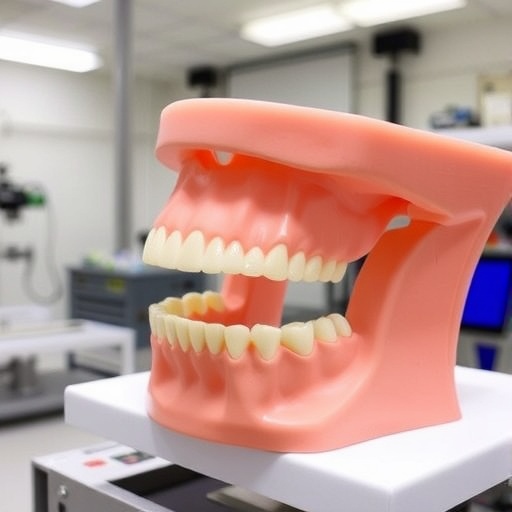
In a significant breakthrough for the field of medical 3D printing, a team of researchers has begun to outline a novel process for the in-house printing of orthognathic surgical splints. This development is particularly relevant given the increasing demand for personalized medical devices that cater specifically to individual patient needs. Traditionally, such splints have been fabricated externally, posing challenges in terms of cost, time efficiency, and adaptability. However, with the advent of advanced 3D printing technology, the prospect of producing these devices within medical facilities not only boosts efficiency but also enhances surgical outcomes.
The process the researchers advocate involves rigorous dimensional verification techniques that ensure the splints produced meet the precise specifications required for effective treatment. In their study, published in 3D Print Med, the authors stress the importance of accuracy, given that even minor discrepancies in dimensions can lead to significant complications during surgical procedures. By conducting a thorough verification process, the team aims to eliminate potential errors associated with the outsourcing of splint production.
One of the pivotal elements of the study is the design phase, which lays the groundwork for successful splint fabrication. The researchers undertake a comprehensive examination of existing design software and 3D printing technologies. They emphasize the necessity for practitioners to have access to both user-friendly design tools and robust printing machines that can yield the required precision and quality. By simplifying the design process, medical professionals can swiftly adapt splints to the unique anatomy of each patient, thus enhancing both the therapeutic and aesthetic outcomes.
Moreover, the study discusses material selection as a critical factor in achieving successful results. The researchers explore a range of biocompatible materials that can be utilized in the printing of orthognathic splints, each possessing distinct properties that affect their usability and longevity in a medical context. They detail how the choice of material can significantly impact the comfort of the patient post-surgery, and how advancements in material science are paving the way for even better options in the near future.
The team has employed a series of experimental validations, involving both computational modeling and hands-on trials, to enhance the dimensional verification process. They provide insights into their testing protocols, highlighting the necessity for a rigorous quality control mechanism. By utilizing advanced imaging techniques and measurement tools, the researchers have been able to quantify the accuracy of the printed splints against established benchmarks, effectively establishing a standard for future production.
The findings reveal that in-house production not only reduces the turnaround time for splint creation but also empowers surgeons to make real-time adjustments during the treatment planning phase. This agility can prove crucial in complex cases where immediate alterations may be required due to unforeseen anatomical considerations. The implications for patient care are profound; faster production and delivery of these tailored devices can lead to quicker recovery times and improved patient satisfaction overall.
This investigation also touches on the economic implications of in-house printing. The costs associated with outsourcing can be significant, especially for smaller medical facilities that may lack the procurement power of larger hospitals. With the implementation of in-house 3D printing technology, clinics can better manage their budgets while simultaneously elevating the quality of care they provide. By strategically investing in 3D printers and training staff in their use, medical facilities could facilitate a transformation in how surgical solutions are delivered.
Additionally, the research encapsulates a broader view of the future of surgery and patient care. As 3D printing technology continues to evolve, it will likely play an increasingly essential role in the customization of surgical tools and implants across various medical specialties—not just orthognathics. The centrality of patient-centric design cannot be overstated, as tailoring solutions to the specifics of individual anatomy offers the potential for enhanced surgical outcomes and overall patient well-being.
The collaborative effort showcased in this research underscores the importance of interdisciplinary cooperation in advancing medical technology. Engineers, surgeons, and materials scientists have come together to bridge the gap between innovation and practical application. This teamwork not only enhances the integrity of the results but also emphasizes the need for ongoing collaboration in the medical community.
In conclusion, the advancement of in-house 3D printing for orthognathic splints is a testament to the critical intersection of technology and healthcare. As this field develops, it holds the promise of not only improving clinical outcomes but also reshaping the landscape of medical manufacturing. It serves as a reminder of the transformative power of innovation in addressing patient needs, ultimately paving the way for a more responsive and effective healthcare system.
As we look to the future, the impact of these advancements will only grow. The interplay between technology and medicine, exemplified in this study, is set to reshape the norms surrounding surgical practices. The researchers have set forth a framework that may well serve as a model for similar initiatives in other areas of medical device manufacturing.
As more facilities adopt in-house printing capabilities, the dialog surrounding regulatory standards, ethical considerations, and training will become vital topics of discussion. The confluence of these elements will determine how effectively the healthcare community harnesses the potential of 3D printing and transforms current practices.
The results of this research serve as a clarion call for the medical field to embrace the integration of 3D printing technologies. As practitioners become increasingly equipped to create bespoke solutions for their patients, we move closer to a healthcare paradigm that fully recognizes the individuality of patient care.
In addition to enhancing surgical precision and reducing costs, the ultimate impact of this research on patient experiences and recovery will likely be far-reaching. As this technology matures, so too will our understanding of its full potential to transform medicine.
In summary, the journey toward an era of customized healthcare solutions has been significantly expedited by innovations such as in-house 3D printing. By paving the way for tailored orthognathic surgical devices, this research marks a critical step forward in the evolution of patient-centered medical practices.
Subject of Research: In-house 3D printing of orthognathic surgical splints
Article Title: Printing outsourced orthognathic surgical splints in-house: a dimensional verification process for point-of-care printing
Article References:
Beidas, T., Light, L., Carrico, C. et al. Printing outsourced orthognathic surgical splints in-house: a dimensional verification process for point-of-care printing. 3D Print Med 11, 24 (2025). https://doi.org/10.1186/s41205-025-00276-9
Image Credits: AI Generated
DOI: https://doi.org/10.1186/s41205-025-00276-9
Keywords: 3D Printing, Orthognathic Surgery, Surgical Splints, In-house Production, Medical Device Manufacturing, Patient-Centered Care


