

The recent discovery of high-temperature superconductivity in bulk La₃Ni₂O₇ under extreme hydrostatic pressure has sparked an intense wave of scientific interest, charting a promising course toward unraveling the interplay between atomic-scale structures and emergent electronic phenomena. Remarkably, this phenomenon is not confined to the confines of high-pressure bulk samples. Thin films of La₃Ni₂O₇, when subjected to biaxial compressive strain induced via epitaxial growth on carefully selected substrates, exhibit superconductivity at critical temperatures rivaling those observed in bulk counterparts. This duality between bulk and thin film phases highlights the transformative role of subtle lattice distortions in stabilizing superconducting states—a puzzle that has remained largely unresolved despite significant theoretical and experimental efforts.
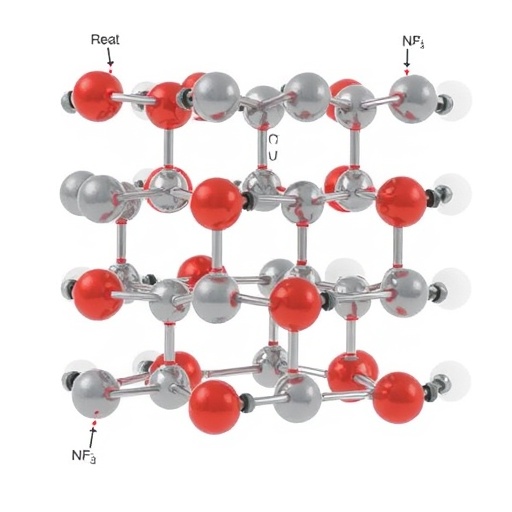
Central to this enigma is the nickel-oxygen bonding environment intrinsic to the bilayer nickelate structure. The crystal lattice of La₃Ni₂O₇ is composed of corner-sharing NiO₆ octahedra, where the precise geometry of these octahedra—characterized by their tilt, rotation, and distortion—critically governs electronic bandwidth, orbital hybridization, and correlation effects. Historically, techniques to directly probe these minute structural modifications under high-pressure conditions were unavailable, leaving a gap in understanding the atomic-scale drivers behind superconductivity. Recent advances in film synthesis have circumvented this limitation by providing a static analog: strain-engineered La₃Ni₂O₇ epitaxial thin films whose lattice parameters are finely tuned through substrate choice, offering an unprecedented platform for direct atomic characterization.
Leveraging this platform, researchers have utilized multislice electron ptychography (MEP), an emerging electron microscopy technique with picometer-scale resolution and enhanced sensitivity to light elements, to visualize the atomic arrangements of both cation and oxygen sublattices in these complex oxide films. This technique surpasses conventional microscopy by capturing phase information and reconstructing high-fidelity lattice images that reveal subtle bond length variations and symmetry distortions invisible to traditional methods. Applying MEP across a series of La₃Ni₂O₇ thin films subjected to incremental biaxial strains has enabled scientists to track the continuous evolution of nickel-oxygen bond geometries with atomic precision.
One of the striking revelations from these measurements is the pronounced lifting of crystalline symmetry within the NiO₆ octahedra under compressive strain. This distortion manifests not only as elongations and compressions along specific octahedral axes but also as intricate alterations in octahedral tilt patterns, yielding a lowered local symmetry that correlates strongly with the emergence of superconductivity. This finding underscores the pivotal role of octahedral distortions in fine-tuning the low-energy electronic structure—particularly the Ni 3d orbitals—that orchestrate superconducting pairing. Studies indicate that such symmetry-breaking facilitates a rearrangement of orbital occupancy and hybridization that is essential to the superconducting ground state.
Interestingly, despite the differing external conditions—hydrostatic pressure in bulk versus biaxial strain in epitaxial films—a common thread emerges in the form of in-plane lattice compression. Both scenarios lead to similar contraction of the Ni-O bonds parallel to the substrate, effectively driving comparable electronic reconstructions that favor superconductivity. This convergence suggests that the underlying mechanism responsible for superconductivity in La₃Ni₂O₇ hinges on compressive modulation of the nickel-oxygen framework, transcending the specific external tuning parameter and emphasizing lattice strain as a unifying control variable.
Beyond experimental observations, cutting-edge theoretical modeling complements and expands the understanding gained from MEP. Researchers have formulated a novel computational framework that disentangles intertwined structural distortions in the corner-sharing NiO₆ octahedral network. This approach quantitatively separates octahedral rotation, tilt, and distortion modes, allowing precise characterization of the structural fingerprints that promote superconductivity. The simulations reveal that superconducting phases correlate with a raised octahedral symmetry that selectively suppresses t₂g orbital mixing in the low-energy Ni bands—a subtle electronic effect that enhances coherent pairing interactions.
This suppression of t₂g orbital mixing effectively reduces detrimental competing interactions and stabilizes superconducting configurations involving predominantly eg orbital character. Consequently, the structural transformations induced either by hydrostatic pressure or compressive strain act cooperatively to tailor the electronic landscape of La₃Ni₂O₇, optimizing conditions for high-temperature superconductivity. Such insights mark a pivotal advance in the quest to rationally design and engineer superconductors through targeted structural manipulation at the atomic scale.
The implications of these findings reverberate across fields spanning condensed matter physics, materials science, and device engineering. Understanding the atomic-scale structure-function relationship in nickelate superconductors paves the way for strategic strain engineering tailored to maximize superconducting transition temperatures or stabilize novel quantum phases. Furthermore, the methodological breakthrough represented by multislice electron ptychography establishes a new paradigm in high-resolution structural characterization, empowering researchers to visualize elusive oxygen sublattices with unprecedented fidelity and shedding light on complex oxide phenomena previously obscured by experimental limitations.
Future research horizons are rich with possibilities, including the systematic exploration of different strain regimes, doping configurations, and heterostructure designs that might further enhance superconducting properties or reveal competing electronic orders. Bridging the microscopic structural landscape with macroscopic transport phenomena will also deepen comprehension of the interplay between lattice, spin, and charge degrees of freedom in these multifaceted materials. Ultimately, such multidisciplinary endeavors aspire to harness the extraordinary potential of nickelate superconductors for transformative technological applications in quantum computing, energy transmission, and beyond.
As the scientific community continues to unravel the nuanced structural determinants of high-temperature superconductivity, the synthesis of experiment and theory exemplified in this recent work serves as a lodestar. It not only illuminates longstanding mysteries surrounding La₃Ni₂O₇ but also establishes guiding principles applicable to a broader class of correlated electron systems. With each picometer resolved and each distortion mapped, we edge closer to decoding the intricate symphony of atomic interactions that orchestrate the superconducting state, propelling the field toward new frontiers of discovery and innovation.
Subject of Research:
The study focuses on the atomic-scale structural evolution and strain-induced modifications in bilayer nickelate thin films (La₃Ni₂O₇) and their correlation with high-temperature superconductivity.
Article Title:
Structural modifications in strain-engineered bilayer nickelate thin films
Article References:
Bhatt, L., Abarca Morales, E., Jiang, A.Y. et al. Structural modifications in strain-engineered bilayer nickelate thin films. Nature (2026). https://doi.org/10.1038/s41586-026-10446-2
Image Credits:
AI Generated


