

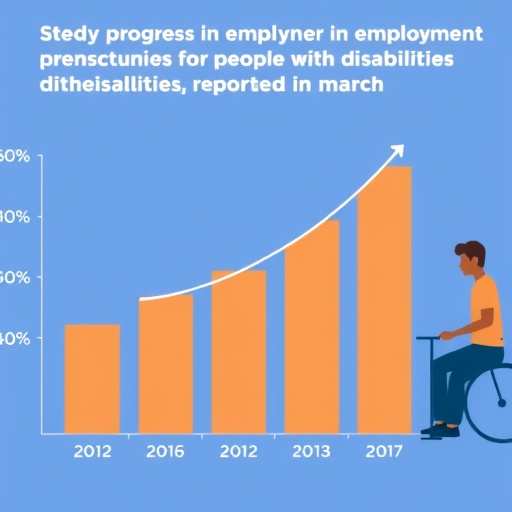
In a timely release coinciding with the latest Bureau of Labor Statistics Jobs Report, the April 2026 edition of the National Trends in Disability Employment (nTIDE) reveals intriguing developments in the labor market participation of working-aged individuals with disabilities. Issued monthly by Kessler Foundation in collaboration with the University of New Hampshire’s Institute on Disability, this report sheds light on subtle yet important shifts in the employment dynamics within this key demographic amidst broader economic conditions influenced by inflationary pressures.
The employment-to-population ratio, a critical metric representing the fraction of people currently employed relative to the total population within working age (16-64 years), exhibited a modest but notable increase for people with disabilities. From February to March 2026, this ratio grew from 38.1% to 38.5%, indicating a 1% relative increase or a 0.4 percentage point absolute gain. For those without disabilities, a parallel but slightly smaller rise was recorded, climbing from 74.5% to 74.8%. These figures, although incremental, reflect persistence in upward labor market engagement for people with disabilities despite ongoing economic uncertainties.
Equally telling is the labor force participation rate, which measures the proportion of the working-age population who are either employed or actively seeking employment. For individuals with disabilities, this rate inched upward from 41.8% to 41.9%, marking a marginal 0.2% relative increase. Intriguingly, the data show a slight decline for those without disabilities, with participation slipping from 78.1% to 78.0%. This divergence underscores a nuanced shift suggesting that economic factors may be motivating more people with disabilities to enter or remain in the labor force, potentially offsetting reduced engagement elsewhere.
Experts attribute these trends to complex intersections of socio-economic pressures and lived realities. John O’Neill, PhD, director of Kessler Foundation’s Center for Employment and Disability Research, emphasizes that the increase in the employment-to-population ratio signals a return to an encouraging trajectory first noted in late 2025. He highlights that rising costs of living, exacerbated by global trade disruptions such as tariffs and conflict-related economic shocks, are likely compelling individuals with disabilities to seek employment with renewed urgency, challenging persistent poverty barriers.
Further contextualizing the labor market shifts, Andrew Houtenville, PhD, professor of economics and director at the Institute on Disability, University of New Hampshire, suggests that inflation is the dominant immediate factor driving increased labor supply among people with disabilities. His analysis points to the vital role employment plays not just in individual livelihoods but in cushioning families facing economic strain, with people with disabilities disproportionately represented in households below the poverty line. This socioeconomic pressure creates a incentive structure favoring labor participation even amid broader economic headwinds.
When comparing year-on-year data, the positive labor market momentum for people with disabilities remains evident. The employment-to-population ratio rose from 37.5% in March 2025 to 38.5% in March 2026, signaling a 2.7% relative increase. Conversely, for people without disabilities, the ratio remained static at 74.8% during the same period. Similarly, the labor force participation rate for people with disabilities increased from 40.9% to 41.9%. The participation figure for those without disabilities showed no change, stabilizing at 78.0%.
Quantitatively significant, the workforce now includes approximately 6,568,000 workers with disabilities out of the total 151,224,000 workers between the ages of 16 and 64 in March 2026. This represents approximately 4.3% of the overall working population, an important demographic proportion that informs ongoing policy and programmatic interventions aimed at improving equity and inclusion.
The nTIDE initiative goes beyond data publication by actively engaging the public and stakeholders through monthly “Lunch and Learn” Zoom webinars. These live discussions provide opportunities to interrogate the latest findings, exchange updates on disability employment research, and involve experts such as policy analysts and research scientists in discourse about evolving employment trends. The April 3, 2026 session featured contributions from prominent figures at the University of New Hampshire’s Institute on Disability and the Association of University Centers on Disabilities, fostering knowledge-sharing critical for informed advocacy.
Funded by the National Institute on Disability, Independent Living, and Rehabilitation Research as well as Kessler Foundation, nTIDE exemplifies a robust collaboration bridging rigorous data analysis with practical engagement. Utilizing customized analysis of Bureau of Labor Statistics datasets focused on working-age adults with disabilities, the initiative offers a refined lens through which disability employment outcomes can be monitored with precision and contextual sensitivity.
Kessler Foundation, renowned for its pioneering rehabilitation research since its founding in 1985, drives innovation both in clinical interventions and in socio-economic inclusion strategies. By combining clinical science with workforce participation research, the foundation strives to dismantle barriers and foster opportunities that enhance independence and quality of life for people with a spectrum of disabilities, from neurological to developmental conditions.
The Institute on Disability at the University of New Hampshire anchors this research ecosystem within an R1 Carnegie-classified university, ensuring academic rigor in its contributions to disability inclusion. Its Center for Research on Disability translates data into actionable knowledge, expanding public understanding and policy leverage points that can effect systemic change in employment equity.
In sum, the April 2026 nTIDE report signals slow but steady progress in disability employment metrics amidst a challenging economic landscape. The nuanced shifts in employment and participation ratios highlight the resilience and adaptive responses of workers with disabilities to inflation and socio-political disruptions. Ongoing monitoring and dialogue through initiatives like nTIDE remain indispensable for shaping inclusive economic policies and workplaces that genuinely reflect and support the full diversity of the American labor force.
—
Subject of Research: Employment trends and labor market participation among working-aged individuals with disabilities.
Article Title: National Trends in Disability Employment: April 2026 Insights from the nTIDE Report
News Publication Date: April 3, 2026
Web References:
– https://kesslerfoundation.org/
– http://www.researchondisability.org/
– http://www.bls.gov/news.release/empsit.nr0.htm
– https://researchondisability.org/nTIDE
References: nTIDE Reports, Bureau of Labor Statistics data, Annual Report on People with Disabilities in America (2026)
Image Credits: Kessler Foundation
Keywords: disability employment, labor force participation, employment-to-population ratio, economic inclusion, inflation impact, workforce diversity, rehabilitation research


