

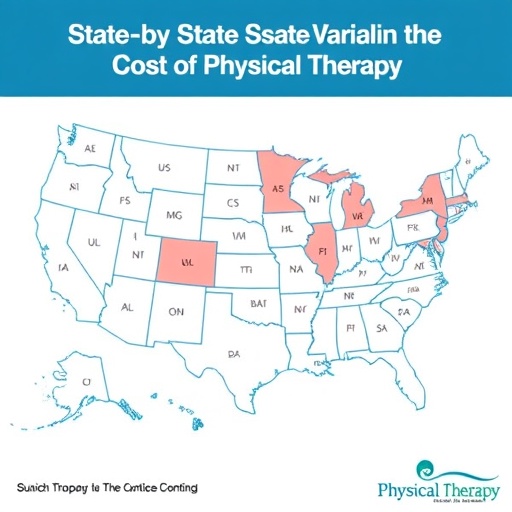
In the United States, physical therapy (PT) stands as a cornerstone in the management and rehabilitation of a myriad of medical conditions ranging from acute musculoskeletal injuries to chronic diseases such as osteoarthritis. Despite its widespread utilization and recognized benefits in improving patient function and reducing complications, a recent study led by researchers at Yale University uncovers substantial variations in the costs associated with outpatient PT services. These discrepancies, which fluctuate notably based on geographic location, insurance coverage, and payment modalities, raise significant concerns about the affordability and accessibility of essential rehabilitative care.
The burgeoning issue of cost variability in healthcare services is not new, but PT services have not been previously examined on a national scale with such granularity. Using data aggregated from Turquoise Health, a platform that compiles hospital price disclosures mandated under federal regulations, researchers analyzed commercial payer-negotiated rates across a spectrum of 1,666 unique hospitals. This expansive dataset allowed a comprehensive assessment of both list and negotiated prices for ten common outpatient PT services, encompassing essential evaluation and management activities alongside supervised exercise regimens that facilitate functional recovery.
One of the pivotal findings from the study is the wide disparity in median charges for PT evaluation services, which ranged from $151 to as high as $215 depending on the facility and region. Notably, prices vary more significantly between different hospitals than they do within the same institution over different service categories. Furthermore, the study reveals that commercially negotiated prices are consistently lower than cash prices, indicating a potentially prohibitive cost burden for uninsured or underinsured patients who must pay out of pocket for PT services.
Geographical location emerges as a critical determinant in PT service pricing, with rural healthcare facilities typically offering lower prices compared to their urban counterparts. This gradient, adjusted for regional healthcare cost differences, suggests systemic factors influencing price-setting that transcend mere market-driven dynamics. Variations in price structures might reflect differences in operational costs, regional economic conditions, payer mix, and negotiating power between hospitals and insurers.
Joshua Skydel, a clinical fellow at Yale School of Medicine and the study’s corresponding author, emphasizes the implications of these findings on patient behavior and health outcomes. Higher out-of-pocket expenses linked to elevated PT prices may act as barriers, discouraging patients from completing prescribed therapy regimens. This underutilization can subsequently lead to suboptimal rehabilitation, increased rates of complications, and heightened demand for more intensive and costly medical interventions.
The policy and clinical significance of this cost variability extends beyond financial considerations. Physical therapy is deemed an integral component of cost-effective care for various medical conditions, enhancing long-term patient functionality and potentially reducing reliance on pharmaceuticals, surgical interventions, or emergency services. Any impediments in access due to financial factors threaten to undermine these benefits, fostering disparities in healthcare quality and outcomes.
While the study provides a foundational understanding of pricing landscapes, it acknowledges substantial gaps in knowledge regarding the drivers of price variation, the direct financial impact on patients, and the downstream effects on therapy utilization and clinical outcomes. Determining whether observed price differences correlate with differential quality or efficiency of care remains an open question, necessitating further rigorous empirical explorations.
Joseph Ross, professor of general medicine at Yale School of Medicine and co-author of the study, highlights the necessity of integrating economic data with clinical outcome measures. This integrated approach could unravel complex interactions between cost, patient adherence, and recovery trajectories, thereby informing policies aimed at standardizing prices and improving fairness in access to PT services.
Nationally, the environment for PT service provision is complex and influenced by insurance market dynamics. Approximately 27 million Americans remain uninsured, while many more contend with restrictive insurance policies that cap coverage for rehabilitative services or impose high copayments. In this context, understanding how these insurance structures interact with hospital pricing practices is vital for ensuring that physical therapy remains an accessible modality.
Moreover, the study’s methodology leverages mandated hospital price disclosures, a regulatory mechanism introduced to foster transparency in healthcare pricing. Although touted as a leap forward in consumer empowerment, the heterogeneous nature of data presentation and hospital compliance poses challenges for patients and policymakers alike when attempting to discern true costs and value.
The ramifications of this research extend to broader healthcare policy debates regarding cost containment, price regulation, and the reduction of health inequities. By spotlighting the discrepancies in PT pricing, the findings advocate for systematic efforts to harmonize charges, enhance pricing transparency, and tailor interventions that mitigate undue financial burdens on vulnerable populations.
Ultimately, the Yale researchers call for expansive investigations that integrate patient-level data, insurance plan details, and outcome metrics to develop a holistic understanding of how cost structures influence therapy engagement and success. This multi-dimensional approach holds promise in guiding reforms conducive to affordable, equitable, and effective physical rehabilitation nationwide.
The implications of the study resonate deeply with stakeholders across the healthcare spectrum—from clinicians advocating for patient-centered care, hospital administrators balancing financial sustainability, insurers designing benefit packages, to policymakers charged with safeguarding public health. Addressing the identified cost variation in physical therapy is thus integral to realizing the full potential of rehabilitative medicine in improving quality of life and long-term health outcomes.
Subject of Research:
Commercial payer-negotiated rates and cost variability of outpatient physical therapy services across U.S. hospitals.
Article Title:
Substantial Variation in Commercial Prices for Outpatient Physical Therapy Services Across the United States.
News Publication Date:
Not explicitly stated in the provided content.
Web References:
https://jamanetwork.com/journals/jamainternalmedicine/fullarticle/2845664
References:
Study co-authored by Joshua Skydel and Joseph Ross, published as a research letter in JAMA Internal Medicine.
Image Credits:
Not provided.
Keywords:
Physical therapy, outpatient rehabilitation, healthcare costs, commercial insurance rates, price transparency, healthcare disparities, musculoskeletal injuries, chronic disease management, healthcare policy, hospital pricing, patient out-of-pocket costs, U.S. healthcare system.


