
Saturday, February 28, 2026
Science
No Result
View All Result
  • Login
  • HOME
  • SCIENCE NEWS
  • CONTACT US
  • HOME
  • SCIENCE NEWS
  • CONTACT US
No Result
View All Result
Scienmag
No Result
View All Result
Home Science News Medicine

Starving cancer cells to enhance DNA damage and immunotherapy response

June 26, 2024
in Medicine
Reading Time: 4 mins read
0
Oncotarget
67
SHARES
605
VIEWS
Share on FacebookShare on Twitter
ADVERTISEMENT

“Depleting amino acid[s] likely expose[s] the Achilles heel of the cancer and exacerbate[s] DNA repair-targeted and immune-based therapy response.”

Oncotarget

Credit: 2024 Shahi and Kidane.

“Depleting amino acid[s] likely expose[s] the Achilles heel of the cancer and exacerbate[s] DNA repair-targeted and immune-based therapy response.”

BUFFALO, NY- June 26, 2024 – A new research perspective was published in Oncotarget’s Volume 15 on June 20, 2024, entitled, “Starving cancer cells to enhance DNA damage and immunotherapy response.”

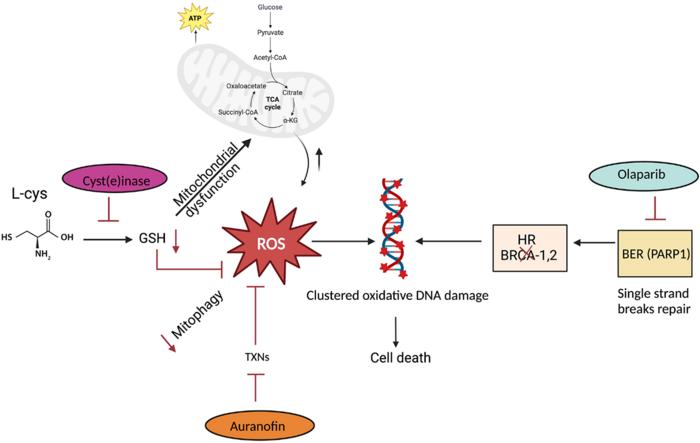
Prostate cancer (PCa) poses significant challenges in treatment, particularly when it progresses to a metastatic, castrate-resistant state. Conventional therapies, including chemotherapy, radiotherapy, and hormonal treatments, often fail due to toxicities, off-target effects, and acquired resistance. In this new research perspective, researchers Aashirwad Shahi and Dawit Kidane from Howard University define an alternative therapeutic strategy focusing on the metabolic vulnerabilities of PCa cells, specifically their reliance on non-essential amino acids such as cysteine. 

“In this prospective, we will rise the driving questions and potential possibilities how amino acid depletion induced oxidative stress associated DNA damage exploited for DNA repair targeted and immune checkpoint blockade therapy […].”

Using an engineered enzyme cyst(e)inase to deplete the cysteine/cystine can induce oxidative stress and DNA damage in cancer cells. This depletion elevates reactive oxygen species (ROS) levels, disrupts glutathione synthesis, and enhances DNA damage, leading to cancer cell death. The combinatorial use of cyst(e)inase with agents targeting antioxidant defenses, such as thioredoxins, further amplifies ROS accumulation and cytotoxicity in PCa cells. 

“Overall, this perspective provides a compressive overview of the previous work on manipulating amino acid metabolism and redox balance modulate the efficacy of DNA repair-targeted and immune checkpoint blockade therapies in prostate cancer.”
 

Continue reading: DOI: https://doi.org/10.18632/oncotarget.28595 

Correspondence to: Dawit Kidane

Email: dawit.kidane-mulat@howard.edu 

Keywords: amino acid depletion, DNA damage, DNA repair, Immunotherapy, tumor immunity

Click here to sign up for free Altmetric alerts about this article.
 

About Oncotarget: Oncotarget (a primarily oncology-focused, peer-reviewed, open access journal) aims to maximize research impact through insightful peer-review; eliminate borders between specialties by linking different fields of oncology, cancer research and biomedical sciences; and foster application of basic and clinical science.

Oncotarget is indexed and archived by PubMed/Medline, PubMed Central, Scopus, EMBASE, META (Chan Zuckerberg Initiative) (2018-2022), and Dimensions (Digital Science).

To learn more about Oncotarget, visit Oncotarget.com and connect with us on social media:

  • X, formerly Twitter
  • Facebook
  • YouTube
  • Instagram
  • LinkedIn
  • Pinterest
  • Reddit
  • Spotify, and available wherever you listen to podcasts


Click here to subscribe to Oncotarget publication updates.

For media inquiries, please contact media@impactjournals.com.


Oncotarget Journal Office

6666 East Quaker Street., Suite 1A

Orchard Park, NY 14127

Phone: 1-800-922-0957 (option 2)

###


Journal

Oncotarget

DOI

10.18632/oncotarget.28595

Method of Research

Commentary/editorial

Subject of Research

People

Article Title

Starving cancer cells to enhance DNA damage and immunotherapy response

Article Publication Date

20-Jun-2024

Share27Tweet17
Previous Post

Revolutionizing ovarian cancer treatment with adaptive PARP inhibitor therapy

Next Post

Tai Chi reduces risk of inflammatory disease, treats insomnia among breast cancer survivors

Related Posts

blank
Medicine

Add-On Self-Care Boosts Recovery in Hip Surgery

February 28, 2026
blank
Medicine

Dual Receptor Knockout Boosts CAR T Solid Tumor Therapy

February 28, 2026
blank
Medicine

Compact Deep Neural Networks Mimic Visual Cortex

February 28, 2026
blank
Medicine

Neurocognitive and Psychiatric Health in Retired American Football Players: New Insights

February 28, 2026
blank
Medicine

Feeding Controls Liver Protein Rhythm via Glycogen

February 28, 2026
blank
Medicine

New Study Reveals Contrasting Effects of IL6 and IL6R on Long-Term Mortality

February 28, 2026
Next Post
Tai Chi reduces risk of inflammatory disease, treats insomnia among breast cancer survivors

Tai Chi reduces risk of inflammatory disease, treats insomnia among breast cancer survivors

  • Mothers who receive childcare support from maternal grandparents show more parental warmth, finds NTU Singapore study

    Mothers who receive childcare support from maternal grandparents show more parental warmth, finds NTU Singapore study

    27618 shares
    Share 11044 Tweet 6902
  • University of Seville Breaks 120-Year-Old Mystery, Revises a Key Einstein Concept

    1022 shares
    Share 409 Tweet 256
  • Bee body mass, pathogens and local climate influence heat tolerance

    665 shares
    Share 266 Tweet 166
  • Researchers record first-ever images and data of a shark experiencing a boat strike

    532 shares
    Share 213 Tweet 133
  • Groundbreaking Clinical Trial Reveals Lubiprostone Enhances Kidney Function

    517 shares
    Share 207 Tweet 129
Science

Embark on a thrilling journey of discovery with Scienmag.com—your ultimate source for cutting-edge breakthroughs. Immerse yourself in a world where curiosity knows no limits and tomorrow’s possibilities become today’s reality!

RECENT NEWS

  • Experts Unite on Key Climate Adaptation Elements
  • Intensive Phototherapy for Neonatal Jaundice: Efficacy and Risks
  • Host Factors Trump Kidney Function in Gut Microbiome
  • Early Heat Exposure Raises Preschoolers’ Neurodevelopmental Risks

Categories

  • Agriculture
  • Anthropology
  • Archaeology
  • Athmospheric
  • Biology
  • Biotechnology
  • Blog
  • Bussines
  • Cancer
  • Chemistry
  • Climate
  • Earth Science
  • Editorial Policy
  • Marine
  • Mathematics
  • Medicine
  • Pediatry
  • Policy
  • Psychology & Psychiatry
  • Science Education
  • Social Science
  • Space
  • Technology and Engineering

Subscribe to Blog via Email

Enter your email address to subscribe to this blog and receive notifications of new posts by email.

Join 5,190 other subscribers

© 2025 Scienmag - Science Magazine

Welcome Back!

Login to your account below

Forgotten Password?

Retrieve your password

Please enter your username or email address to reset your password.

Log In
No Result
View All Result
  • HOME
  • SCIENCE NEWS
  • CONTACT US

© 2025 Scienmag - Science Magazine

Discover more from Science

Subscribe now to keep reading and get access to the full archive.

Continue reading