

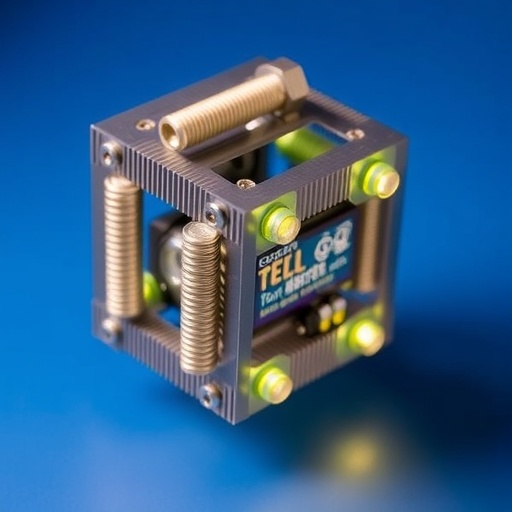
In a groundbreaking advance that revisits the fundamental principles of computation, researchers from St. Olaf College and Syracuse University have engineered a mechanical computer built entirely from commonplace materials like steel springs and bars. Published in Nature Communications, this pioneering device eschews traditional electronic components, relying instead on mechanical interactions to perform basic computational tasks without any need for electricity or batteries. This development not only challenges our conventional understanding of memory and computation but also opens new horizons for computing in environments hostile to electronic devices.
Typically, when we think of memory, we picture data stored on digital devices or neural processes within the brain. However, materials science has long appreciated that many materials inherently possess a form of “memory” based on their physical history. For instance, a rubber band “remembers” how far it has been stretched, a property encoded in its mechanical deformation. Led by Associate Professor Joey Paulsen of St. Olaf College’s Physics Department, the team sought to exploit such phenomena, investigating whether everyday materials could be configured not only to record mechanical history but also to perform logical operations—that is, computation.
The research culminated in the design and fabrication of three distinct mechanical computers, each exhibiting unique computational capabilities. The first device functions as a mechanical counter, capable of tallying three discrete inputs by translating physical manipulation into a count. The second can determine whether the number of actuations is odd or even, effectively performing a parity check. The third can detect and remember whether a threshold force—medium or large—was applied, combining sensing and memory in a compact mechanical form.
What makes these devices remarkable is not just their ability to perform computation mechanically, but that they harness power exclusively from applied physical forces rather than electric currents. This means the systems are inherently energy efficient and temporally stable, unaffected by electrical noise or power supply disruptions. “We have articulated a principled framework for engineering machines that compute through purely mechanical means, leveraging hysteresis and tunable interactions between mechanical components,” Paulsen remarks.
Central to this mechanical computing paradigm is the concept of hysterons—mechanical elements that retain a state based on the history of applied force or deformation. By precisely tuning the interactions among these hysterons, the team engineered mechanical logic gates capable of performing simple but meaningful computational operations. This approach permits the design of systems with configurable memory states and defined transition pathways, enabling complex behavior from relatively simple mechanical parts.
The implications of these findings extend beyond academic curiosity. Mechanical computers promise reliable operation in environments where conventional electronics fail, such as extreme temperatures, high radiation fields, or corrosive chemical atmospheres. In such conditions, electronic circuits may degrade or cease functioning altogether, whereas robust mechanical systems could continue to operate, performing essential data processing for monitoring or control.
Moreover, the mechanical computers’ potential integration into smart materials suggests exciting advances in sensor technology and responsive systems. Materials that can sense force application, make decisions autonomously, and respond accordingly could revolutionize prosthetics, robotics, and interactive environments. For example, artificial limbs embedded with such mechanical computing elements might achieve improved tactile feedback or adaptive responses, enhancing user experience and functionality.
The research team is also exploring scalability and the complex coupling between mechanical components. Current efforts include examining how the state of one rotor influences the state change in others, building towards networks of interacting mechanical logic elements. This endeavor is supported by experiential learning through the Collaborative Undergraduate Research and Inquiry program at St. Olaf, where students engage directly with the experimental challenges and novel questions arising from mechanical computation.
This study’s funding and support from distinguished institutions—including the Aspen Center for Physics, Syracuse University, St. Olaf College, and the U.S. National Science Foundation—underscore the significance and interdisciplinary nature of the work. With this foundational proof of concept, the future could see mechanical computers complementing or even substituting digital ones in niche applications demanding resilience, low power consumption, and mechanical simplicity.
While the current devices perform relatively simple computations, they reveal a pathway to develop more sophisticated mechanical computers. Integrating these mechanical elements into larger architectures could realize novel classes of computational devices. Their inherent robustness and independence from electrical power could find critical application in space exploration, industrial sensing, and extreme scientific environments.
Furthermore, this research rekindles interest in classical mechanical computation paradigms, reminiscent of early computation before the dominance of the electronic transistor. By harnessing modern materials science and precision engineering, the work reimagines classical mechanics as a viable medium for computation, suggesting new intersections between physics, materials science, and computer engineering.
In summary, this mechanical computing research imprints a transformative vision for future computing technologies. By exploiting the intrinsic physical memories of materials and their mechanical interactions, it challenges preconceived boundaries of what constitutes a computer. Moving forward, this paradigm promises devices that are simpler, tougher, and capable of performing fundamental computations under conditions where conventional electronics cannot thrive, paving the way for innovations across scientific and technological fields.
Subject of Research:
Not applicable
Article Title:
Mechanical hysterons with tunable interactions of general sign
News Publication Date:
11-Apr-2026
Web References:
https://www.nature.com/articles/s41467-026-70913-2
References:
Paulsen, J., et al. “Mechanical hysterons with tunable interactions of general sign.” Nature Communications, 2026.
Image Credits:
St. Olaf College
Keywords
Computational mechanics, Materials science, Materials engineering, Computational physics, Physics


