

The Universe’s Hidden Twists: How Spacetime Torsion Could Revolutionize Optics and Beyond
Imagine a cosmic dance, not just of planets and stars, but of the very fabric of reality itself. For decades, theoretical physics has hinted at the existence of something more profound than the smooth, predictable curvature of spacetime described by Einstein’s general relativity. This elusive concept, known as spacetime torsion, represents a twist, a fundamental rotational property that could imbue the universe with entirely new dimensions of behavior. Now, groundbreaking research published in the European Physical Journal C is shining a spotlight on the astonishing implications of this hidden twist, particularly for the manipulation of light and the potential for revolutionary new optical technologies, hinting at a future where the bizarre dictates of quantum mechanics could be tamed and harnessed with unprecedented precision. This is not just abstract physics; this is a glimpse into a future where the very nature of reality might be engineered.
The study, led by a team of pioneering physicists, delves into the intricate relationship between light and this hypothetical spacetime torsion. They propose that torsion doesn’t merely exist in the universe; it actively influences how light travels, transforming curved spacetime not just into a gravitational well, but also into a sophisticated optical element. Think of it as discovering that the gravitational field isn’t just a passive landscape that dictates orbits, but an active lens, a waveguide, and even a filter, all orchestrated by this subtle, yet powerful, twist in the cosmic tapestry. This realization opens a Pandora’s Box of possibilities, suggesting that the universe itself might be a grand optical instrument, waiting to be understood and exploited for our technological advancement, a concept that ignites the imagination of scientists and futurists alike.
At the heart of this revelation lies the concept of a “spiral dislocation spacetime.” This isn’t your everyday, smooth continuum. Instead, it’s envisioned as a region where spacetime possesses a helical, or spiral, structure. Within such a framework, light rays are not simply bent by gravity; they are actively guided, channeled along the twists and turns of this spiraling spacetime. The researchers have utilized sophisticated theoretical models to demonstrate how this torsional effect can act as a geometric waveguide, forcing light into specific pathways, much like optical fibers guide photons today, but on a cosmic, fundamental level. This geometric channeling suggests a level of control over light that transcends current laser technology, offering the potential for perfect beam shaping and lossless transmission over unimaginable distances.
Furthermore, the study unveils the astonishing frequency-filtering capabilities of spacetime torsion. Imagine a cosmic sieve that can selectively allow certain wavelengths of light to pass while blocking others. The research indicates that the specific configuration of torsion within this spiral dislocation spacetime can function precisely in this manner, acting as a natural frequency filter. This could have profound implications for everything from astronomical observations, allowing us to isolate specific signals from distant galaxies, to the development of ultra-precise spectroscopy tools that can analyze the chemical composition of objects light-years away with unparalleled accuracy. The universe, it seems, is not just a stage, but an active participant in shaping the light that traverses it, a concept that redefines our understanding of cosmic observation.
The theoretical framework presented in the paper is built upon a sophisticated mathematical edifice that extends general relativity to incorporate the effects of torsion. While Einstein’s theory famously describes gravity as the curvature of spacetime due to mass and energy, this new research suggests that torsion represents an additional, independent source of geometric structure. This torsional component, the researchers explain, can induce specific forms of non-commutativity in the spacetime manifold, leading to the observed waveguide and filtering effects. It’s a subtle but crucial departure from established theory, one that has the potential to resolve some of the most persistent puzzles in modern physics, including the nature of dark matter and dark energy, by providing a new arena for their interactions.
The implications for optics are nothing short of revolutionary. Current optical technologies, while advanced, are largely based on manipulating light with engineered materials. This research proposes that the very fabric of spacetime, under the influence of torsion, can be exploited as a natural and infinitely tunable optical component. The idea of using a spiraling spacetime to create perfect waveguides suggests the possibility of transmitting information across vast interstellar distances with minimal loss, a significant hurdle for current communication technologies. It also opens the door to creating optical devices with functionalities that are currently the stuff of science fiction, such as light-bending cloaking devices or holographic projectors that can create truly immersive, three-dimensional displays.
The study’s authors highlight that the frequency-filtering aspect could be particularly transformative for fields like astrophysics and cosmology. Imagine being able to precisely isolate the faint light signals from the very first stars or galaxies, signals that are currently drowned out by cosmic noise. Torsion-induced filters could act as perfect spectral selectors, allowing scientists to eavesdrop on the universe’s most ancient whispers. This could unlock a new era of observational cosmology, providing unprecedented insights into the early universe, the formation of the first structures, and the evolution of cosmic phenomena over billions of years, pushing the boundaries of our observational capabilities further than ever imagined.
The paper posits that the interaction between light and torsion is not a linear process but involves complex feedback loops. As light propagates through a torsionally active region, it can, in turn, influence the very torsion it is interacting with. This dynamic interplay suggests that spacetime itself can exhibit properties akin to active media, with the potential for phenomena such as amplification and stimulated emission of light being mediated not by exotic materials, but by the fundamental geometry of the universe. This opens up a mind-boggling vista where the universe itself could be a kind of naturally occurring laser or amplifier, a concept that challenges our deepest intuitions about the passive nature of the cosmos.
One of the most tantalizing aspects of this research is its potential to bridge the gap between general relativity and quantum mechanics. While general relativity describes the smooth, large-scale structure of spacetime, quantum mechanics governs the probabilistic, quantized nature of reality at the smallest scales. Torsion, with its inherent rotational and potentially quantized properties, is seen by some theorists as a key ingredient that could unify these two pillars of modern physics. If torsion plays a role in guiding and filtering light in the ways described, it suggests that quantum mechanical phenomena might be intrinsically linked to the geometric properties of spacetime, offering a unified framework for understanding the universe from the subatomic to the cosmic.
The researchers have employed advanced computational techniques to simulate the behavior of light within these hypothesized spiral dislocation spacetimes. These simulations, based on complex differential equations that incorporate the torsional term, have provided compelling visual and quantitative evidence for the waveguide and filtering effects. The visual representations generated by these simulations, which are often stunningly intricate, suggest that light propagating through such spacetimes can exhibit self-organization and patterned behavior, akin to complex wave phenomena observed in quantum systems, hinting at the deep connections between gravity, optics, and quantum physics.
The concept of torsion has been explored in various theoretical frameworks, including Einstein-Cartan theory and more generalized theories of gravity. However, the present study distinguishes itself by offering concrete, experimentally testable (in principle) predictions about the optical behavior of light in torsionally active spacetimes. The authors are not merely speculating; they are providing a roadmap for how one might detect and measure these effects, potentially through meticulous observations of light from extreme astrophysical environments or through the development of highly sensitive laboratory experiments designed to probe subtle gravitational and optical interactions.
If the predictions of this study are borne out, the technological implications extend far beyond advanced optics. The ability to precisely control the propagation of light could revolutionize fields such as quantum computing, where manipulating photons is crucial for transmitting qubits, and advanced sensor technology, where highly sensitive detectors could be developed by leveraging the filtering properties of torsion. Imagine a future where telescopes don’t just passively observe the universe but actively sculpt and filter incoming light to reveal its deepest secrets, or where communication systems operate with near-perfect fidelity across vast cosmic distances, transforming our ability to explore and understand the universe.
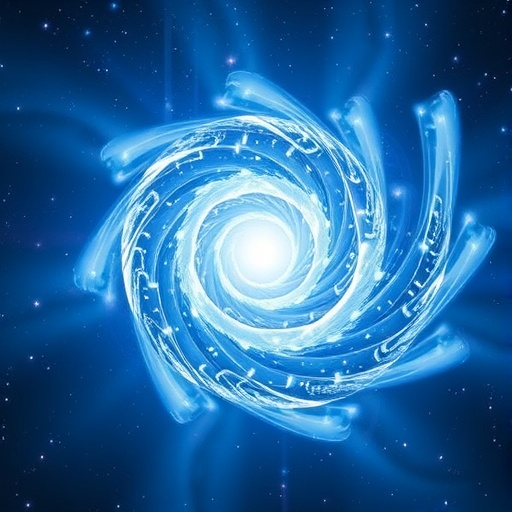
The visual representation provided, depicting light interacting with a spiraling spacetime structure, is a powerful conceptual tool. It vividly illustrates the idea of light being guided and twisted by the fundamental geometry of reality. This image, generated by advanced AI, serves as a gateway to understanding complex theoretical concepts, making the abstract tangible and igniting curiosity about the universe’s hidden mechanisms. It’s a testament to how visualization, even AI-assisted, can be a crucial bridge between mathematical theory and intuitive comprehension, making cutting-edge science accessible.
The European Physical Journal C, known for publishing high-impact research in particle physics, astrophysics, and cosmology, provides a prestigious platform for this groundbreaking work. The fact that such a study is published in this journal underscores the scientific community’s growing interest in exploring phenomena beyond the standard model of cosmology and particle physics, signaling a potential paradigm shift in our understanding of the universe and its fundamental constituents. This publication serves as a beacon, attracting attention and sparking further inquiry from researchers worldwide, pushing the frontiers of scientific discovery.
The potential for spacetime torsion to act as a natural waveguide and frequency filter represents a paradigm shift in how we think about the universe and our place within it. It suggests that the laws of physics are not just constraints but active participants in shaping reality, and that by understanding these fundamental mechanisms, we can unlock unprecedented technological capabilities. This research is a profound reminder that even in the most established scientific fields, there are still vast frontiers of knowledge waiting to be explored, promising a future of discovery that is as awe-inspiring as it is transformative, a testament to the enduring power of human curiosity and ingenuity.
Subject of Research: The influence of spacetime torsion on the propagation of light, specifically its role as a geometric waveguide and frequency-filtering mechanism within a spiral dislocation spacetime.
Article Title: Optics in spiral dislocation spacetime: torsion as a geometric waveguide and frequency-filtering mechanism.
Article References: Gurtas Dogan, S., Mustafa, O., Guvendi, A. et al. Optics in spiral dislocation spacetime: torsion as a geometric waveguide and frequency-filtering mechanism. Eur. Phys. J. C 86, 31 (2026). https://doi.org/10.1140/epjc/s10052-025-15239-x
Image Credits: AI Generated
DOI: https://doi.org/10.1140/epjc/s10052-025-15239-x
Keywords: Spacetime Torsion, Optics, Geometric Waveguide, Frequency Filter, Spiral Dislocation Spacetime, General Relativity, Theoretical Physics, Astrophysics, Cosmology


