

Cosmic Spin Doctors Unravel Black Hole Secrets: A Topological Twist on Gravity’s Ultimate Mysteries
Prepare to have your mind bent like spacetime around a black hole. In a groundbreaking revelation that promises to redefine our understanding of gravity’s most enigmatic abodes, a team of intrepid physicists has unveiled a novel approach to deciphering the complex dance of matter in the extreme environments surrounding black holes. Their research, published in the prestigious European Physical Journal C, introduces the concept of “robust topological invariants” as a powerful new lens through which to examine the behavior of spinning test particles in these celestial cauldrons. This isn’t just another black hole paper; it’s a potential paradigm shift, offering a way to identify fundamental properties of black hole spacetimes that remain invariant, or unchanging, even under the most chaotic conditions. Imagine trying to understand a hurricane by looking at each individual raindrop’s trajectory; it’s incredibly complicated and seemingly random. This new work, however, aims to find the overarching patterns, the fundamental laws that govern the entire storm, regardless of the specifics of any single drop. This ability to pinpoint intrinsic features could be the key to unlocking questions that have puzzled cosmologists for generations, from the nature of singularities to the very fabric of reality.
At the heart of this revolutionary discovery lies the intricate interplay between general relativity and the quantum realm, a frontier that has long been a holy grail for theoretical physicists. The team, led by Yen-Tsung Song, Junqi Fu, and Yu Cen, has meticulously investigated the timelike circular orbits of spinning test particles – essentially, what happens to tiny, fast-spinning objects as they navigate the warped spacetime near a black hole. What they’ve found is that the presence of spin on these particles, often overlooked in simpler models, introduces a layer of complexity that, paradoxically, leads to elegant and robust topological features. These features act like an unchanging signature, a fingerprint of the black hole’s gravitational field, allowing us to study its fundamental nature without getting lost in the ever-changing details of particle motion. This is akin to recognizing a famous landmark by its overall shape and distinctive features, even if the lighting or the surrounding crowds momentarily change.
The concept of topological invariants themselves is not new, but their application to the dynamic and extreme spacetime geometries of black holes, particularly in the context of spinning particles, represents a significant leap forward. Topology, in essence, deals with the properties of geometric objects that are preserved under continuous deformations, such as stretching or bending, but not tearing or gluing. Think of a coffee mug and a donut – topologically, they are the same because you can deform one into the other without creating or destroying holes. In the context of black holes, these invariants offer a way to classify and understand different types of black holes and their associated spacetimes based on fundamental, unchanging characteristics. This new research demonstrates that the spin of the test particles is not just a minor detail but a crucial ingredient that reveals these hidden topological structures, making them more accessible and robust for study.
One of the most tantalizing implications of this research is its potential to probe the very essence of black holes, pushing beyond the limitations of classical descriptions. Black holes are notorious for their singularity, a point of infinite density and curvature, where our current laws of physics break down. However, the robust topological invariants identified by Song and his colleagues might offer a way to characterize the spacetime around the singularity in a manner that is independent of the singularity itself. This means we could potentially learn about the fundamental nature of these objects without needing to fully comprehend the physics at the singularity, a problem that has plagued physicists for decades. It’s like being able to describe the entire ecosystem of a forest by observing the trees and the animals, even if the very center of the forest is perpetually shrouded in an impenetrable fog.
Furthermore, the study delves into the subtle yet profound effects of frame-dragging, a phenomenon predicted by Einstein’s theory of general relativity where a rotating massive object effectively “drags” spacetime around with it. For black holes, this effect is amplified to an extraordinary degree. The spin of the test particles, when interacting with this frame-dragging, generates specific patterns of motion that are intrinsically linked to the black hole’s spin and mass. The identified topological invariants capture these patterns, providing a unique signature that can distinguish between different types of black holes, such as Schwarzschild (non-rotating) and Kerr (rotating) black holes, and even potentially probe their internal structure or the presence of exotic matter. This is like discovering that the wake left by a boat can tell you not only the speed of the boat but also its shape and how its engine is running.
The concept of robustness in these invariants is paramount. In the messy, chaotic reality of the cosmos, observational data is rarely perfect. There are always uncertainties, noise, and approximations involved. The fact that these topological invariants are “robust” means they are expected to survive these imperfections, making them ideal candidates for real-world astronomical observations. Even if a measurement of a particle’s energy or angular momentum is slightly off, the underlying topological structure should still be detectable. This resilience is a testament to the deep mathematical foundations of the theory and suggests that these invariants are not just theoretical curiosities but possess a genuine physical significance that can be experimentally verified, opening up new avenues for observational astronomy.
The mathematical framework developed in this paper is intricate, involving advanced concepts from differential geometry and topology. The researchers leverage tools such as Kaluza-Klein reductions and the concept of Chern classes, which are used in topology to classify manifolds and vector bundles. By applying these sophisticated mathematical tools to the Einstein field equations that describe black hole spacetime, they have managed to extract universal quantities – the topological invariants – that are directly linked to the spin of the orbiting particles and the characteristics of the black hole itself. This fusion of abstract mathematical concepts with concrete physical phenomena highlights the power of theoretical physics to unlock the universe’s deepest secrets.
For those outside the immediate field of theoretical physics, the implications might seem esoteric. However, a deeper understanding of black holes isn’t just an academic exercise. It’s intrinsically linked to our understanding of gravity, the evolution of the universe, and potentially even the quest for a unified theory of quantum gravity. Black holes are extreme laboratories where gravity is pushed to its limits, offering insights that cannot be replicated on Earth. By providing new tools to study these objects, this research indirectly contributes to our quest to answer fundamental questions about existence. It’s like understanding the properties of water under extreme pressure helps us understand the formation of planets, even if we never experience those pressures ourselves.
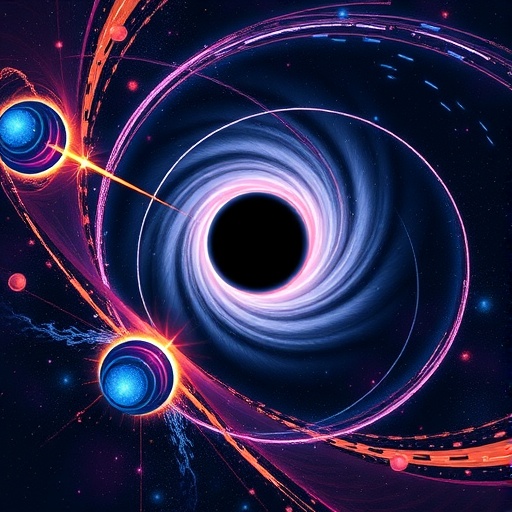
The visual aspect of the research is also noteworthy, with the accompanying image illustrating the complex spacetime geometry around a black hole, hinting at the intricate paths that these spinning particles would trace. While the image is an artistic representation, it serves to underscore the alien and awe-inspiring nature of black hole environments. The mathematical elegance uncovered by the researchers, however, offers a sense of order and predictability within this apparent chaos, suggesting that even in the most extreme corners of the cosmos, there are fundamental laws at play waiting to be discovered. This juxtaposition of visual complexity and underlying mathematical simplicity is a hallmark of profound scientific inquiry.
Moreover, the robustness of these topological invariants suggests they might also play a role in understanding phenomena like the information paradox, a thorny problem that questions what happens to information that falls into a black hole. If certain fundamental properties are preserved and can be extracted, even if indirectly through these topological signatures, it might offer a path towards reconciling quantum mechanics with general relativity in the context of black holes. This research doesn’t definitively solve the information paradox, but it provides a novel perspective and a set of tools that could be crucial in future investigations of this long-standing puzzle. It offers a potential lifeboat in the turbulent seas of black hole physics.
The contribution of Y. Song, J. Fu, and Y. Cen is not merely incremental; it offers a new philosophical approach to studying black holes. Instead of solely focusing on the dynamic evolution of matter, which can be incredibly complex and sensitive to initial conditions, their work emphasizes the identification of enduring, fundamental properties. This shift in focus can lead to a more stable and universally applicable understanding of black hole spacetimes. It’s like shifting from studying the momentary ripples on a pond to understanding the fundamental properties of the water itself – its density, its viscosity – that govern all ripples.
Looking ahead, the potential applications of these robust topological invariants are vast. They could be used to refine our models of neutron stars, another exotic astrophysical object, or even to search for evidence of physics beyond the Standard Model in gravitational wave signals. The universality of topological concepts means that what is learned in the extreme environment of a black hole could have profound implications for physics across the board. This discovery opens up a new chapter in gravitational physics, one that promises to be filled with further revelations about the nature of gravity, spacetime, and the universe itself. The cosmos, it seems, is full of profound mathematical beauty, waiting for clever minds to uncover it.
The mathematical beauty lies not just in the existence of these invariants but in their intrinsic connection to the very properties of the black hole that generate them. The specific values or forms of these invariants are directly dictated by the black hole’s mass, spin, and perhaps even other fundamental parameters that are not yet fully understood within current theoretical frameworks. This means that by studying these topological signatures, astronomers and physicists could potentially deduce more about the nature of matter and energy that formed the black hole, or even detect subtle deviations from standard general relativity that might hint at new physics. It’s a cosmic detective story, where the invariant topological fingerprints are the clues leading to the truth.
This research marks a significant step towards building a more complete and coherent picture of the universe, particularly concerning one of its most mysterious inhabitants: the black hole. By providing a new set of tools and a fresh perspective, Song, Fu, and Cen have opened a door that was previously locked, offering a glimpse into the fundamental structure of spacetime shaped by extreme gravity. The implications for future research are immense, promising to fuel a new generation of theoretical and observational endeavors aimed at unraveling the deepest secrets of the cosmos. The journey of discovery in physics is a continuous one, and this work represents a crucial waypoint, illuminating the path forward with a touch of topological magic.
Subject of Research: The behavior of spinning test particles in the warped spacetimes of black holes and the identification of invariant topological properties that characterize these spacetimes.
Article Title: Robust topological invariants of timelike circular orbits for spinning test particles in black hole spacetimes
Article References:
Song, Y., Fu, J. & Cen, Y. Robust topological invariants of timelike circular orbits for spinning test particles in black hole spacetimes.
Eur. Phys. J. C 86, 98 (2026). https://doi.org/10.1140/epjc/s10052-026-15333-8
Image Credits: AI Generated
DOI: https://doi.org/10.1140/epjc/s10052-026-15333-8
Keywords: Black Hole Spacetimes, Topological Invariants, Spinning Test Particles, General Relativity, Timelike Circular Orbits, Gravitational Physics, Frame-Dragging, Theoretical Physics


