

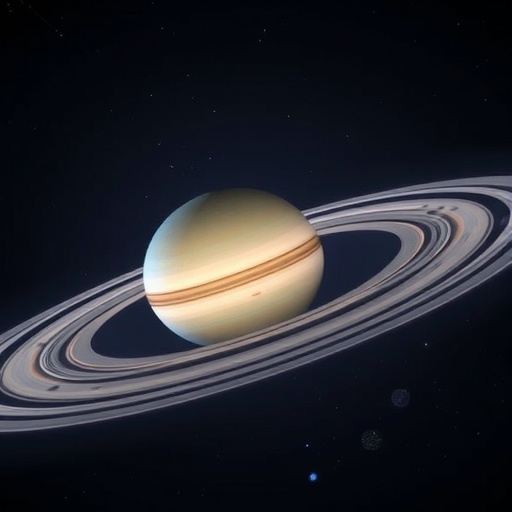
In a groundbreaking analysis of data gathered by the Cassini-Huygens mission, scientists have unveiled a profound structural surprise within Saturn’s magnetosphere, reshaping our understanding of the magnetic environments surrounding gas giants. This discovery reveals that the magnetospheric architecture of massive planets like Saturn operates under fundamental principles that diverge sharply from Earth’s paradigms. The findings underscore the profound influence that rotational dynamics have on shaping planetary magnetic fields and their interactions with solar wind, a component crucial to understanding the space weather phenomena in giant planet systems.
The Cassini spacecraft, a collaborative venture by NASA, the European Space Agency, and the Italian Space Agency, spent over a decade orbiting Saturn from 2004 to 2017. This extensive observational period provided an unprecedented wealth of data regarding Saturn’s rings, moons, and magnetosphere. By leveraging observations collected from the years 2004 to 2010, researchers focused on pinpointing the exact spatial position of Saturn’s magnetospheric cusp—a key feature where solar particles can penetrate a planet’s magnetic shield and interact with its atmosphere.
Unlike Earth, where the magnetospheric cusp aligns closely with the local noon due to the balance between the solar wind pressure and the planet’s magnetic field, Saturn’s cusp exhibits a striking dawn-dusk asymmetry. The cusp is systematically dragged by Saturn’s rapid rotation, shifting its average occurrence significantly towards the afternoon sector, notably between 13:00 and 15:00 local time, at times extending to the later afternoon and early evening hours. This displacement has profound implications for understanding how planetary rotation alters magnetospheric configuration and dynamics on a fundamental level.
This duskward positioning of Saturn’s cusp challenges traditional models of magnetic reconnection—a process where magnetic field lines from different magnetic domains merge, releasing vast amounts of energy and accelerating charged particles to high velocities. On Earth, magnetic reconnection generally occurs near the magnetic cusp at noon, fueling auroral activity. However, at Saturn, this process must be reconsidered in light of the delayed cusp location, providing new insights into where intense particle acceleration and auroral phenomena manifest on gas giants.
The rotational period of Saturn, approximately 10.7 hours, contrasts sharply with Earth’s 24-hour cycle, amplifying the centrifugal forces that sculpt its magnetosphere uniquely. In addition to its rapid rotation, Saturn’s magnetosphere is replenished with ionized material from its geologically active moon Enceladus. This material forms a dense plasma disk corotating with the planet, which interacts dynamically with the solar wind and magnetic fields, contributing to the distinct magnetospheric environment observed.
The interplay between Saturn’s fast rotation, solar wind pressure, and the internally sourced plasma environment culminates in a complex equilibrium that redefines magnetospheric structures such as the cusp. The intense rotational forces effectively “drag” the cusp away from its solar-aligned position, skewing the average location toward the planet’s afternoon side. This effect was deduced with robust data analysis techniques, including statistical and spatial correlation models, confirming that the magnetospheric imprint of planetary rotation dominates over solar forces in massive gas giants.
These revelations cast a new light on the mechanisms driving Saturn’s spectacular auroral displays, which, unlike Earth’s, are powered not only by solar wind interactions but also by the planet’s intrinsic rotational and plasma dynamics. Precise measurements and modeling efforts suggest that the luminous auroras predominantly mapped to Saturn’s dusk sector may be direct consequences of the spun-alone positioning of the cusp and associated magnetic reconnection processes located away from the conventional noon meridian.
Dr. Licia Ray of Lancaster University emphasized that this discovery affords the scientific community a fresh perspective to advance theoretical models governing planetary magnetospheres. Enhanced understanding of rotation-driven magnetospheric asymmetries provides the critical framework necessary to interpret the magnetospheric dynamics of not only Saturn but potentially other rapidly rotating gas giants within and beyond our solar system, offering a window into exoplanetary space weather environments.
The Cassini mission data continues to be a treasure trove of scientific discovery, underscoring the value of long-term space exploration missions. Over eight years since Cassini’s mission conclusion, the nuanced reinterpretation of its datasets reveals physics that were previously obscured or underestimated, highlighting the mission’s enduring legacy in planetary science and magnetospheric physics.
In particular, these insights could reverberate across fields such as astrogeology and planetary atmospheric science, where understanding particle precipitation dynamics into the atmosphere influences broader planetary system models. The asymmetry in cusp positioning and its associated effects might also advance subfields focused on magnetic reconnection and particle acceleration, linking planetary surface phenomena to magnetospheric and heliospheric conditions.
This advanced comprehension of Saturn’s magnetospheric cusp opens the door to revisiting and revising models of near-space environments around rapidly rotating bodies. The shift from Earth-centric views of magnetospheres to broader, rotationally influenced frameworks allows scientists to anticipate novel physical regimes not only within our Solar System but also in the diverse exoplanetary systems continuously being discovered.
Ultimately, the work exemplifies how planetary magnetospheres are deeply influenced by both intrinsic planetary properties—such as rotation rate and internal plasma sourcing—and extrinsic factors like solar wind pressure. The asymmetry in Saturn’s cusp location vividly illustrates the dynamic interplay of these forces and heralds a new era of space science focused on understanding the complex magnetic environments of giant planets.
Subject of Research: Not applicable
Article Title: Dawn-dusk Asymmetrical Distribution of Saturn’s Cusp
News Publication Date: 1-Apr-2026
Web References: http://dx.doi.org/10.1038/s41467-026-69666-9
References: Data/statistical analysis from Cassini mission datasets (2004–2010)
Image Credits: NASA/JPL/Space Science Institute
Keywords: Space sciences, Space exploration, Space flight, Space probes, Solar gas giants, Geophysics, Planetary science, Magnetosheath, Space weather, Solar terrestrial planets, Astrogeology, Celestial bodies, Planetary bodies, Planets, Gas giants, Solar system, Spacecraft


