

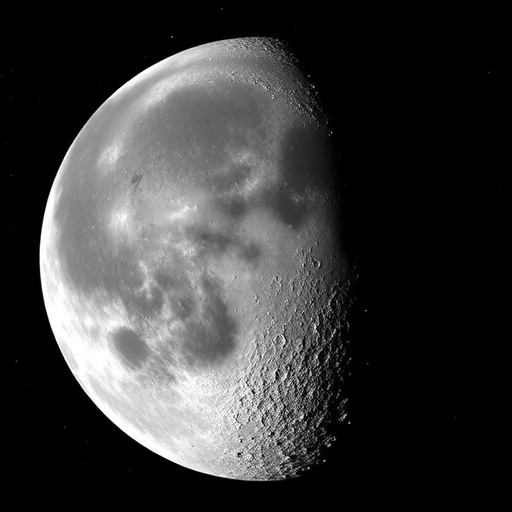
In a groundbreaking study poised to reshape our understanding of lunar surface processes, researchers Luo, Cui, Wang, and colleagues have unveiled novel insights into how space weathering reaches a saturation point that fundamentally alters the morphology of lunar regolith particles. Published in Nature Communications in 2026, this research delves into the complex interplay between the Moon’s harsh space environment and the fine granular material blanketing its surface, offering fresh perspectives on the long-term evolution of lunar soil at microscopic scales.
Space weathering refers to the suite of physical and chemical changes that occur when the Moon’s surface is bombarded by micrometeorites, solar wind ions, and cosmic radiation. These interactions gradually modify the optical, chemical, and mechanical properties of regolith—the layer of loose, fragmented material covering the bedrock. While previous studies have emphasized the dynamic and continuous nature of space weathering, the new work emphasizes an intriguing saturation effect wherein the morphological transformation of individual lunar soil particles reaches a plateau after extended exposure.
Central to the study is the painstaking analysis of regolith samples returned from the Moon combined with high-resolution electron microscopy, surface spectroscopy, and experimental simulations designed to replicate space weathering conditions. The researchers identified that upon initial exposure, lunar soil particles undergo rapid morphological changes: their surfaces develop nanophase iron inclusions, their outer rims become amorphous and roughened, and their shape evolves from crystalline fragments toward rounded, pitted structures. However, strikingly, these alterations do not proceed indefinitely.
After a critical threshold of cumulative space weathering, the particle morphology exhibits a saturation effect—beyond this point, the extent of surface modification levels off, signaling an equilibrium in the weathering process. This suggests that lunar regolith particles ultimately acquire a characteristic “weathered” morphology that no longer progresses despite ongoing bombardment. This plateau challenges prior assumptions about continuous regolith evolution and introduces new parameters for modeling lunar surface dynamics over geological timescales.
The implications of saturation in space weathering are profound for interpreting remote sensing data. The spectral signatures observed by orbiters, traditionally attributed to ongoing gradual alteration, may in fact represent a mosaic of particles at various stages of saturation. This realization calls for refined algorithms that consider saturation limits when deducing mineralogy and maturity from reflectance spectra, potentially resolving longstanding ambiguities in lunar surface composition analysis.
Moreover, the discovery aids in understanding the mechanical behavior of lunar soil. Since particle morphology influences bulk properties such as cohesion, friction, and compaction, the saturation stage likely governs the physical evolution of regolith layers. This has immediate relevance to lunar exploration, affecting the design of landers, rovers, and excavation tools, which must contend with the soil’s unpredictable mechanical response.
Mechanistically, the study attributes saturation to a balance achieved between the accumulation of nanophase iron and amorphous rims formed by solar wind sputtering and micrometeorite impacts, and competing processes such as agglutinate welding and microfracturing. Once the surface decoration reaches its maximum capacity, further weathering primarily modifies subsurface layers or induces regolith gardening (mixing), rather than altering the topmost particle morphology.
Through controlled laboratory experiments, the authors recreated the progressive weathering of lunar simulants subject to ion bombardment and thermal cycling, confirming the existence of morphological saturation. These findings strengthen the hypothesis that space weathering operates not as a linear, unending process but rather approaches dynamic equilibrium states under natural lunar conditions.
This paradigm shift also enriches our understanding of other airless bodies subjected to space weathering, such as asteroids and Mercury. The saturation phenomenon may be a universal characteristic governing regolith maturation, pending verification across diverse planetary environments. Thus, this research extends beyond lunar science, opening avenues for interpreting the evolutionary histories of a broad range of solar system surfaces.
Additionally, the paper discusses the ramifications for future sample-return missions and in-situ resource utilization efforts. Recognizing when regolith has reached weathering saturation will help select sampling sites and optimize extraction methods targeting relatively ‘fresh’ or ‘mature’ soils as required. It also provides calibration benchmarks for ongoing and future lunar reconnaissance instruments.
Significantly, the comprehensive approach combining direct observation, experimental replication, and theoretical modeling provides a robust framework for predicting how lunar soil will respond to cumulative exposure over millions of years. This enhances predictive capabilities essential for both scientific inquiry and practical mission planning on the Moon’s surface.
In conclusion, the elucidation of saturation in space weathering marks a pivotal advancement in planetary science. By revealing intrinsic limits to the morphological evolution of lunar regolith particles, Luo and collaborators illuminate the static and dynamic facets of the Moon’s surface environment. Their findings invite a reassessment of how we interpret remote sensing data, evaluate regolith properties, and design future exploration systems, firmly establishing space weathering saturation as a key concept in lunar and planetary geology.
As humanity prepares for renewed lunar exploration under programs like Artemis, understanding the subtle yet profound processes shaping the Moon’s surface is more critical than ever. This research not only deepens fundamental scientific knowledge but also has tangible applications for engineering and mission success. It represents a compelling fusion of cutting-edge technology, interdisciplinary expertise, and visionary exploration goals, setting the stage for the next era of lunar discovery.
Subject of Research: Lunar regolith morphology and the saturation phenomenon in space weathering processes.
Article Title: Saturation of space weathering in shaping lunar regolith particle morphology.
Article References:
Luo, A., Cui, Y., Wang, G. et al. Saturation of space weathering in shaping lunar regolith particle morphology. Nat Commun (2026). https://doi.org/10.1038/s41467-026-68824-3
Image Credits: AI Generated


