

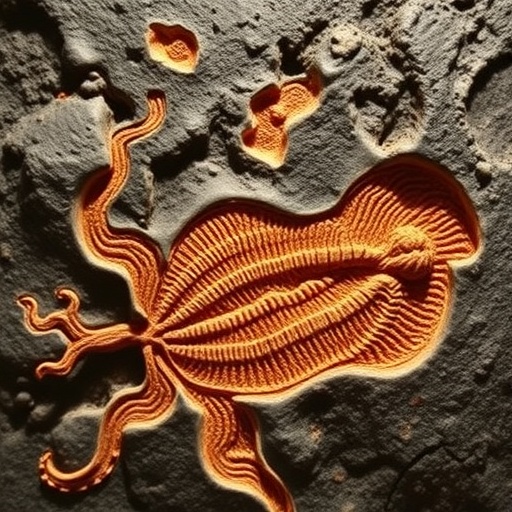
In a groundbreaking discovery poised to reshape our understanding of early animal evolution, Gaorong Li and his research team have unearthed a remarkable fossil assemblage in the Jiangchuan Biota of Yunnan Province, Southwest China. This assemblage, dating from approximately 575 to 539 million years ago, offers an unprecedented glimpse into a pivotal transitional phase bridging the enigmatic Ediacaran period and the Cambrian explosion, one of the most spectacular events in Earth’s biological history. The findings promise to fill a crucial void in paleobiology, illuminating the evolutionary narrative from soft-bodied organisms to the emergence of complex animal lineages that dominate today’s biosphere.
The Ediacaran period, characterized by a diverse array of soft-bodied, often enigmatic organisms, had long posed a challenge for paleontologists seeking to trace the origins of modern animal body plans. The intervening span leading up to the Cambrian period remained scarcely understood due to the paucity of fossil evidence capturing this transition. The Jiangchuan Biota, however, with its exceptional preservation of over 700 specimens as carbonaceous compressions, bridges this significant temporal and biological gulf. This rich assemblage includes newly identified taxa exhibiting a mosaic of morphological traits, some reminiscent of late Ediacaran biota and others foreshadowing Cambrian forms.
Notably, the fossil collection reveals an intriguing coexistence of body plans traditionally attributed either to the soft-bodied forms of the Ediacaran or to the more anatomically complex bilaterians that flourished during the Cambrian. Bilaterians, defined by their bilateral symmetry during embryogenesis, are the forebears of most extant animal phyla and represent a major evolutionary leap in body organization and functionality. The presence of early bilaterians within this assemblage challenges the conventional timeline, hinting that diversification within this group may have commenced significantly earlier than previously hypothesized.
The exceptional preservation quality of the fossils allows detailed morphological analyses, particularly of structures related to feeding and locomotion, aspects rarely discernible in such ancient specimens. These well-preserved anatomical features suggest that the ecological complexity and functional capabilities of these organisms were already advancing during the late Ediacaran. This insight reshapes interpretations of early animal ecodynamics, implying that evolutionary innovations facilitating more active lifestyles and diversified trophic interactions were underway long before the Cambrian radiation.
Further examination of the Jiangchuan fossils uncovers evidence of emerging developmental and anatomical sophistication among early multicellular animals. Structures indicative of musculature, primitive nervous systems, and organized organ systems hint at evolutionary experimentation in body plan complexity. These findings provide tangible clues about the evolutionary pressures and environmental factors that may have driven the rapid expansion and elaboration of animal life forms during this critical interval in Earth’s history.
The research team’s meticulous stratigraphic analyses also contribute to refining the geological context of the fossils. By establishing precise chronostratigraphic correlations, the study anchors the timings of evolutionary milestones with greater accuracy, facilitating cross-comparison with other global fossil sites. This integrative approach enhances the robustness of paleoecological reconstructions and evolutionary models concerning the Ediacaran-Cambrian boundary.
From a broader evolutionary perspective, this discovery underscores the incremental nature of animal complexity’s emergence rather than abrupt innovation. It suggests a protracted phase of morphological experimentation and diversification preceding the Cambrian explosion, reshaping our understanding of evolutionary tempo and mode. Such nuanced insights into the tempo of early animal diversification have profound implications for evolutionary developmental biology (evo-devo), paleogenomics, and the interpretation of molecular clock data.
Additionally, the fossil assemblage provides valuable data on paleoenvironmental conditions during the late Ediacaran, contributing to decoding the interplay between biotic evolution and abiotic factors such as ocean chemistry, sedimentology, and climate dynamics. Understanding these relationships is essential for reconstructing the ecological backdrop against which early animals adapted and diversified, offering clues to the drivers of macroevolutionary trends.
In the context of evolutionary ecology, the evidence of diverse feeding strategies and locomotory adaptations among the Jiangchuan specimens indicates a complex ecosystem with multiple ecological niches already established. Such intricate ecological frameworks likely fostered evolutionary innovation, competitive interactions, and symbiotic relationships, setting the stage for the Cambrian biodiversity burst.
Moreover, the discovery invites a reevaluation of taxa previously considered evolutionary dead-ends or mere evolutionary curiosities. By revealing transitional forms possessing a blend of archaic and advanced anatomical features, the assemblage challenges dichotomous categorizations in paleontology and encourages reassessing phylogenetic relationships within early metazoan lineages.
The technological approaches underpinning this discovery involved state-of-the-art microscopy and geochemical analyses that allowed the team to distinguish carbonaceous films and decipher minute anatomical details. Coupling these methods with robust phylogenetic frameworks empowered a comprehensive interpretation of the fossils’ evolutionary significance, setting methodological benchmarks for future studies in early animal evolution.
Going forward, the Jiangchuan Biota promises to serve as a rich natural laboratory for investigating the molecular and developmental underpinnings of body plan innovation. Integrating paleontological data with genomic and evo-devo insights may unravel the genetic architectures and regulatory networks that facilitated the emergence of bilaterian traits, providing a holistic picture of early animal evolution.
This landmark study, slated for publication in Science, exemplifies how fossil discoveries in understudied geological formations can revolutionize long-standing paradigms. As we continue to explore the ancient past, such findings remind us that Earth’s evolutionary history is a complex tapestry woven over millions of years, with each new fossil discovery adding a vital thread to our understanding of life’s diversification.
Subject of Research: Early animal evolution and transition from Ediacaran to Cambrian fauna
Article Title: The dawn of the Phanerozoic: a transitional fauna from the late Ediacaran of Southwest China
News Publication Date: 2-Apr-2026
Web References: 10.1126/science.adu2291
Keywords: Ediacaran, Cambrian, Jiangchuan Biota, bilaterians, fossil assemblage, animal diversification, soft-bodied organisms, early metazoans, evolutionary transition, paleobiology, carbonaceous films, early animal morphology


