

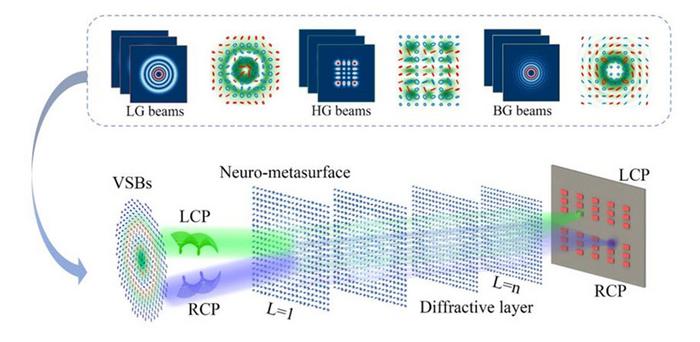
In the dynamic realm of optical physics, researchers are continually pushing the boundaries of how light can be manipulated and harnessed for practical applications. As reported in Advanced Photonics Nexus, a groundbreaking study from the Harbin Institute of Technology (HIT) introduces a method for sorting and distinguishing various types of vector structured beams (VSBs), promising significant advancements in optical communication and quantum computing.

Credit: X. Li et al., doi 10.1117/1.APN.3.3.036010.
In the dynamic realm of optical physics, researchers are continually pushing the boundaries of how light can be manipulated and harnessed for practical applications. As reported in Advanced Photonics Nexus, a groundbreaking study from the Harbin Institute of Technology (HIT) introduces a method for sorting and distinguishing various types of vector structured beams (VSBs), promising significant advancements in optical communication and quantum computing.
Unlike conventional light beams that propagate in simple, straight trajectories, VSBs are engineered to form complex, intricate patterns. These beams transmit information not only through traditional means such as intensity and wavelength but also via sophisticated spatial and polarization configurations. Their versatility makes them ideal for data encoding and communication.
Efficiently managing and utilizing VSBs has historically posed significant challenges. Their inherent complexity demands precise sorting and identification methods for practical applications. Enhancing the efficiency, bandwidth, and security of optical communications and fostering innovations in quantum computing hinge on our ability to handle these intricate beams effectively.
At the heart of the study by the research team at HIT lies a compact, highly efficient device based on a spin-multiplexed diffractive metasurface. This meticulously engineered surface operates at the microscopic level, manipulating light beams with remarkable precision.
The device directs beams of light through a sequence of finely tuned layers of metasurface. Each layer interacts with the light in a precise manner, shaping it incrementally into predetermined patterns. As the light emerges from the device, each VSB type is distinctly separated and identifiable by its unique characteristics. This simultaneous sorting capability opens new possibilities for high-dimensional communication and quantum information processing.
Technological implications include:
- Optical communications: Transmitting more data at higher speeds with enhanced security remains a critical goal. The metasurface ability to process complex light beams suggests a potential paradigm shift in data transmission, enabling greater efficiency within existing physical infrastructure.
- Quantum computing: Quantum information processing fundamentally diverges from classical computing. Precise control over light beams introduces fresh avenues for speeding up quantum computing systems.
Challenges and outlook
While this research represents a formidable advancement, integrating the device into existing technological frameworks and optimizing it for practical applications remain challenges. Nonetheless, researchers are optimistic about its future impact and actively refining the technology.
Senior corresponding author Professor Weiqiang Ding remarks, “Our breakthrough in light manipulation technology marks a pivotal step toward the practical application of complex light beams. By facilitating precise control over these beams, the technology not only augments existing capabilities but also opens new avenues for scientific exploration.”
The journey from laboratory innovation to widespread practical use is intricate, but with these pioneering advancements, the pathway toward everyday integration becomes increasingly tangible.
For details, see the Gold Open Access article by X. Li et al., “Simultaneous sorting of arbitrary vector structured beams with spin-multiplexed diffractive metasurfaces,” Adv. Photon. Nexus 3(3) 036010 (2024) doi 10.1117/1.APN.3.3.036010.
Journal
Advanced Photonics Nexus
Article Title
Simultaneous sorting of arbitrary vector structured beams with spin-multiplexed diffractive metasurfaces
Article Publication Date
20-May-2024

