

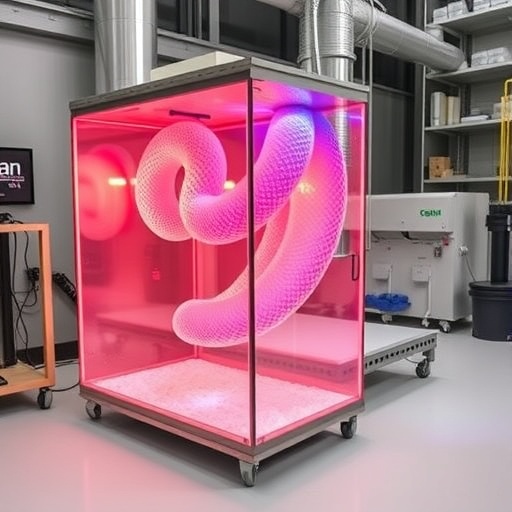
In the race against global warming and escalating energy demands, the quest for efficient, sustainable cooling technologies has never been more urgent. Conventional refrigeration systems primarily rely on vapor compression cycles, which, despite their ubiquity, pose challenges like high energy consumption and reliance on harmful refrigerants. Against this backdrop, a groundbreaking study has unveiled an innovative sorption-driven dissolution refrigeration cycle, promising to reshape how we think about cooling and thermal energy storage. This technology not only promises superior efficiency but also harnesses readily available medium- and low-grade heat sources, making it a landmark development in eco-friendly refrigeration.
Emerging beyond the popular magnetic, electrocaloric, and ionocaloric cooling technologies, which have garnered attention for their ability to produce cooling effects without traditional refrigerants, the proposed sorption-driven dissolution cycle presents an entirely new paradigm. Though solid-state caloric cooling methods have shown potential, they often falter due to their requirement for high driving fields, limited cooling capacity, or inadequate power density. By contrast, the sorption-driven dissolution cycle exploits the energy of phase transitions in a fundamentally different manner, allowing for more flexible applications with larger adiabatic temperature changes.
At the core of this novel refrigeration cycle lies a unique sorption process combined with dissolution thermodynamics. This mechanism leverages the ability of certain materials to adsorb or absorb liquids or gases under moderate thermal input, causing a dissolution-induced cooling effect. The system cleverly cycles between sorption and desorption phases, thereby rejuvenating the refrigerant’s ability to absorb heat. This cyclical transformation offers a pathway to efficiently convert low- and medium-grade heat sources, such as industrial waste heat or solar thermal energy, into cooling power.
The researchers spearheading this breakthrough have demonstrated through both theoretical modeling and experimental validation that this cycle yields an adiabatic temperature change significantly greater than those achieved by existing caloric cooling systems. Specifically, the study reports an impressive adiabatic temperature drop of 37 kelvin, far surpassing the temperature changes documented for classical magnetocaloric or electrocaloric materials. This capacity enables the creation of cooling environments as low as -25.4°C, a critical metric for applications ranging from food preservation to medical storage.
One of the standout features of this sorption-driven refrigeration approach is its inherent thermal storage capability. Traditional refrigeration cycles are typically challenged by fluctuating energy availability, making consistent cooling delivery difficult without expensive energy reserves or batteries. In contrast, the sorption process in this new cycle acts as an effective thermal energy reservoir, allowing heat to be stored and released on demand. This property facilitates adaptable cooling and heating supply, which can be finely tuned to meet the diverse and evolving demands of practical implementation scenarios.
The practical implications of such thermal storage are profound. It offers the dual benefit of not only cooling on demand but also warming when required, making it a versatile solution for climate control technologies. This flexibility enables the integration of renewable energy sources, especially solar thermal energy, which inherently fluctuates with weather and diurnal cycles. By storing thermal energy during peak availability and deploying it for refrigeration later, the system maximizes energy utilization and reduces dependency on grid electricity, aligning well with decarbonization goals.
Importantly, the driving energy requirements of the system fall within a modest temperature range of 80 to 150°C. This is a crucial attribute because such heat levels are readily attainable from low-grade industrial heat, geothermal sources, and concentrated solar power without resorting to complex or costly heat pumps. Compared to caloric cooling technologies that require high-intensity magnetic or electric fields, this thermal input requirement dramatically lowers barriers for scalability and deployment across industries.
Experimental validation was conducted using a prototype sorption-driven dissolution refrigeration setup, confirming the theoretical predictions and showcasing robust performance. The prototype decisively demonstrated the cycle’s ability to sustain large adiabatic temperature changes while maintaining steady-state operation. This milestone underscores the feasibility of translating laboratory innovations into real-world applications, which marks a critical step toward commercialization.
The environmental benefits of this technology cannot be overstated. By leveraging heat that would otherwise be wasted or underutilized, the cycle reduces the overall carbon footprint associated with cooling. It eschews harmful refrigerants in favor of environmentally benign substances involved in the sorption and dissolution processes, aligning with global efforts to phase out substances with high global warming potential. Furthermore, its potential integration with renewable energy sources positions it as a cornerstone technology in the transition towards sustainable energy systems.
Beyond refrigeration, the sorption-driven dissolution cycle offers the additional promise of customizable temperature management due to its tunable sorption characteristics. This adaptability means that the system can be engineered to meet application-specific requirements, whether ultra-low temperatures for cryogenic purposes or moderate cooling for residential and commercial air conditioning. Such flexibility encourages widespread adoption across diverse sectors including healthcare, food logistics, and industrial process cooling.
The authors of this pioneering study have carefully elucidated the thermodynamic underpinnings of the cycle, shedding light on the interplay between sorption equilibrium, dissolution enthalpy, and the material selection criteria critical for optimizing performance. Their theoretical framework enables targeted screening of sorbent-refrigerant pairs, guiding future development toward materials with enhanced cooling effects and operational stability. This rigorous scientific approach lays the groundwork for ongoing innovation and incremental improvement.
Additionally, the cycle’s modular nature means that scaling up or down for different capacity requirements is both practical and cost-effective. This modularity eases the pathway toward widespread industrial and residential integration. Potential system architectures include standalone refrigeration units, integrated heating-cooling systems, and hybrid setups combining multiple renewable heat input sources, further broadening the technology’s applicability and market reach.
Looking forward, the research community is poised to address remaining challenges such as optimizing sorption kinetics, minimizing system losses, and enhancing material durability. Collaborations between material scientists, thermodynamicists, and engineers will be pivotal in refining the cycle’s efficiency and commercial viability. Parallel advances in low-cost, environmentally benign sorbents will further accelerate the technology’s entry into mainstream markets, ensuring that green refrigeration becomes accessible to all.
This research not only reinvigorates the field of solid-state cooling but also positions sorption-driven dissolution refrigeration as a transformative technology in the global energy landscape. As climate change mandates urgent decarbonization and efficiency improvements, innovations like this herald a future where sustainable cooling is both achievable and scalable at an unprecedented level. For governments, industries, and consumers alike, this marks an exciting juncture where science converges with urgent environmental imperatives.
In essence, the sorption-driven dissolution refrigeration cycle opens new horizons in thermal management technologies by transforming modest heat inputs into powerful, adaptable cooling outputs with inherent thermal storage capabilities. This synergy of innovation and practicality makes it a compelling candidate to meet the pressing global challenges of energy conservation, environmental stewardship, and climate resilience. As research progresses and prototypes mature into commercial products, the world may soon witness a paradigm shift in how cooling—and heating—are engineered for the future.
Subject of Research: Sorption-driven dissolution refrigeration cycle for energy-efficient cooling and thermal storage applications
Article Title: Sorption-driven dissolution refrigeration cycle with thermal storage
Article References:
Wu, S., Tang, K., Zhang, X. et al. Sorption-driven dissolution refrigeration cycle with thermal storage. Nat Energy (2026). https://doi.org/10.1038/s41560-026-01992-0
DOI: https://doi.org/10.1038/s41560-026-01992-0


