

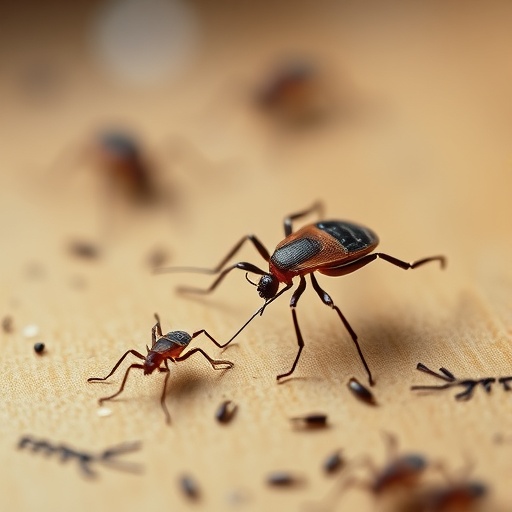
In a groundbreaking study emerging from the laboratories of The Ohio State University, scientists have established for the first time that certain species of ticks, which frequently latch onto humans or pets, can survive for extended periods indoors on various common household flooring materials. This discovery challenges the previous assumption that ticks would perish quickly once inside a building and highlights a significant public health concern regarding tick-borne diseases.
The study zeroed in on two particular species: the lone star tick (Amblyomma americanum) and the Gulf Coast tick (Amblyomma maculatum). Both species are notorious vectors for pathogens that can cause serious illnesses in both humans and animals. The researchers methodically tested the survival duration of these ticks on five types of flooring routinely found in homes—ranging from hard surfaces like tile, wood, and vinyl to softer surfaces such as short-pile and shag carpets.
One of the most striking outcomes was the remarkable resilience of the Gulf Coast tick. On average, this species survived up to approximately 18 days, with its longevity peaking at around 25 days on vinyl flooring. In contrast, the lone star tick displayed an overall shorter survival span of about 11 days but persisted the longest on long-pile carpet, averaging nearly 15 days. This nuanced understanding of habitat suitability within a home environment has critical implications for tick control strategies.
“The ability of these ticks to survive indoors for days and even weeks underscores a latent threat that many people simply do not anticipate,” said Afsoon Sabet, a PhD candidate in entomology and the study’s lead author. “Our findings drive home the point that the supposedly safe haven of one’s home can become a vulnerable environment for tick exposure if these pests are inadvertently transported indoors.”
The methodology was exhaustive and meticulous. The research team subjected 90 adult, unfed ticks from each species to 15 separate tests—three rounds per floor type. Each tick was confined under a cup to prevent escape while still allowing movement, simulating a scenario akin to a tick releasing from clothing or a pet inside a home. Their viability was monitored closely over multiple days with thousands of individual observations logged, ensuring high-resolution survival data.
A key biological factor influencing tick survival indoors is desiccation, or moisture loss. Ticks rely heavily on environmental moisture to maintain cellular functions, and the drier conditions typical of indoor environments significantly challenge their longevity. Nevertheless, despite these adverse conditions, the species tested manifested substantial survival times. Control groups maintained in humidity and temperature-controlled laboratory chambers demonstrated survival for more than a year, starkly contrasting the survival times seen on household floors.
Dr. Risa Pesapane, associate professor of veterinary preventive medicine and co-senior author, stressed the epidemiological importance of this insight. “Ticks have life cycles that span years, and their survival hinges on moisture retention. The mere fact that they survive up to three weeks inside homes implies a tangible risk of tick bites indoors, especially since ticks often seek hosts shortly after arriving in a new environment.”
Another intriguing observation surfaced in the comparative survival times between floor types. Long-pile carpet provided a more hospitable microclimate for lone star ticks than tile or other hard surfaces, which may retain slightly more moisture or offer physical refuge from desiccation. This raises concerns that carpeting could inadvertently harbor ticks longer, increasing the chance of human or pet infestation.
Tick-borne illnesses are on the rise in the United States, with reported cases increasing by approximately 40% from 2019 to 2022 according to CDC data. Both lone star and Gulf Coast ticks contribute to this surge. Lone star ticks are vectors for ehrlichiosis and are infamously linked to alpha-gal syndrome—a severe allergy to red meat and mammal-derived products triggered by tick saliva. Gulf Coast ticks carry pathogens responsible for various spotted fever rickettsioses.
Given the demonstrated indoor survival abilities of these ticks, the research team emphasizes rigorous preventive measures. Recommendations include employing both chemical and non-chemical tick deterrents for people and animals, conducting thorough daily tick inspections using brushes or lint rollers, and immediately laundering or isolating potentially exposed clothing. Such practices can effectively curtail the propagation of ticks within domestic environments.
Samuel Ward, assistant professor of entomology and co-senior author on the study, highlighted the public health perspective: “The ultimate message here is vigilance. While we can’t completely eliminate ticks from the environment, we can reduce the risk of tick bites indoors through awareness and proactive prevention. Our data provide quantitative backing to advocate for daily tick checks and improved household hygiene.”
This pioneering work was funded by the National Institute of Food and Agriculture, U.S. Department of Agriculture, ensuring the rigorous scientific standards and relevance to both veterinary and human medicine. The full research article was published online on March 13, 2026, in the Journal of Vector Ecology and presents a substantial advancement in understanding tick ecology and risk management in indoor environments.
This study is a timely alert to the public and health professionals alike. It dismantles the complacency surrounding ticks in indoor settings and compels a reconsideration of how household conditions and human behaviors might unwittingly contribute to tick-borne disease risks. The insights gained have the potential to shape future recommendations for tick control and prevention, particularly as climate change and expanding tick habitats elevate the ongoing threat.
Subject of Research: Not applicable
Article Title: Effect of floor type on survival of Amblyomma maculatum and Amblyomma americanum (Acari: Ixodidae)
News Publication Date: 13-Mar-2026
Web References: Not provided
References: Not provided
Image Credits: Not provided
Keywords: tick survival indoors, lone star tick, Gulf Coast tick, Amblyomma maculatum, Amblyomma americanum, tick-borne diseases, tick ecology, desiccation, tick prevention, indoor tick risk


