

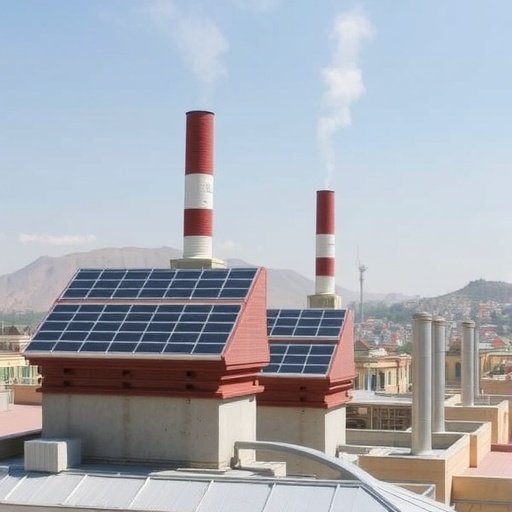
In recent years, urban air pollution has emerged as a critical concern, particularly in sprawling metropolitan environments like Tehran. Researchers have been ardently exploring innovative solutions to combat this pressing issue, with one of the most intriguing approaches being the utilization of the solar chimney effect. By harnessing this natural phenomenon, scientists aim to foster cleaner air and improve the overall air quality index (AQI) for densely populated areas. In a landmark study, Yousefi et al. delve into a numerical investigation using computational fluid dynamics (CFD) to assess the efficacy of solar chimneys in alleviating urban air pollution in Tehran.
The study systematically examines the interplay between solar radiant energy, chimney height, and airflow dynamics to quantify the solar chimney effect’s potential in urban environments. By deploying advanced CFD simulations, the researchers scrutinize airflow patterns and pollutant dispersion, illustrating how modifications in chimney design could significantly influence air quality. This meticulous approach reveals the intrinsic link between architectural designs and environmental health, providing a proactive framework for urban planners and policymakers.
Harnessing solar energy through the chimney mechanism is not merely a theoretical exercise; it stands as a testament to what sustainable architecture can achieve. The fundamental principle of a solar chimney involves heating air at the base, causing it to rise as it expands, thereby creating an inlet for cooler air. This natural convection process not only enhances ventilation within urban spaces but also facilitates the removal of airborne pollutants, creating a win-win situation for city infrastructure and public health.
In their investigation, Yousefi and colleagues implemented a comprehensive model focusing on the various parameters influencing efficacy, including local climatic conditions, urban morphology, and pollution sources. Each element was carefully integrated into the CFD simulations, leading to a holistic portrayal of how solar chimneys could be optimized. By targeting specific urban hot spots for installation, the model could predict reductions in particulate matter and other detrimental pollutants, a significant finding for cities striving to meet international air quality standards.
One of the standout revelations from the study is the evidential decrease in the AQI levels correlated with the introduction of solar chimneys. Deploying these structures led to measurable reductions in contaminants such as nitrogen dioxide and particulate matter, which are notoriously challenging targets in urban centers. The implications of this research extend beyond mere numbers; they highlight the urgency of adopting green technologies in urban settings, offering a practical pathway to cleaner air.
Moreover, Yousefi et al. shed light on the economics of implementing solar chimney solutions in Tehran. By analyzing costs pertaining to construction, maintenance, and energy savings, their findings present compelling evidence that investing in such sustainable infrastructure can yield long-term financial benefits while promoting public health. The potential return on investment makes this initiative not just an environmental imperative but a financially savvy decision for cities grappling with pollution-related challenges.
The CFD model exhibited in the study is robust yet adaptable, allowing other cities worldwide facing similar air quality issues to tailor solar chimney designs to their unique contexts. This flexibility is crucial as it ensures that solutions are not one-size-fits-all but rather customized to the specific needs of different urban environments. The importance of localized interventions cannot be understated; urban pollution sources vary significantly, and so must the strategies employed to combat them.
Additionally, the research emphasizes the role of interdisciplinary collaboration in addressing urban air pollution. Engineers, urban planners, environmental scientists, and policymakers must work hand-in-hand to create holistic strategies aimed at reducing emissions and transforming city landscapes. By synergizing theoretical research with practical applications, cities can pioneer innovative solutions that are both scientifically sound and socially acceptable. This collaborative spirit is essential for implementing effective environmental changes.
Furthermore, the study touches upon the psychological implications of improved air quality on urban populations. Cleaner air not only affects physical health but also contributes to better mental well-being and social cohesion. The presence of green technology, including solar chimneys, can instill a sense of pride and ownership among residents, fostering a community-oriented approach towards sustainable living. This aspect highlights the broader implications of urban air quality initiatives, transcending mere numbers and touching on the betterment of community life.
As cities worldwide grapple with the dual challenges of air pollution and climate change, the findings of Yousefi et al. provide a beacon of hope. Their research showcases viable, sustainable solutions that harmonize urban development with environmental stewardship. The solar chimney effect stands out as a compelling case for reimagining urban landscapes in alignment with nature rather than in opposition to it. Such transformative thinking is paramount if we are to navigate the pressing environmental crises of our time.
In summary, Yousefi et al.’s research elucidates the overlooked potential of solar chimneys as an innovative option for mitigating urban air pollution. By relying on cutting-edge CFD simulations, the study underscores the multidimensional benefits of these structures, from improving air quality to potentially boosting urban economies. The foundational motive behind such research is crystal clear: it is time to harmonize our urban environments with sustainable practices. The future of our cities depends on our willingness to embrace and implement innovative solutions like the solar chimney effect, ensuring a healthier, cleaner living space for generations to come.
As we anticipate the forthcoming publication of this study, it serves as a reminder of our collective responsibility to advocate for environmental justice in our cities. Armed with the insights gained from this research, we must urge our local leaders and policymakers to consider integrating solar chimneys into their urban renewal strategies. Only through such proactive measures can we hope to reclaim our cities from the grip of air pollution, fostering environments where both people and nature can thrive side by side.
With the rapid pace of urbanization, the call to action has never been more pressing. The revolutionary concept of solar chimneys holds the promise of transforming not just individual buildings but entire urban landscapes. Encouraged by this research, let us collectively champion these green innovations and pave the way for cleaner, healthier cities, ensuring a sustainable legacy for future inhabitants.
Subject of Research: The effectiveness of solar chimneys in urban air pollution reduction in Tehran.
Article Title: CFD-based numerical investigation of solar chimney effect on urban air pollution and AQI reduction: a case study of Tehran.
Article References: Yousefi, H., Dorfeshan, M., Dorfeshan, M. et al. CFD-based numerical investigation of solar chimney effect on urban air pollution and AQI reduction: a case study of Tehran. Environ Monit Assess 198, 131 (2026). https://doi.org/10.1007/s10661-025-14899-2
Image Credits: AI Generated
DOI: https://doi.org/10.1007/s10661-025-14899-2
Keywords: Solar chimney, urban air pollution, AQI reduction, computational fluid dynamics, sustainable architecture, Tehran.


