

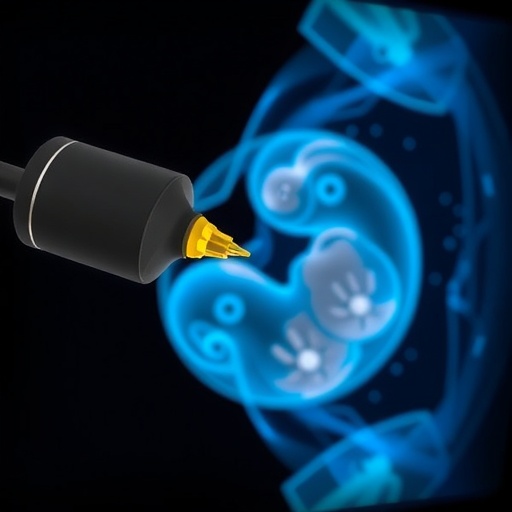
In a groundbreaking development within the field of fetal medicine, researchers have unveiled a state-of-the-art bioelectronic system designed to enhance the monitoring of fetal health during in utero procedures. This innovative system incorporates a multimodal, steerable filamentary probe that directly interfaces with the fetus, addressing significant challenges in evaluating physiological changes during fetal surgeries. Current methods often fall short in providing the predictive value, specificity, and compatibility required for these delicate interventions, underscoring the critical need for advancements in this area.
The inspiration behind this technology stems from the recognition of the complexities involved in undertaking fetal surgeries. Conventional approaches typically rely on unimodal monitoring techniques, which can be inadequate in capturing the multidimensional data necessary for understanding fetal responses during surgery. The newly introduced filamentary probe offers a unique solution by integrating multiple monitoring modalities within a single device, providing a comprehensive view of the fetus’ health status in real time.
One of the most significant advantages of this filamentary probe lies in its ability to maintain consistent contact with fetal surfaces through the use of integrated soft robotic actuators. These actuators facilitate controlled navigation and force delivery, allowing the probe to adaptively respond to the delicate physiological environment of the fetus. By creating a gentle, secure interface, the design minimizes the risk of damage to fetal tissues, which is paramount during minimally invasive interventions.
In a series of experimental applications using a sheep fetal surgery model, the probe demonstrated its capacity to monitor critical fetal conditions effectively. Notably, it was able to detect instances of fetal bradycardia—an abnormally low heart rate—hypoxia, and hypothermia. The ability to identify these conditions in real time presents an invaluable opportunity for healthcare providers to implement timely interventions, potentially reducing the incidence of operative complications.
Moreover, results from studies conducted on both rodents and larger animal fetuses indicate the broader applicability of this innovative monitoring system. These experimental findings point towards the probe’s potential for direct translation into human clinical settings, marking a significant leap forward in fetal health monitoring. As healthcare paradigms shift towards minimally invasive techniques, this technology aligns perfectly with the ongoing evolution of surgical practices.
The filamentary system’s design is not only functional but also emphasizes the importance of safety and efficacy in medical devices. By prioritizing a soft robotic structure, the technology ensures that the probe can navigate the fragile anatomy of the fetus without imposing excessive force that could lead to adverse effects. This characteristic is vital, as optimizing the interactions between surgical instruments and fetal tissues can drastically improve surgical outcomes.
Throughout the development of this probe, researchers have placed a strong emphasis on integrating soft robotics with bioelectronic systems. This fusion enhances the probe’s adaptability and responsiveness, allowing it to collect a diverse range of physiological parameters simultaneously. The array of data gathered can provide clinicians with a richer understanding of the intrauterine environment, paving the way for more informed decision-making during complex surgical procedures.
This multimodal approach not only enriches the data available to clinicians but also equips them with insights that can lead to better patient outcomes. As the technology develops, the expectation is that it will facilitate more personalized intervention strategies tailored specifically to the needs of each fetus, an evolution that could revolutionize the field of prenatal surgery.
The prototype’s initial testing has yielded promising results, indicating that the filamentary probe can operate effectively under the challenging conditions often present in utero. Researchers continue to refine the technology, aiming for enhanced performance and reliability. The ultimate goal is to create a device that can seamlessly integrate into existing surgical workflows, offering clinicians powerful new tools to enhance the safety and efficacy of fetal surgeries.
As understanding deepens regarding the physiological changes that occur in fetuses during surgical interventions, the implications for fetal health and maternal care become increasingly profound. The potential to intervene earlier and more precisely could lead to significant improvements in outcomes for infants born with congenital disabilities, a field that desperately needs innovation and improved methodologies.
In light of these advancements, the medical community awaits further exploration and validation of the filamentary probe. The continuous evolution of this research underscores the commitment to advancing fetal surgical techniques, improving health outcomes for both mothers and their babies. This pioneering work has the potential to set new standards in fetal monitoring, providing a clearer avenue toward ensuring fetal wellbeing during surgeries.
As this research continues to evolve, it remains imperative to engage with clinical practitioners to inform them of new developments and potential applications. Bridging the gap between research and clinical practice will ensure that these advancements reach the patients who need them most. The ongoing dialogue within the healthcare community about best practices will help to facilitate the adoption of such innovative technologies in our increasingly sophisticated medical landscape.
In conclusion, the advent of this filamentary soft robotic probe for multimodal in utero monitoring heralds a new era in fetal health intervention. With its capacity to seamlessly integrate advanced monitoring capabilities and soft robotic technology, this system promises to transform how fetal surgeries are performed, ultimately improving the prognoses for newborns with congenital disorders. The future of fetal health monitoring is bright, and the research community is poised to lead this impactful change.
Subject of Research: Fetal Health Monitoring and Surgical Interventions
Article Title: A filamentary soft robotic probe for multimodal in utero monitoring of fetal health.
Article References:
Bai, H., Zhou, J., Wu, M. et al. A filamentary soft robotic probe for multimodal in utero monitoring of fetal health.
Nat. Biomed. Eng (2026). https://doi.org/10.1038/s41551-025-01605-3
Image Credits: AI Generated
DOI: https://doi.org/10.1038/s41551-025-01605-3
Keywords: Fetal surgery, bioelectronic systems, soft robotics, multimodal monitoring, bradycardia, hypoxia, healthcare innovation


