

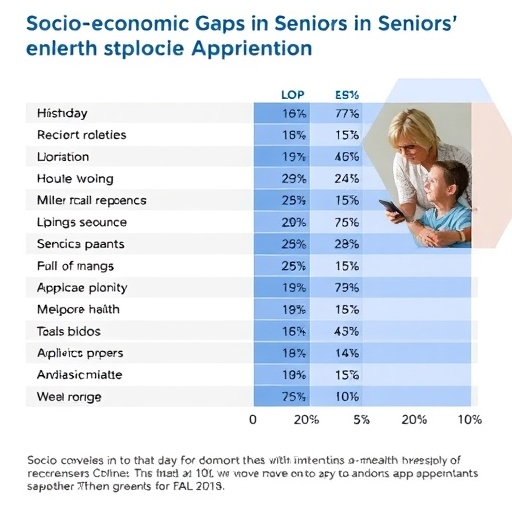
As the global population ages at an unprecedented rate, the healthcare industry is undergoing a profound transformation driven by digital innovation. Among the most promising developments is the rise of mobile health (mHealth) applications—tools that empower older adults to manage chronic conditions, monitor wellness, and maintain independence through seamless technology integration. Yet, underlying this technological evolution lies a critical question: who actually intends to use these digital health aids, and what role does socioeconomic status play in shaping this intention? A groundbreaking study published in BMC Geriatrics by van Elburg, Nieboer, and Askari delves deep into this intersection, uncovering the nuanced socioeconomic variations influencing older adults’ proclivity toward mHealth adoption.
The introduction of mHealth apps has been lauded as a revolutionary step in geriatric healthcare, promising enhanced patient engagement and improved clinical outcomes. However, adoption remains uneven, with some segments of the elderly population embracing these tools enthusiastically while others remain reluctant or unable to leverage their potential benefits. This study pivots on the hypothesis that socioeconomic differences—comprising factors such as income level, educational attainment, and access to digital infrastructure—substantially dictate older adults’ intentions to use mHealth applications.
Employing a sophisticated quantitative methodology, the researchers conducted extensive surveys encompassing diverse demographic groups to gather data on attitudes, perceived usefulness, and barriers related to mHealth usage. The statistical analyses carried out reveal a compelling correlation between higher socioeconomic status and greater readiness to adopt mHealth solutions. This trend underscores far more than mere familiarity with technology; it points to underlying disparities in health literacy, trust in digital platforms, and the perceived integration of mHealth apps within existing healthcare paradigms.
Crucially, the study highlights that older adults residing in lower socioeconomic brackets face multifaceted challenges that extend beyond technical know-how. Limited access to stable internet connections, affordability constraints around purchasing compatible devices, and reduced exposure to educational resources create formidable obstacles. For these individuals, the intention to engage with mHealth apps is not simply about willingness but is intertwined with systemic inequities that restrict digital healthcare access and literacy.
The interplay between socioeconomic status and intention to use mHealth also invites an exploration of the psychosocial factors at play. Van Elburg and colleagues delineate how older adults with greater economic means and educational background often exhibit heightened self-efficacy and health consciousness, making them more receptive to technology-mediated health interventions. In contrast, those with fewer resources frequently harbor skepticism about data privacy, perceive complexity in app interfaces, or feel alienated by design approaches that do not cater to their specific needs.
This research underscores the necessity for a multifactorial approach in mHealth deployment strategies targeting older populations. Innovators and healthcare providers must go beyond user-friendly design to embrace inclusive frameworks that address socioeconomic determinants. Specific recommendations include the development of low-cost devices, offline functionalities to counter connectivity issues, and culturally sensitive educational programs that bolster digital and health literacy for vulnerable elders.
Furthermore, the findings illuminate the potential for mHealth applications to either bridge or exacerbate existing health disparities among older adults. While digital health tools offer promising avenues to democratize healthcare access, without deliberate interventions, there is a risk of deepening the divide—creating a two-tier system where the socioeconomically advantaged reap the benefits of digital health innovations, and the disadvantaged fall further behind.
Integration of mHealth apps into traditional healthcare systems is another focal point derived from the study. Healthcare professionals’ endorsement and their engagement in educating patients regarding app functionalities significantly influence older adults’ attitudes. Facilitating seamless clinical workflows that incorporate mHealth data can enhance patient-provider relationships and foster trust, encouraging sustained use. This relationship between socioeconomic status and trust in healthcare providers further complicates adoption patterns and requires tailored communication strategies.
A unique aspect of this study lies in its longitudinal perspective, tracking intention trends over time. As digital technologies evolve and become more embedded in everyday life, the researchers anticipate shifts in adoption patterns. Younger cohorts approaching older age with greater digital nativity may alter the landscape, but socioeconomic disparities might persist without targeted policy interventions.
From a technical standpoint, the study leverages cutting-edge statistical modeling techniques to isolate variables most predictive of mHealth adoption intent. Structural equation modeling, for example, disentangles the complex covariance among socioeconomic indicators, digital literacy, perceived ease of use, and health motivation. Such rigorous analysis moves beyond surface-level correlations, offering granular insights that inform developers and policymakers.
Beyond individual-level factors, the study also emphasizes the broader context—social support networks, community resources, and healthcare infrastructure—that modulate the decision-making process. Older adults embedded in supportive environments with access to peer groups and caregiver assistance demonstrate higher mHealth app usage intentions, pointing to social capital as a vital component intertwined with socioeconomic status.
Importantly, van Elburg, Nieboer, and Askari’s work serves as a clarion call for multidisciplinary collaboration between technologists, gerontologists, public health experts, and social scientists. Only through combined expertise can scalable, equitable mHealth solutions be crafted to meet the diverse needs of the aging population.
At the forefront of digital health trends, this research sparks a critical discourse on ethical considerations related to inclusivity, autonomy, and engagement in the design and dissemination of mHealth technologies. It challenges stakeholders to rethink conventional paradigms about aging, technology access, and personalized healthcare delivery while striving for equitable innovation.
In conclusion, the socioeconomic determinants of older adults’ intention to use mHealth applications represent a complex, multifaceted challenge with profound implications for geriatric healthcare innovation and policy. The findings from this seminal study provide an essential roadmap to navigate this terrain, underlining the urgent need for targeted interventions, inclusive design strategies, and systemic reforms to harness the transformative potential of mobile health technologies for all segments of the aging population.
As digital ecosystems continue to permeate healthcare, understanding and addressing socioeconomic disparities ensures that mHealth applications fulfill their promise as democratizing tools rather than exclusive privileges. This research not only advances academic discourse but also lays the groundwork for practical, impactful solutions that can enrich health outcomes, autonomy, and quality of life among older adults worldwide.
Subject of Research: Socioeconomic factors influencing older adults’ intention to use mobile health (mHealth) applications.
Article Title: Socioeconomic differences in older adults’ intention to use mhealth applications.
Article References:
van Elburg, F., Nieboer, A.P. & Askari, M. Socioeconomic differences in older adults’ intention to use mhealth applications. BMC Geriatr (2026). https://doi.org/10.1186/s12877-026-07340-x
Image Credits: AI Generated


