

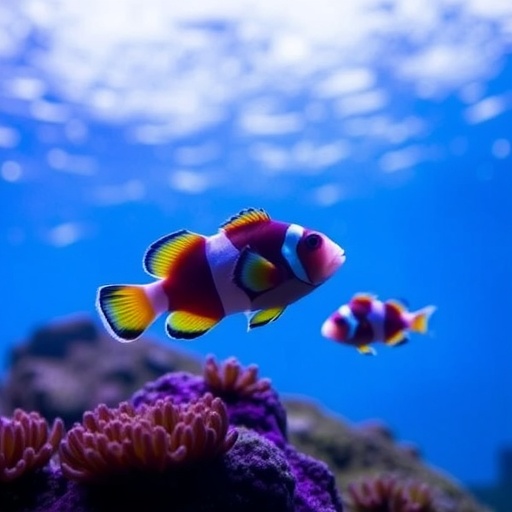
In the diverse aquatic world, color patterns are much more than mere aesthetics; they serve essential communicative and social functions. Recent research from the Okinawa Institute of Science and Technology Graduate University (OIST) has uncovered the intricate biological and social dynamics controlling color pattern plasticity in tomato anemonefish (Amphiprion frenatus), particularly focusing on the phenomenon of bar loss in juvenile fish. This study reveals a compelling connection between social environment and cellular processes, offering new perspectives on developmental adaptability and evolutionary biology in reef ecosystems.
Juvenile tomato anemonefish are born with a set of distinctive white vertical stripes, known as bars, adorning their typically vibrant orange bodies. These bars play a critical role in social hierarchy and communication within their groups. However, intriguingly, many young anemonefish lose some of these bars as they mature. While the presence and number of these stripes have long been recognized as visual markers for social status, the biological underpinnings and adaptive significance of bar loss had remained elusive until now.
The OIST team conducted a comprehensive field study, carefully observing juvenile fish both in natural anemones occupied by adults and in controlled environments without older conspecifics. Their findings were surprising: the rate at which young fish lost their white bars was accelerated in the presence of adult fish. This counterintuitive effect suggested that juvenile anemonefish adjust their coloration dynamically in response to social cues, possibly as a strategy to navigate the complex hierarchies that govern their communities.
This social modulation of appearance is interpreted as a form of visual negotiation within the anemonefish social structure. Typically, each host anemone supports a single breeding pair, with a few subordinate juveniles occupying subordinate positions. Bar loss, then, emerges as a visual signal reflecting a fish’s integration and rank within the group. Juveniles in occupied anemones lose their bars faster to signal submission, reducing conflict with dominant adults, whereas those residing in unoccupied or fake anemones retain their bars longer, potentially as a deterrent to would-be intruders.
Diving deeper into the cellular mechanisms, researchers focused on iridophores—specialized pigment cells responsible for the white coloration of these bars. Microscopic examination revealed a striking process of programmed cell death, or apoptosis, within these cells during bar loss. Iridophores shrink, their membranes fold, and their nuclei fragment, culminating in complete cellular elimination without replacement. The white bar tissues are gradually overtaken by the fish’s characteristic orange skin, underscoring this developmental transformation.
At the molecular level, gene expression analyses highlighted the upregulation of genes associated with apoptosis, notably caspase-3, a central executor in the cell death pathway. Concurrently, variations in thyroid hormone-related gene expression correlated with social context, suggesting a hormonal axis linking environmental perception to cellular behavior. This points to a sophisticated integration of social signals and internal developmental pathways driving morphological changes in the fish.
The plasticity displayed by anemonefish bars offers a window into evolutionary strategies that balance genetic programming with environmental flexibility. Phylogenetic analyses performed by the team indicate that bar loss evolved independently in multiple anemonefish species—not inherited from a single ancestor but favored in species inhabiting smaller social groups. This convergence supports the hypothesis that in tight-knit social structures, visual modulation of subordinate status is crucial for minimizing lethal conflicts and maintaining group stability.
These findings transcend the realm of ichthyology, lending insight into broader biological principles. The study exemplifies how developmental plasticity can serve as an adaptive mechanism in fluctuating social environments and may represent an intermediate evolutionary step toward fixed species-specific traits. The implications extend to understanding biodiversity, speciation, and ecological resilience in coral reef ecosystems, which face unprecedented environmental challenges.
Beyond its ecological and evolutionary implications, this research underscores the importance of inter-disciplinary approaches. By combining field ecology, genomics, and developmental biology, the team effectively decoded a complex behavioral and physiological trait. Their work illustrates how seemingly simple visual features can harbor deep biological significance, mediated through finely tuned cellular processes.
Moreover, these insights raise fascinating questions about sensory and hormonal communication in fish social systems. How precisely do juvenile fish perceive the presence and status of adults at a molecular level? What are the neural and endocrine pathways linking social detection to gene expression shifts? Future research will undoubtedly aim to dissect these mechanisms, providing a more holistic understanding of social regulation in marine life.
In conclusion, the dynamic loss of white vertical bars in juvenile tomato anemonefish integrates social cues and programmed cellular changes, reflecting an elegant evolutionary adaptation. This plasticity in color patterning not only facilitates social integration and survival within territorial reef environments but also deepens our grasp of the molecular orchestration underlying phenotypic flexibility. Through this lens, the radiant stripes of clownfish are more than stunning visual traits—they are living narratives of social negotiation, developmental biology, and evolutionary innovation beneath the waves.
Subject of Research: Animals
Article Title: Iridophore apoptosis mediates socially-regulated developmental color pattern plasticity in an anemonefish
News Publication Date: 19-Feb-2026
Web References: DOI: 10.1371/journal.pbio.3003630
Image Credits: Camille Sautereau
Keywords: Anemonefish, Color Pattern Plasticity, Social Hierarchy, Iridophore Apoptosis, Developmental Biology, Evolutionary Adaptation, Phenotypic Flexibility, Tomato Anemonefish, Marine Ecology, Apoptosis, Cell Death, Hormonal Regulation


