

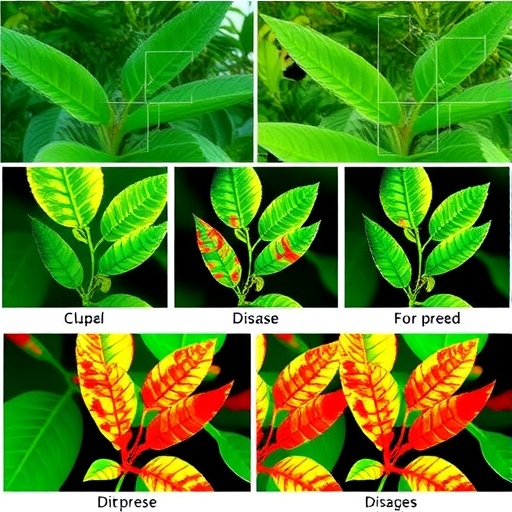
In the ever-evolving landscape of agricultural technology, advancements in machine learning and artificial intelligence are proving to be transformative for traditional farming practices. A recent pioneering study conducted by Kabir et al. has unveiled a robust framework aimed at revolutionizing tea leaf disease detection. This innovative approach, termed Tealeafnet-gwo, combines the strengths of Convolutional Neural Networks (CNN) and Transformer models, harnessing the efficiency of gray wolf optimization to enhance disease identification in tea plants.
Tea production is significantly susceptible to diseases, which pose a serious threat to yield and quality. Farmers traditionally rely on manual inspections or rudimentary visual methods to detect disease signs, often resulting in late diagnoses and increased susceptibility of crops to infections. The integration of high-level technologies into these processes could mitigate these issues, enabling timely interventions and improving the overall health of tea plantations.
The authors of the study adopted a hybrid model that synergistically merges CNN and Transformer architectures. CNNs are widely recognized for their prowess in image classification tasks, particularly in recognizing patterns within visual data. They analyze the local features of images, making them ideally suited for identifying specific symptoms of leaf diseases. On the other hand, Transformers, renowned for their success in natural language processing, offer a unique advantage in capturing long-range dependencies across data. This blending of methodologies paves the way for more accurate detection mechanisms as it allows the model to consider both localized and contextual information effectively.
One of the most critical components of the Tealeafnet-gwo framework is the implementation of gray wolf optimization (GWO). This nature-inspired algorithm mimics the hunting behavior of gray wolves, renowned for their strategic pack hunting techniques. In the context of machine learning, GWO serves as a potent optimization tool that enhances the training of the hybrid model, enabling it to learn from a diverse dataset more effectively. Through this approach, the researchers managed to improve the model’s performance significantly in terms of accuracy and efficiency, thereby setting a new benchmark in the field of agricultural disease detection.
To validate the effectiveness of the Tealeafnet-gwo framework, the researchers conducted extensive experiments on various datasets comprised of tea leaf images affected by multiple diseases. The results were compelling, highlighting a marked improvement in disease detection rates compared to traditional methods. The framework not only reduced false positives and negatives but also accelerated the diagnostic process, enabling quicker responses from farmers facing crop threats.
Furthermore, the study meticulously outlines the rigorous testing protocols employed to ascertain the robustness of the model. Best practices were adhered to in terms of data augmentation, ensuring that the model wasn’t just trained on ideal conditions, but rather on a myriad of challenges that reflect real-world scenarios. This thorough approach reinforces the reliability of the model, ensuring that it can perform under various environmental conditions.
As agricultural losses due to diseases continue to soar, the significance of this research cannot be overstated. By leveraging advanced AI techniques, Kabir et al. provide a template for the future of agricultural technology. Their efforts represent a critical stride toward integrating machine learning into everyday farming practices, fostering a paradigm shift that could lead to more sustainable and resilient agricultural systems.
The hybrid Tealeafnet-gwo framework also sets a precedent for future research, not just in tea crops but across various types of agriculture. With customization and scalability in mind, this model could be adapted to a range of crops, tailored to meet the specific disease threats they encompass. This paves the way for a wider application of AI technologies in agriculture, ultimately contributing to food security in the face of a growing global population.
Moreover, the implications of this research extend beyond agricultural productivity. By minimizing pesticide use through early and accurate disease detection, the model aligns with sustainable farming principles, thus promoting environmental well-being. This dual focus on efficiency and sustainability could help pave the way for future legislation surrounding agricultural technology and its impact on the environment.
As more countries vie for leadership in technological innovation within agriculture, projects like Tealeafnet-gwo foster an environment of investment and interest in AI-driven solutions. Consequently, this could stimulate economic growth in regions reliant on agriculture, ultimately resulting in improved livelihoods for farmers and their communities.
In conclusion, the study published by Kabir et al. marks a significant milestone in the intersection of AI and agriculture. Their innovative approach to tea leaf disease detection through the Tealeafnet-gwo framework signals a new era in agricultural technology, showcasing how intelligent solutions can improve productivity while advocating for sustainable practices. As research in this field continues to flourish, the ripple effects are bound to resonate far and wide, heralding a new age of smart farming solutions that could bolster food production across the globe.
Subject of Research: Tea leaf disease detection using an AI-driven framework.
Article Title: Tealeafnet-gwo: an intelligent CNN-Transformer hybrid framework for tea leaf disease detection using gray wolf optimization.
Article References: Kabir, M.F., Rahat, I.S., Beverley, C. et al. Tealeafnet-gwo: an intelligent CNN-Transformer hybrid framework for tea leaf disease detection using gray wolf optimization. Discov Artif Intell 5, 377 (2025). https://doi.org/10.1007/s44163-025-00686-y
Image Credits: AI Generated
DOI: https://doi.org/10.1007/s44163-025-00686-y
Keywords: Tea leaf disease, CNN, Transformer, gray wolf optimization, artificial intelligence, agricultural technology.


