

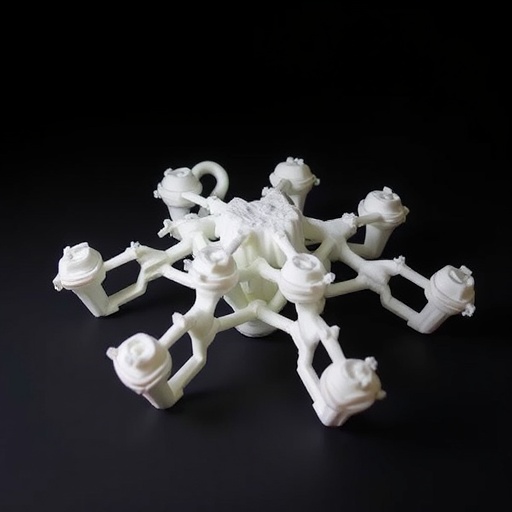
Researchers are constantly seeking innovative solutions to address the challenges posed by vibrations in various engineering domains. The latest study published in the journal “Discover Sustainability” showcases a fascinating development in this field: the exploration of sustainable smart polylactic acid (PLA) polymeric-based gyroid structures that have been 3D printed for vibration control applications. This research not only highlights the mechanical and dynamic behaviors of these structures but also emphasizes their environmental sustainability, providing a multi-faceted approach to modern engineering problems.
Gyroid structures, with their unique geometrical configuration, have garnered attention for their exceptional mechanical properties. Characterized by a complex lattice network, these structures demonstrate not only lightweight and high-strength properties but also remarkable flexibility. The study leverages this unique geometry, employing advanced 3D printing techniques to fabricate gyroids from smart PLA. This combination of innovativeness in design and material choice sets the foundation for significant advancements in vibration control technology.
One of the most exciting facets of the research lies in the use of sustainable materials, underscoring the growing importance of eco-friendliness in modern engineering processes. Polylactic acid, derived from renewable resources, is at the forefront of biodegradable polymer research. This study reinforces the idea that high-performance materials can be created from sustainable sources, demonstrating that environmental considerations can harmonize with technological advancements in significant ways.
In the backdrop of increasing global environmental concerns, the need for sustainable engineering solutions is more pressing than ever. The research focuses on configuring gyroid structures for optimal vibration absorption and dampening. By effectively controlling vibrations, it targets a variety of practical applications, such as in automotive, aerospace, and structural engineering. The ability to reduce vibrations can enhance the durability and longevity of components while improving user comfort and safety.
The mechanical behavior of the gyroid structures was thoroughly analyzed, providing a comprehensive understanding of how variations in design parameters—such as infill density and orientation—affect the overall performance. Testing was performed under different loading conditions to determine the structures’ responses to dynamic stresses. The results indicate that specific configurations can significantly improve vibration dampening capabilities, leading to new benchmarks in structural engineering.
Dynamic behavior analysis complements the mechanical assessments, revealing further insights into how these gyroid structures respond when subjected to fluctuating forces. The study employed computational simulations alongside experimental validations to provide a robust framework for understanding these behaviors. The combination of simulation and real-world testing paves the way for more reliable predictions in mechanical performance, guiding future engineers in the selection and optimization of materials and designs.
3D printing technology has revolutionized traditional manufacturing processes, allowing for the rapid prototyping of complex geometries that were previously challenging to achieve. In this research, the application of additive manufacturing not only simplifies production but also enhances customization options. This flexibility in manufacturing facilitates the creation of tailored solutions for specific vibration control challenges in various industries, from consumer electronics to heavy machinery.
Moreover, the sustainable aspect of the PLA gyroid structures cannot be overstated. As industries increasingly gravitate towards greener practices, this study sets a precedent for utilizing biodegradable materials without compromising on performance. The incorporation of smart materials can further enhance these structures, integrating sensors and actuators to dynamically adjust to changing vibration patterns. This integration opens the door to intelligent systems that not only react to but also predict oscillations, marking a shift towards the next generation of active vibration control technologies.
While the focus of the study is predominantly on engineering applications, its implications reach far beyond technical boundaries. It casts a spotlight on the necessity for interdisciplinary approaches in tackling global challenges, where engineering, sustainability, and technology converge. By fostering collaboration among experts from diverse fields, innovative solutions can emerge that not only address immediate problems but also contribute to long-term environmental goals.
As the interest in smart materials continues to rise, this research serves as a significant contribution to this burgeoning field. The exploration into the mechanical and dynamic behavior of 3D printed gyroid structures enriches the existing body of knowledge, offering valuable insights that can inform future research endeavors. The findings encourage further investigation into hybrid materials and advanced manufacturing techniques, potentially leading to breakthroughs that can revolutionize design paradigms across multiple sectors.
The practical implications of this research extend to manufacturing protocols, design standards, and material sourcing. Companies implementing these sustainable approaches not only stand to improve their environmental footprints but also position themselves favorably within a growing market that values eco-conscious products. As consumers become more aware of sustainability issues, the demand for products crafted using environmentally friendly methods will only increase, driving innovation within industries.
Additionally, this research aligns seamlessly with broader global sustainability initiatives. With the growing urgency to combat climate change and reduce plastic waste, the shift towards renewable resources and biodegradable materials is more important than ever. The work presented in this study reflects a proactive stance within the scientific community to champion solutions that not only enhance engineering performance but also contribute to a healthier planet.
Looking ahead, the authors of this study have opened up various avenues for continued research. Future investigations could further explore different materials and their combinations in advancing gyroid structures’ performance. The evolving landscape of 3D printing technology, coupled with ongoing innovations in smart materials, could yield exciting developments in the realm of vibration control, leading to transformative changes in how engineered systems are designed and manufactured.
In conclusion, the research conducted by Roopa, A.K., A., R., and Acharya, S. marks a significant advancement in the realm of sustainable engineering. By merging innovative 3D printing techniques with environmentally friendly materials, the study offers a compelling vision for the future of vibration control applications. As tech-centric solutions continue to evolve, this work will undeniably inspire a new wave of sustainable engineering practices that resonate with both current demands and future aspirations for a greener planet.
Subject of Research: Sustainable smart PLA polymeric-based structures for vibration control.
Article Title: Mechanical and dynamic behavior of sustainable smart PLA polymeric-based 3D printed gyroid structures for vibration control applications.
Article References:
Roopa, A.K., A., R., Acharya, S. et al. Mechanical and dynamic behavior of sustainable smart PLA polymeric-based 3D printed gyroid structures for vibration control applications. Discov Sustain (2025). https://doi.org/10.1007/s43621-025-02491-0
Image Credits: AI Generated
DOI: 10.1007/s43621-025-02491-0
Keywords: Sustainable materials, vibration control, PLA, 3D printing, gyroid structures, mechanical behavior, dynamic analysis, smart materials, eco-friendly engineering, additive manufacturing.


