

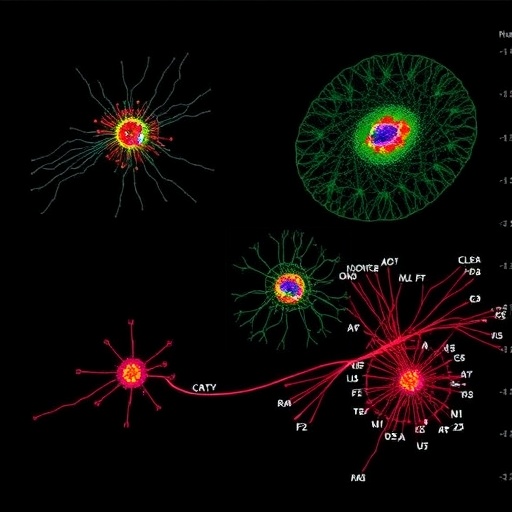
In a groundbreaking development poised to reshape our understanding of cellular identity, scientists have unveiled a next-generation methodology that simultaneously deciphers four critical layers of the epigenome at the single-cell level. This new approach, designated as CHARM (Chromatin Architecture, Regulatory histone modifications, and transcriptome Mapping), transcends traditional techniques by integrating genome conformation, histone modifications, chromatin accessibility, and gene expression analysis into one simultaneous assay. The implications of this multifaceted technology reach far into developmental biology, disease modeling, and therapeutic innovation, presenting an unprecedented resolution of the molecular choreography underlying cell fate decisions.
Cellular diversity—the foundation of organismal complexity—is controlled not just at the genetic code level but also by a rich tapestry of epigenomic regulatory layers. Among these controls are nucleosome positioning, histone tail modifications, and the three-dimensional spatial organization of the genome within the nucleus. Previous studies have underscored how these traits dictate gene expression programs, yet methods to study them have historically been isolated, providing fragmented snapshots from heterogeneous cell populations. The advent of CHARM propels the field into a new era of epigenomic analysis by enabling a holistic capture of chromatin dynamics alongside transcriptomic profiles in the exact same cell, thus revealing intimate correlations invisible to prior approaches.
The technical foundation of CHARM is elegantly complex. It utilizes high-throughput single-cell sequencing technologies expertly adapted to simultaneously measure chromatin contacts, histone modifications, chromatin accessibility, and RNA transcripts. This multiplexed scheme leverages combinatorial indexing and highly specific antibody-based targeting of histone marks, paired with advanced chromatin conformation capture protocols, to seize a panoramic view of regulatory landscapes. This integrative measurement platform enables researchers to chart epigenomic modifications and genome folding patterns that cooperate to activate or silence genes, offering data with unmatched depth and breadth from minute cell populations.
Applying CHARM to mouse embryonic stem cells (ESCs) revealed profound insights into cell-cycle-dependent epigenomic remodeling. The temporal coordination between chromatin accessibility and histone modification patterns fluctuated systematically as cells transitioned through different stages of the cell cycle, exposing dynamic regulatory shifts essential for maintaining pluripotency or directing lineage commitment. This observation underscores the importance of temporal genomics and epigenomics, emphasizing that snapshot studies are insufficient to fully understand the fluid nature of chromatin states within proliferating cells.
Expanding the scope, CHARM was harnessed to disentangle the epigenomic complexity within cortical tissues, an environment typified by cellular heterogeneity and layered architecture. Through this, researchers identified spatial clusters of regulatory elements that organize in three-dimensional nuclear space distinctively across cell types and subtypes. These spatial topologies appear to facilitate communication between distal enhancers and their target gene promoters, thus structuring gene expression networks fundamental to neural differentiation and function. The ability to resolve such spatial relationships at single-cell resolution unlocks new avenues for exploring brain development and neurological disorders in exquisite detail.
A hallmark achievement of CHARM is its capacity, in concert with interpretable machine learning algorithms, to infer thousands of enhancer–promoter linkages with remarkable precision. Enhancers are regulatory DNA sequences that can modulate gene expression from a distance by looping through three-dimensional space to contact promoters, yet identifying these functional connections has remained challenging. By integrating chromatin accessibility, histone modification states, and spatial genome architecture, CHARM’s computational framework discerns these interactions in a cell-type-specific context, enabling an unprecedented mapping of gene regulatory circuits and their impact on transcriptional outputs.
This convergence of multi-omics data establishes a new paradigm for understanding how epigenomic modalities interplay to define cellular phenotypes. It becomes increasingly clear that no single molecular layer acts in isolation; rather, a densely interconnected network of chromatin structure, histone marks, accessibility, and transcriptional output together shapes cellular identity. CHARM’s comprehensive profiles thus provide a much-needed blueprint for decoding gene regulation complexity in both normal physiology and disease states, improving our grasp of epigenetic plasticity and dysfunction.
Beyond its immediate applications, CHARM introduces a versatile platform poised for broad adoption in biomedical research. Its compatibility with diverse tissue types offers a roadmap for dissecting pathological epigenomic alterations underlying cancer, neurodegenerative diseases, and developmental disorders. Moreover, CHARM can facilitate precision medicine strategies by revealing patient-specific regulatory landscapes that may guide targeted therapeutic interventions, particularly in contexts where cell-type-specific gene regulation is disrupted.
The integration of CHARM with sophisticated machine learning models emphasizes the growing role of artificial intelligence in biology. Deep interpretability of model outputs allows not just pattern recognition, but the generation of mechanistic hypotheses regarding enhancer–promoter interactions and regulatory element function. This cross-disciplinary synergy exemplifies the next wave of genomics research, merging experimental assays with computational power to unlock the genome’s regulatory code at unprecedented granularity.
Overall, CHARM represents a monumental advance in the epigenomics toolkit, enabling researchers to resolve the intricate maps of gene regulation within individual cells. With this methodology, the biological community is positioned to explore fundamental questions surrounding development, cell identity, and disease progression through the lens of integrated chromatin architecture and gene expression. It sets the stage for discoveries that may redefine our understanding of cellular regulation and open new frontiers in biomedicine.
As the scientific community intensifies efforts to chart the regulatory landscapes of complex tissues, technologies like CHARM provide the clarity required to distinguish subtle cellular subtypes and states. This breakthrough highlights the necessity and power of multi-dimensional data integration for biological insight and will serve as a cornerstone for future discoveries aiming to harness the epigenome for human health.
In sum, the introduction of single-cell four-omics sequencing marks a transformative leap toward decoding the regulatory genome in its full multidimensional complexity. The ability to simultaneously capture chromatin conformation, histone modifications, accessibility, and transcriptomic activity in individual cells offers an unparalleled window into the molecular determinants of cellular identity and function. This pioneering approach may revolutionize our capacity to understand, diagnose, and treat a wide spectrum of diseases governed by gene regulation.
Subject of Research: Single-cell epigenomic regulation encompassing chromatin conformation, histone modifications, chromatin accessibility, and gene expression profiling.
Article Title: Gene regulatory landscape dissected by single-cell four-omics sequencing.
Article References:
Chen, Y., Liu, Z., Xu, H. et al. Gene regulatory landscape dissected by single-cell four-omics sequencing. Nature (2026). https://doi.org/10.1038/s41586-026-10322-z
Image Credits: AI Generated


