

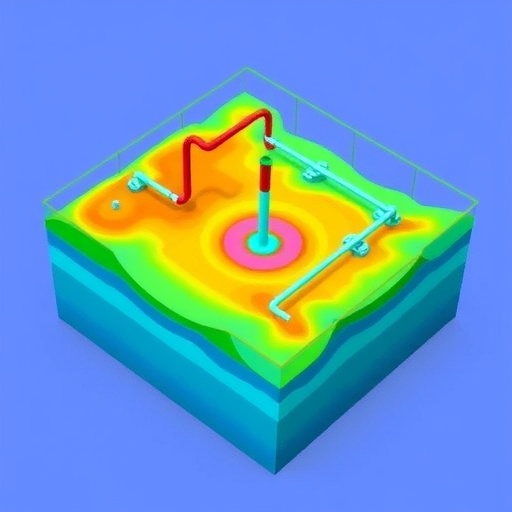
A groundbreaking study published in the journal Nature Resources Research focuses on the intricacies of gas hydrate reservoirs, particularly emphasizing how geomechanical responses vary across heterogeneous structures. The research, conducted by Cheng, J. et al., showcases numerical simulations that unravel the complexities involved in gas production from these reservoirs. Gas hydrates, composed of water and natural gas, are increasingly recognized as significant energy resources, and understanding their behavior in response to production techniques is crucial for optimizing extraction methods.
Gas hydrate reservoirs are found in unique environments such as marine sediments and permafrost regions, making them both valuable and challenging to explore. The study by Cheng et al. presents an advanced numerical simulation approach that enables researchers to analyze the gas production processes in these heterogeneous reservoirs comprehensively. The geographic and geological variances within gas hydrate formations lead to different properties and responses under extraction pressure, making this research timely and necessary.
One of the standout features of this research is the innovative use of numerical simulations to predict the behavior of gas hydrate reservoirs under various extraction scenarios. The results indicate that the geomechanical response differs significantly in heterogeneous settings, challenging previous assumptions that homogeneous models could adequately represent real-world conditions. This finding is pivotal, as it prompts a reevaluation of existing models that potentially oversimplify the complex dynamics of these reservoirs.
The research team utilized extensive data sets and refined modeling techniques to simulate conditions likely encountered during gas production from hydrate reservoirs. By integrating geological factors such as pore pressure, temperature, and sediment composition, their simulations provided insights into the stability of the structures over time. These findings suggest that effective management of gas extraction processes must take the heterogeneous nature of these reservoirs into account to ensure both safety and efficiency.
A significant concern that arises in gas production from hydrate reservoirs is the potential for geomechanical instability. The team’s simulations revealed critical thresholds related to changes in pressure and temperature that can lead to catastrophic failures within the formation. Identifying these thresholds is imperative for stakeholders, including energy companies and regulatory agencies, to prevent unintended consequences during extraction operations.
The research addresses the growing necessity for sustainable and responsible energy development as the world seeks alternatives to fossil fuels. Gas from hydrates represents a cleaner-burning option compared to other hydrocarbons, but exploiting this resource requires advanced understanding and technology to mitigate risks associated with production practices. Cheng et al. have made strides toward this goal by elucidating how geomechanical responses influence the efficiency and safety of hydrate extraction processes.
Furthermore, the authors propose methodologies for future studies that could enhance the predictive accuracy of numerical simulations for gas hydrate behavior. This approach not only encourages further research but also facilitates the development of more effective models that consider specific geological and operational conditions. The implications of more precise modeling extend beyond academia; they also touch on the economic and environmental aspects of energy production.
Importantly, this study marks a significant contribution to the ongoing discourse surrounding energy resources and their environmental impacts. The findings underscore the necessity for integrated approaches that combine geoscience, engineering, and environmental stewardship in gas hydrate research. This multidisciplinary perspective can guide responsible energy extraction practices that prioritize minimal ecological disruption and uphold safety standards.
Another key highlight of the study is its potential to influence policy decisions regarding gas hydrate exploitation. By providing empirical data and theoretical frameworks, Cheng et al. equip policymakers with vital information that can inform regulations surrounding exploration and production. Understanding the geomechanical effects of extraction will be crucial for crafting guidelines that balance innovation with environmental protection.
As the global energy landscape continues to evolve, the search for alternative energy resources becomes more pressing. The research conducted by Cheng and his colleagues serves as a timely reminder of the potential that gas hydrates hold in the energy sector. By advancing our knowledge through sophisticated simulations, the study not only uncovers the underlying mechanics of gas hydrate reservoirs but also contributes to the broader conversation about sustainable energy futures.
In summary, the rigorous numerical simulations presented in this study offer profound insights into the geomechanical responses of gas hydrate reservoirs, reflecting the complexity of these energy resources. The authors call for continued exploration and adaptability in methodologies to ensure that both the scientific and energy communities can grasp the full potential of gas hydrate extraction while acknowledging and addressing the inherent risks involved.
This insightful research is poised to serve as a cornerstone for future investigations into the complexities of gas hydrate reservoirs. The ongoing development of more nuanced models has the potential to revolutionize our understanding and approach to energy resources extracted from these fascinating geological formations.
In conclusion, as society grows increasingly reliant on diverse energy sources, research like that of Cheng et al. illuminates pathways toward maximizing extraction efficacy while maintaining environmental integrity. The future of gas hydrate exploration and production, shaped by such pioneering studies, holds the promise of delivering a more secure and sustainable energy paradigm.
Subject of Research: Gas Hydrate Reservoirs and Their Geomechanical Responses
Article Title: Numerical Simulation of Gas Production and Geomechanical Response of Heterogeneous Gas Hydrate Reservoirs
Article References: Cheng, J., Zhang, S., Wang, L. et al. Numerical Simulation of Gas Production and Geomechanical Response of Heterogeneous Gas Hydrate Reservoirs. Nat Resour Res (2025). https://doi.org/10.1007/s11053-025-10577-9
Image Credits: AI Generated
DOI: https://doi.org/10.1007/s11053-025-10577-9
Keywords: Gas Hydrates, Geomechanical Response, Numerical Simulation, Energy Resources, Natural Gas, Heterogeneous Reservoirs, Sustainable Energy.


