

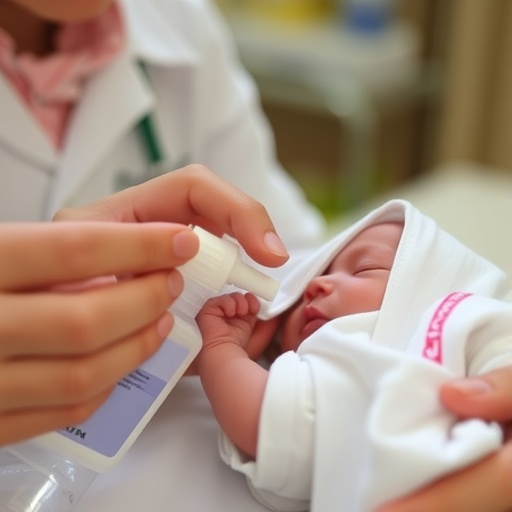
A groundbreaking new systematic review published in the Cochrane Database of Systematic Reviews presents compelling evidence supporting the use of chlorhexidine antiseptic for umbilical cord care in newborns, particularly within low- and middle-income countries (LMICs). This extensive review synthesizes data from 18 randomized controlled trials involving over 143,000 newborn infants, highlighting a significant reduction in umbilical cord infections and a potential decrease in neonatal mortality rates attributed to sepsis and other infection-related causes.
Umbilical cord care represents a critical nexus in neonatal health, serving as an essential barrier against pathogens that frequently invade through the freshly severed cord stump post-delivery. The neonatal period remains one of the most vulnerable stages of life, with an alarming estimate of 2.3 million neonatal deaths worldwide as reported by the World Health Organization (WHO) in 2023, with the highest mortality burdens borne by LMICs. This new analysis underscores the necessity of tailoring cord care practices to specific public health contexts, particularly where healthcare infrastructure and hygienic delivery conditions are suboptimal.
Current WHO guidelines delineate two distinct care protocols based on regional neonatal mortality rates and healthcare capacities. For regions exhibiting low neonatal mortality and access to comprehensive obstetric care, dry cord care—keeping the stump clean and dry without antiseptic application—is recommended to permit natural healing and detachment. Conversely, in locales characterized by elevated neonatal mortality rates and compromised hygiene, routine daily application of 4% chlorhexidine for a week is advocated to mitigate infectious risks.
The systematic review rigorously evaluated multiple antiseptic agents — notably chlorhexidine (4.0%), 70% alcohol, silver sulfadiazine, and povidone iodine — assessing their relative efficacies in preventing severe bacterial infections such as omphalitis, as well as their influence on the timing of cord stump separation. The meta-analysis revealed that chlorhexidine application correlates with an approximate 29% reduction in cord infection incidences, effectively decreasing infection cases from 87 per 1,000 newborns to 62 per 1,000 within LMICs. Notably, neonatal mortality following chlorhexidine application also demonstrated a modest yet meaningful decline from 18 to 15 deaths per 1,000 newborns.
An intriguing finding documented by the review is that chlorhexidine tends to delay cord separation times by approximately one to two days. From a clinical perspective, this slight prolongation does not appear to carry adverse implications but warrants consideration when communicating postnatal care expectations to caregivers. In contrast, evidence relating to alcohol-based antiseptics showed greater uncertainty in LMIC settings, and although moderate-certainty data from high-income countries indicated that alcohol prolongs cord separation by roughly 1.6 days, there was insufficient evidence to assert benefits in infection prevention or mortality reduction in these contexts.
Attention must be drawn to the lack of robust data from high-income countries on chlorhexidine use, where only one study was available and demonstrated very uncertain effects regarding infection prevention and cord separation. This paucity of high-quality evidence restricts generalizing findings across diverse global health environments, emphasizing the paramount importance of contextualizing public health interventions.
The authors emphasize that the optimal approach to umbilical cord care is inherently context-dependent, shaped by regional variations in hygiene standards, healthcare access, cultural practices, and infrastructure. In regions where hygiene and care are adequate, simple dry cord care has proven effective and remains the WHO-recommended standard to avoid unnecessary medicalization. However, in high-risk environments marked by under-resourced health systems and high neonatal mortality rates, the judicious application of chlorhexidine offers a scalable, cost-effective intervention to reduce infectious morbidity and mortality.
One of the most significant challenges faced throughout the synthesis was the limited availability of individual patient data across many studies, constraining nuanced subgroup analyses that could further elucidate which specific populations derive the most benefit from antiseptic interventions. The authors advocate for enhanced data-sharing practices within the scientific community to foster greater transparency and enable more sophisticated, individualized meta-analyses that could refine recommendations and inform policy.
Dr. Aamer Imdad, lead author and a researcher at the University of Iowa, reflects on the real-world relevance of these findings, stressing how many newborns globally continue to be born into precarious hygienic environments. He underscores that simple, affordable cord-care approaches such as chlorhexidine application can exert a profound impact where neonatal infections remain a leading driver of mortality, particularly in vulnerable populations.
Professor Zulfiqar Ahmed Bhutta, a senior author affiliated with the Centre for Global Child Health in Canada and Aga Khan University in Pakistan, articulates an overarching public health principle echoed by their review: interventions must be tailored to local needs and circumstances rather than imposed as universal solutions. He stresses that the study’s findings bolster WHO’s current guidance but reiterate the critical influence of environmental determinants, healthcare system capacity, and cultural practices on intervention success.
This systematic review’s conclusions represent a pivotal advancement in neonatal care discourse by quantitatively evidencing chlorhexidine’s protective efficacy, and potentially its life-saving impact, while framing cord care within the broader fabric of global health inequalities. For practitioners, policy makers, and global health advocates, these insights underscore the urgent need for adaptive, culturally informed strategies that harness evidence-based antiseptic use to ameliorate neonatal infection burdens in the most vulnerable populations.
As neonatal care interventions evolve, ongoing research, particularly with greater transparency and data accessibility, will be indispensable to refine and contextualize antiseptic applications further. This will facilitate enhanced clinical guidelines that optimize newborn outcomes worldwide, reducing the staggering toll of neonatal infections through scientifically grounded, locally relevant measures. The emerging evidence paints a hopeful picture that even straightforward, low-cost antiseptic protocols hold the promise of saving countless young lives in the years to come.
Subject of Research: People
Article Title: Umbilical cord antiseptics for preventing sepsis and death among newborns
News Publication Date: 25-Mar-2026
Web References:
http://dx.doi.org/10.1002/14651858.CD008635.pub3
References:
Cochrane Database of Systematic Reviews, 25-Mar-2026, “Umbilical cord antiseptics for preventing sepsis and death among newborns”
Keywords:
Umbilical cord, neonatal infection, chlorhexidine, antiseptic cord care, newborn mortality, low- and middle-income countries, omphalitis, neonatal sepsis prevention, cord care guidelines, WHO recommendations, neonatal hygiene, neonatal health


