

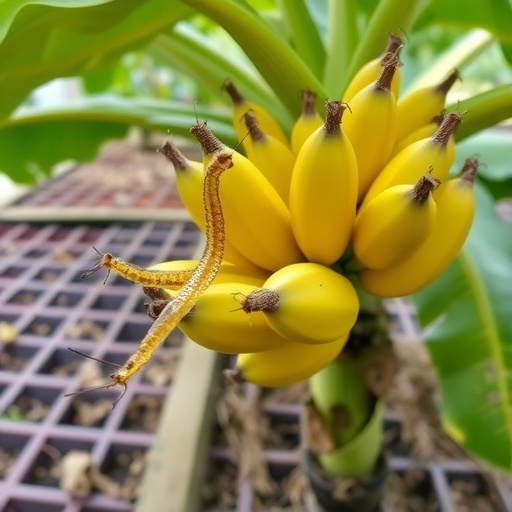
In a groundbreaking study that could revolutionize the way we approach agricultural pest management, researchers have unveiled a natural alliance between soil microbes and nematodes that holds the key to protecting banana crops from devastating root-knot nematodes. This new discovery centers on the role of siderophore-producing Bacillus strains and free-living nematodes in enhancing soil’s ability to naturally suppress these harmful pathogens, marking a significant step forward in sustainable agriculture and integrated pest management.
Banana crops worldwide suffer enormous losses due to root-knot nematodes, microscopic parasitic worms that invade roots, causing galls and hampering nutrient uptake. Conventional control strategies often rely heavily on chemical nematicides, which are environmentally damaging and increasingly restricted due to their toxicity and nonselective nature. The urgent need for eco-friendly alternatives has prompted scientists to explore biological avenues that harness natural soil dynamics to mitigate plant disease pressures.
At the heart of the research lies an intricate interplay between specific soil bacteria and nematodes that doesn’t merely coexist but actively contributes to soil suppressiveness — the soil’s innate ability to limit pathogen establishment or proliferation. Siderophore-producing Bacillus species were identified as critical microbial players that support this suppressiveness by sequestering iron, an essential but scarce nutrient in the soil ecosystem. By producing siderophores, these bacteria outcompete and inhibit root-knot nematodes indirectly, curbing their detrimental effects on banana roots.
The study’s mechanistic insights suggest that siderophores act as biochemical weapons by depriving nematodes and other pathogens of bioavailable iron, thus stunting their growth and reproductive potential. Iron scavenging, a glorified microbial survival strategy, has been recontextualized here as a biocontrol tool that can be leveraged to protect high-value crops from parasitic nematodes, which are notoriously difficult to eradicate once established in the soil.
Moreover, free-living nematodes — often overlooked soil inhabitants — play a synergistic role in strengthening soil suppressiveness. These nematodes contribute to the soil food web by predating on pathogenic nematodes and by facilitating microbial activity through the recycling of organic matter. Their presence encourages a dynamic microbial community that thrives on nutrient cycling and promotes beneficial bacterial populations like Bacillus, creating a formidable biotic barrier against root-knot nematode infestation.
The researchers employed a combination of metagenomics, soil microcosm experiments, and in-situ field trials across multiple banana plantations exhibiting varying degrees of nematode infestation. Through high-throughput sequencing, they characterized the microbial and nematode communities associated with naturally suppressive soils, revealing a robust correlation between siderophore-producing Bacillus populations and nematode activity modulation.
This synergy between enzymes, microbial metabolites, and faunal predators provides a compelling narrative that soil health is a complex tapestry woven from multi-organism interactions. The findings emphasize that managing plant-parasitic nematodes extends beyond targeting the nematodes themselves; it requires nurturing the entire soil ecosystem to foster conditions unfavorable to these pests.
Intriguingly, the study also uncovered that siderophore production by Bacillus spp. can modulate the soil’s chemical milieu beyond iron chelation alone. Secondary metabolites produced in tandem with siderophores potentially disrupt nematode signaling and mobility, which are critical aspects of their life cycle. These metabolites, while not fully elucidated yet, open avenues for bioengineering microorganisms with heightened biocontrol efficacy.
From an applied perspective, this research paves the way for developing probiotic soil amendments tailored to enhance native Bacillus populations and free-living nematode abundance. Unlike traditional pesticides, these biotic amendments would integrate seamlessly into organic farming systems, promoting biodiversity and reducing dependency on chemicals. The scalability of such interventions could render them invaluable for smallholder farmers reliant on sustainable practices.
Moreover, the identification of biomarkers associated with soil suppressiveness could lead to diagnostic tools enabling farmers to assess their soil’s health and biocontrol potential preemptively. Early detection of shifts in siderophore-producing bacteria or free-living nematode communities might signal the need for targeted inoculation or cultural practices that restore soil resilience.
This discovery’s implications resonate far beyond bananas, offering a template for tackling a variety of soil-borne pests affecting other staple crops. The principles learned here about microbial-metazoan interactions governing soil suppressiveness can be extrapolated to different agroecosystems, fostering holistic approaches to crop protection.
Future research will undoubtedly focus on isolating and characterizing the molecular nature of the siderophores and associated metabolites, understanding their biosynthetic gene clusters, and unraveling their multifaceted roles in soil ecology. Additionally, dissecting the behavioral responses of both parasitic and free-living nematodes to these microbial signals will deepen understanding and optimize biocontrol strategies.
The integration of such microbial allies into crop management strategies marks a shift towards precision agriculture technologies that leverage biodiversity to safeguard food security. It reaffirms the paradigm that sustainable farming is not merely about reducing chemical inputs but about unlocking the potential of ecosystems themselves.
Given the projected challenges of climate change, intensifying pest pressures, and the need to expand food production sustainably, the translation of this research into practical applications could be transformative. By harnessing nature’s own defense mechanisms, farmers might soon cultivate banana plants thriving amid nematode pressures without compromising environmental integrity.
As this study demonstrates, the future of agriculture lies underground, in the unseen battles waged by microbes and micrometazoans. Their alliances form the foundation of a resilient soil microbiome capable of defending roots against formidable enemies. Such discoveries illuminate the path to regenerative and sustainable food systems that coexist harmoniously with the living earth.
In conclusion, the identification of siderophore-producing Bacillus and free-living nematodes as key contributors to soil suppressiveness against banana root-knot nematodes heralds an exciting chapter in biocontrol research. This knowledge unlocks new strategies for eco-friendly pest management and strengthens the case for conserving and enhancing soil biodiversity as a cornerstone of agricultural productivity and sustainability.
Subject of Research: Interactions between siderophore-producing Bacillus bacteria, free-living nematodes, and soil suppressiveness to banana root-knot nematodes.
Article Title: Siderophore-producing Bacillus and free-living nematodes are associated with soil suppressiveness to banana root-knot nematodes.
Article References:
Lu, Q., Wang, K., Gu, S. et al. Siderophore-producing Bacillus and free-living nematodes are associated with soil suppressiveness to banana root-knot nematodes. Nat Commun (2026). https://doi.org/10.1038/s41467-026-69647-y
Image Credits: AI Generated


