

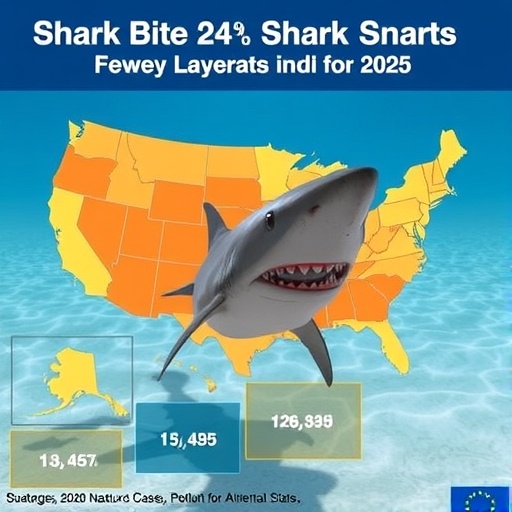
In 2025, global unprovoked shark bite incidents stabilized near long-term averages following a notable dip the previous year, providing critical data that informs scientific understanding of shark behavior and human-shark interactions. The International Shark Attack File (ISAF), maintained by the Florida Museum of Natural History, recorded 65 such incidents worldwide—slightly below the 10-year average of 72. Despite this marginal decrease in total bites, fatalities experienced an uptick, with nine deaths reported compared to the historical average of six. These figures underscore the complexity of interpreting shark bite trends within the context of both ecological variables and human activity.
The ISAF, a comprehensive database established in 1958, includes historical records dating back to the 1500s, offering one of the most enduring scientific efforts to track unprovoked shark attacks. Unprovoked bites are defined as shark incidents where humans are passive participants, with no intentional initiation of contact via activities such as spearfishing or bait release. This stringent classification ensures the data reflect natural interactions, enhancing the biological and ecological relevance of the dataset, while filtering out incidents that might artificially skew risk assessments.
Geographically, the United States continues to lead regions reporting the highest incidence of unprovoked shark bites, accounting for 38% of global cases in 2025. This marks a significant proportional decline from previous years, where the U.S. frequently accounted for over half of worldwide bites annually since 2019. Florida remains a hotspot within the nation, particularly Volusia County, known colloquially as the shark bite capital of the world. Despite Volusia’s reputation, recorded cases there have declined in recent years, with six bites in 2025 compared to a decade average of nine and a peak of 17 in 2021. This downward trend may reflect effective local management or shifts in environmental factors influencing shark presence.
The U.S. east coast witnessed a concentrated spate of incidents in June 2025, bringing national attention back to shark-human encounters. Among these was a severe bite on a 9-year-old girl in Boca Grande, Florida, which resulted in the severing of her hand and subsequent surgical repair. Meanwhile, Hilton Head Island, South Carolina, experienced two separate shark incidents in a single week, one involving a 12-year-old girl requiring airlift to a medical facility. Further north, Long Island, New York, recorded a rare juvenile sand tiger shark bite. This species’ established nursery grounds south of Long Island likely contribute to such incidents due to juvenile sharks’ tendency for exploratory bites while hunting baitfish that increasingly venture closer to shore under certain oceanographic conditions.
Beyond these dense population centers, unprovoked shark bites also occurred sporadically across states such as California, Hawaii, Texas, and North Carolina. Among these, a fatal attack was recorded in central California involving a white shark (Carcharodon carcharias), one of the ocean’s apex predators renowned for their size—approaching 20 feet—and powerful jaws. The victim, a 55-year-old triathlete, was attacked after entering the waters of Monterey Bay, illustrating the persistent risk posed by encounters with large predatory sharks known to inhabit nearshore environments.
Australia ranked second globally for unprovoked bites, contributing 32% of worldwide incidents in 2025, with total bites registering at 21. Coastal waters surrounding Australia harbor three of the most dangerous shark species responsible for severe bites: the white shark, tiger shark (Galeocerdo cuvier), and bull shark (Carcharhinus leucas). Despite their notoriety, Australia’s robust beach safety infrastructure—complete with rapid helicopter response teams—has effectively limited fatalities, which numbered five in 2025. Contrastingly, more remote areas lack this infrastructure, leading to higher fatality risks. For example, a Swiss couple attacked by a bull shark in a remote area suffered one fatality due to delayed emergency response.
Shark bites on tropical islands underscore additional vulnerabilities tied to ecological and human factors. In Samoa, a 13-year-old Australian boy was bitten by a tiger shark while surfing and required both local emergency aid and subsequent medical evacuation to Australia. Similarly, an attack in the Canary Islands involved a shark biting a British surfer’s hydrofoil surfboard before inflicting a significant thigh wound. Surfers globally comprise 32% of unprovoked bite victims, reflecting their extended ocean exposure and high-risk activities.
An intriguing ecological note was the first unprovoked shark bite reported in Canada since 2021. Here, a white shark bit a paddleboard but left the paddler unharmed. This aligns with observations from the St. Lawrence Shark Observatory, which has reported increased white shark sightings in the Northwest Atlantic—a recovery following a 70% population decline in the 1960s due to overfishing and ecosystem disturbances. Despite being listed as endangered in Canada, white shark numbers appear to be recovering locally, an important indicator for conservationists.
In an alarming development, 2025 marked the first confirmed fatality linked to a dusky shark (Carcharhinus obscurus) bite during South Africa’s annual sardine run, a natural phenomenon attracting many predators, including dusky sharks. The victim, a free diver harvesting crayfish, underscores the inherent risks of engaging with marine life during peak predator feeding events. This species was also implicated in a highly unusual and fatal incident in Israel, where human feeding behavior near warm water discharge points led to “begging” behavior in sharks, culminating in a fatal bite. This behavioral adaptation highlights the complex interplay between human interference and shark ethology.
Analyzing the data, the majority of bites in the ISAF database involve unidentified shark species, largely due to the chaotic nature of attacks and difficulties in immediate species identification. Differentiating species often requires forensic analysis, with many victims and witnesses unable to accurately report details during the stressful event. This uncertainty poses challenges for research aimed at species-specific risk assessments and tailored mitigation strategies.
On a broader scale, shark bite statistics remain remarkably stable on a decadal basis, with minimal variation in bite frequency or associated fatalities. Yet, contrary to perceptions of abundant shark populations, global numbers are significantly diminished compared to historical baselines. Approximately 30% of the 1200 known shark species are currently categorized as endangered, a sobering reality given sharks’ evolutionary resilience spanning over 330 million years, surviving mass extinction events such as the Permian and Cretaceous.
The principal driver behind global shark declines is overfishing, exacerbated by bycatch and habitat degradation. While certain nations like the United States and Australia have seen localized population recoveries due to strengthened protections and marine management, global shark mortality from fishing pressures is increasing. Coupled with shifting ocean temperatures and changing habitat conditions, these factors induce alterations in species distributions, occasionally manifesting as localized population spikes but reflecting an overall downward or stable trajectory worldwide.
Ultimately, shark bite occurrences are multifactorial, influenced by predator ecology, climatic variables, and human aquatic activity synchronization. Public risk remains low, with drowning and lightning strikes far exceeding shark bite fatalities globally. The World Health Organization notes drowning as a leading cause of unintentional injury death worldwide, while lightning causes tens of thousands of fatalities annually. Nevertheless, the ISAF provides practical recommendations to further mitigate risk: swimming in groups, avoiding peak shark activity periods at dawn and dusk, steering clear of fishing areas, and refraining from artificial baiting or feeding behaviors that can condition sharks to associate humans with food.
In conclusion, 2025’s shark bite data contribute vital insights into the dynamics of human-shark interactions, emphasizing the need for balanced conservation efforts that safeguard both human safety and vulnerable shark populations. Continual monitoring, public education, and robust marine ecosystem management remain critical tools in promoting coexistence with these apex predators that have endured through the Earth’s most turbulent ecological epochs.
Subject of Research:
Global unprovoked shark bite incidents and ecological factors influencing shark-human interactions
Article Title:
Stabilizing Trends in Global Shark Bite Incidents Amid Growing Conservation Challenges in 2025
News Publication Date:
2026
Web References:
Florida Museum of Natural History, International Shark Attack File: https://www.floridamuseum.ufl.edu/shark-attacks/
References:
Data and insights from the International Shark Attack File annual report, 2025
Image Credits:
Florida Museum of Natural History


