

Unveiling the Cosmic Echoes: Scientists Decode the Mysterious ‘Shadows’ and ‘Ringdowns’ of Distant Black Holes
In a groundbreaking revelation that promises to rewrite our understanding of the most enigmatic objects in the universe, a team of theoretical physicists has delved deep into the heart of a warped spacetime, meticulously unraveling the secrets held within the “shadows” and “quasi-normal modes” of a specific type of black hole. This ambitious research, published in the prestigious European Physical Journal C, offers an unprecedented glimpse into the very fabric of gravity and the extreme conditions that define these cosmic titans. The study focuses on the Schwarzschild–Hernquist black hole, a theoretical construct that, while idealized, serves as a crucial stepping stone in our quest to comprehend the complexities of real-world black holes observed across the cosmos. By modeling these abstract entities, scientists are forging powerful tools to interpret the torrent of data that will soon be provided by next-generation telescopes, pushing the boundaries of astrophysical observation and theoretical physics into uncharted territories.
The concept of a black hole’s “shadow” is not a literal cast of darkness in the traditional sense, but rather a fascinating manifestation of light bending around these immensely dense objects. Imagine a celestial lantern placed behind a perfectly spherical, opaque ball; the ball would obscure the light, creating a dark silhouette. In the case of a black hole, its extreme gravity warps the path of photons, the fundamental particles of light. Photons that pass too close are captured, forming the event horizon, the point of no return. However, photons that skirt the edge of this gravitational abyss are bent, some trapped in orbit, and others deflected. The “shadow” we refer to in this context is the region from which no light can escape to reach a distant observer. It’s a visual representation of the black hole’s gravitational grip, a cosmic umbra defined by the interplay of light and spacetime curvature, providing crucial insights into the black hole’s size and the geometry of its surroundings.
Complementing the visual enigma of the shadow are the “quasi-normal modes” (QNMs), which represent the characteristic vibrational frequencies or “ringdown” of a black hole as it settles after a catastrophic event, such as the merger of two black holes or the accretion of a massive object. Think of striking a bell; it resonates with specific frequencies that decay over time. Similarly, when a black hole is disturbed, it oscillates, emitting gravitational waves at these characteristic QNMs. These modes are imprinted with the intrinsic properties of the black hole – its mass and spin – acting as a unique cosmic fingerprint. By analyzing the frequencies and decay rates of these gravitational wave signals, scientists can effectively “listen” to the black hole’s song, extracting profound information about its physical characteristics and the dynamics of the gravitational field in its immediate vicinity.
The pioneering work by Feng and Zhang specifically examines the Schwarzschild–Hernquist black hole, a model that incorporates a unique form of matter distribution that influences the spacetime geometry. Unlike the simpler Schwarzschild black hole, which assumes a point-like singularity and empty space around it, the Hernquist model introduces a spherically symmetric distribution of matter, akin to a halo. This added complexity significantly alters the gravitational field, leading to subtle but important deviations in the expected behavior of its shadow and its quasi-normal modes. Understanding these deviations is paramount because real astronomical black holes are not isolated entities; they exist within galaxies and are surrounded by gas, dust, and stars, all of which contribute to the complex gravitational landscape. The Schwarzschild–Hernquist model provides a more nuanced theoretical framework to analyze these astrophysical realities.
The theoretical framework developed in this research allows for precise calculations of how the unique mass distribution of the Schwarzschild–Hernquist black hole affects the size and shape of its shadow. Researchers can predict how much larger or smaller the shadow might appear compared to a standard Schwarzschild black hole of the same mass, and how subtle changes in the matter distribution might distort the shadow’s appearance. This detailed understanding is invaluable for interpreting observational data from instruments like the Event Horizon Telescope (EHT), which has already captured iconic images of the shadows of supermassive black holes at the centers of galaxies. Future observations, armed with the insights from this study, could potentially distinguish between different black hole models based on the fine details of their observed shadows.
Furthermore, the study meticulously investigates the quasi-normal modes of this specific black hole model. By solving complex differential equations that describe the propagation of gravitational perturbations, Feng and Zhang have determined how the presence of the Hernquist matter distribution influences the frequencies and damping times of these characteristic oscillations. This means that the “ringdown” signal originating from a Schwarzschild–Hernquist black hole would have a distinct spectral signature, different from that of a simpler black hole. Detecting these subtle differences in gravitational wave signals, perhaps from future black hole mergers detected by observatories like LIGO and Virgo, could provide direct evidence for the existence of such matter distributions around black holes in the real universe.
The implications of this research extend far beyond mere theoretical curiosity. The ability to accurately model and predict the shadows and quasi-normal modes of various black hole types is a critical step towards testing Einstein’s theory of General Relativity in the most extreme gravitational environments. Black holes are natural laboratories for probing the limits of our current understanding of gravity. Any deviation from the predictions of General Relativity observed in the behavior of these cosmic phenomena would signal the need for a new, more comprehensive theory of gravity. This study, by providing a more sophisticated model, allows for more precise tests and the potential discovery of new physics.
The pursuit of understanding black holes is intimately linked with the development of gravitational wave astronomy. When two black holes merge, they unleash a cataclysmic burst of gravitational waves, ripples in spacetime that travel across the universe at the speed of light. These waves carry information about the properties of the merging black holes, and their subsequent ringdown provides a unique window into the final moments of this cosmic dance. The calculations performed in this paper will be essential for interpreting the complex waveforms detected by gravitational wave observatories, helping scientists distinguish the ringdown of a standard black hole from that of a more complex model like the Schwarzschild–Hernquist black hole, thereby refining our understanding of these cosmic events.
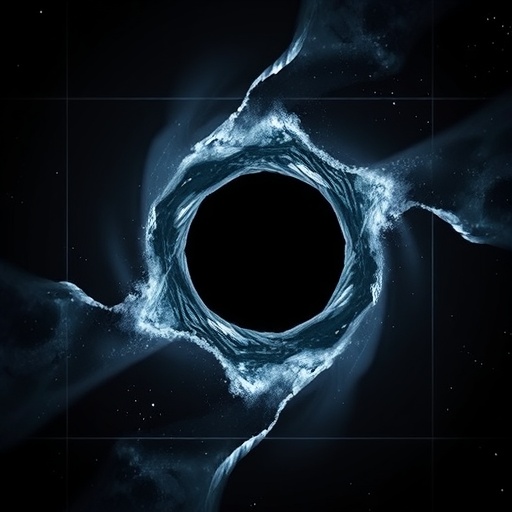
The visual representation provided alongside this research, depicting the shadow of a black hole, is a powerful illustration of the abstract concepts being explored. While the actual black hole itself is invisible, its presence is betrayed by the way it distorts light. The striking visual, generated by advanced computational techniques, serves as a tangible representation of the theoretical predictions, making these complex ideas more accessible to a broad audience and igniting public imagination about the mysteries of the cosmos. Such visualizations are critical for bridging the gap between cutting-edge scientific research and public understanding, fostering a greater appreciation for the wonders of the universe.
The mathematical tools and theoretical insights generated by Feng and Zhang’s work have the potential to unlock further secrets of black hole physics. By extending these calculations to more complex black hole geometries, such as rotating black holes (Kerr black holes) with additional matter distributions, scientists can build increasingly realistic models of observed black holes. This iterative process of theoretical refinement and observational verification is the bedrock of scientific progress, continually pushing the frontiers of our knowledge and revealing the intricate workings of the universe.
Moreover, the study of quasi-normal modes is not confined to gravitational waves. These fundamental modes are also believed to play a role in how black holes interact with other fields, such as electromagnetic fields. Future research could explore how the QNMs of a Schwarzschild–Hernquist black hole might influence the emission of radiation from its accretion disk or its surrounding magnetosphere. This interdisciplinary approach, connecting gravity, light, and matter, promises a more holistic understanding of these complex celestial objects and their influence on their cosmic environments.
The precision of modern astronomical instruments is rapidly increasing, allowing for more detailed observations of black holes than ever before. Telescopes like the EHT are beginning to resolve the fine structures within the shadows of black holes, and future gravitational wave detectors will offer unparalleled sensitivity. The theoretical predictions derived from model black holes like the Schwarzschild–Hernquist black hole are essential for interpreting this wealth of new data. Without these sophisticated theoretical frameworks, the observational signals would remain enigmatic, their profound scientific implications lost.
This research represents a significant stride in our quest to understand the universe’s most extreme objects. By meticulously dissecting the theoretical shadow and quasi-normal modes of a complex black hole model, Feng and Zhang have provided invaluable tools for interpreting future observations and pushing the boundaries of gravitational physics. Their work is a testament to the power of theoretical modeling in unraveling the mysteries of the cosmos, transforming abstract equations into tangible insights about the fundamental nature of reality and the enigmatic denizens of spacetime.
The findings underscore the intricate relationship between matter and gravity. The presence of matter distribution, even in a more diffuse or halo-like form, significantly impacts the geometry of spacetime around a black hole, consequently altering both its visible shadow and its gravitational wave emissions. This has profound implications for how we interpret observations of galaxies and their central supermassive black holes, suggesting that the environment surrounding these objects is not merely passive but actively shapes their observable properties and their gravitational signatures.
The scientific community is abuzz with the potential applications of this research. As astronomers gather more precise data on black hole systems, the ability to distinguish between various theoretical models, such as the simplified Schwarzschild and the more complex Schwarzschild–Hernquist, will become increasingly critical. This enhanced discriminative power will allow for more accurate astrophysical interpretations, leading to a deeper understanding of the formation, evolution, and diverse populations of black holes across the universe and potentially revealing deviations from standard gravitational theories.
The detailed mathematical analysis performed in this study is a sophisticated endeavor, requiring a deep understanding of differential geometry, tensor calculus, and advanced physics principles. The successful derivation of the shadow characteristics and QNM frequencies for the Schwarzschild–Hernquist black hole is a testament to the researchers’ expertise and their ability to tackle highly complex theoretical challenges, paving the way for future explorations into even more intricate astrophysical scenarios.
Subject of Research: The shadow and quasi-normal modes of a Schwarzschild–Hernquist black hole. This research delves into the theoretical properties of a specific black hole model that includes a uniform distribution of matter, examining how this influences the visual shadow cast by the black hole and its characteristic gravitational wave ringdown signals.
Article Title: Shadow and quasi-normal modes of Schwarzschild–Hernquist black hole
Article References:
Feng, XH., Zhang, GY. Shadow and quasi-normal modes of Schwarzschild–Hernquist black hole.
Eur. Phys. J. C 86, 36 (2026). https://doi.org/10.1140/epjc/s10052-026-15293-z
Image Credits: AI Generated
DOI: https://doi.org/10.1140/epjc/s10052-026-15293-z
Keywords: Black holes, Schwarzschild–Hernquist black hole, Shadow, Quasi-normal modes, Gravitational waves, General Relativity, Spacetime curvature, Astrophysics, Theoretical Physics.


