

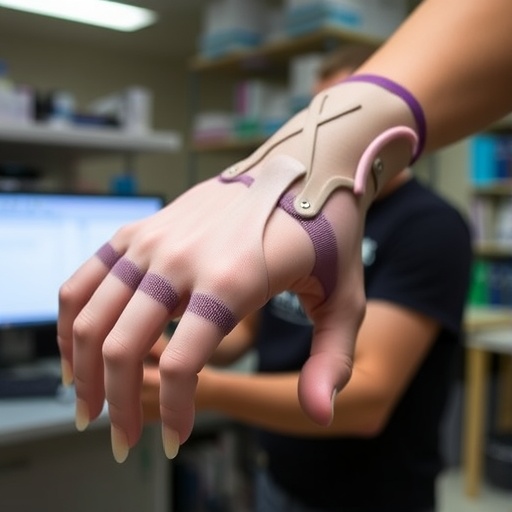
Revolutionizing Prosthetics: SFU’s Custom 3D Printed Socket Breakthrough
In a remarkable stride toward personalized medicine and advanced prosthetics, researchers at Simon Fraser University (SFU) have developed a next-generation 3D printed limb socket that promises unprecedented customization and comfort. This innovative prosthetic socket design leverages cutting-edge pressure mapping paired with artificial intelligence to deliver a dramatically improved wearing experience. Unlike traditional sockets molded from static casts or scans, this highly adaptive technology responds dynamically to individual user biomechanics, potentially transforming lives worldwide.
At the core of SFU’s breakthrough lies a sophisticated integration of miniature pressure sensors embedded within a silicone liner, which the patient wears beneath the socket. This sensor array continuously maps the precise distribution of forces and pressures exerted by the residual limb during diverse activities such as standing, walking, and leaning. Capturing these unique biomechanical signatures, the system produces a comprehensive profile of limb–socket interaction, enabling a level of customization never previously possible.
This detailed pressure data is then processed by custom AI algorithms that generate an optimized 3D socket design tailored specifically to the patient’s limb characteristics. Unlike conventional socket fabrication, which typically employs homogenous solid infills, this approach introduces a proprietary lattice structure inspired by natural designs like honeycomb and trabecular bone. Using the Gyroid pattern—a continuous and highly organized three-dimensional network—the socket achieves unprecedented balance between strength, breathability, and weight.
One of the most striking quantitative findings in the study reveals that these lattice-based sockets absorb energy at magnitudes far exceeding traditional sockets. When standing, the energy absorption increases by an astounding 1,600%, while walking generates 1,290% enhanced energy dissipation. This remarkable capability attenuates impact forces, potentially reducing the development of pressure ulcers, pain, and musculoskeletal complications that have long plagued prosthetic users.
The lightweight lattice infill design not only enhances biomechanical performance but also significantly improves comfort and wearability. By enabling better airflow and reducing socket mass, the prosthesis addresses common complaints such as skin irritation and fatigue over extended use. This dual focus on mechanical optimization and clinical needs exemplifies an elegant fusion of engineering and patient-centered care.
SFU’s research team wants to fundamentally change how prosthetics are manufactured, emphasizing streamlined customization enabled by digital workflows. The process begins with the sensor-equipped liner that acquires live patient data, reviewed by AI-driven design optimization software. This feeds directly into state-of-the-art 3D printing platforms that fabricate the custom socket with remarkable precision and reproducibility. Such an integrated approach promises not only superior fit and function but also scalability and cost-effectiveness.
Clinical collaboration has been instrumental in this project’s success, notably with Hodgson Group Orthotics and Prosthetics providing critical expertise and real-world validation. Their prosthetists underscore the transformative potential of the data-driven system, highlighting how fine-tuning fit and load distribution can profoundly enhance long-term skin health and patient satisfaction. This synergy between emergent technology and clinical practice points toward a new paradigm in prosthetic care.
Beyond technical advancements, this research contributes to the broader vision of making advanced prosthetic solutions widely accessible. By refining manufacturing costs and leveraging AI to ease customization complexity, SFU aims to democratize high-quality prosthetic care. This is especially vital in helping local prosthetic providers serve diverse populations more effectively and ensuring fewer barriers for those in need.
Importantly, the research addresses a longstanding challenge in prosthetics: accommodating the dynamic and heterogeneous nature of each individual’s residual limb. Traditional sockets largely rely on shape conformity alone, insufficiently mitigating localized pressure hotspots that can cause tissue damage. By integrating real-time pressure sensing, AI modeling, and lattice engineering, the SFU design ushers in an era of adaptive, responsive prosthetics.
This study’s publication in the esteemed journal Biosensors and Bioelectronics highlights the interdisciplinary nature of the work bridging mechatronics, materials science, and biomedical engineering. Professor Woo Soo Kim and team have showcased how sophisticated sensor technologies coupled with machine learning can drive meaningful clinical innovation. Their research opens exciting avenues for future work, including expanded sensor modalities and application to upper limb prosthetics.
As this technology matures, the implications extend beyond prosthetics into broader wearable medical devices, personalized orthotics, and even sports performance gear. The core principle of leveraging detailed biomechanical feedback to inform highly customizable, lightweight structures may revolutionize numerous fields where fit, comfort, and dynamic load management are critical. SFU’s pioneering research positions them at the forefront of this transformative wave.
In conclusion, Simon Fraser University’s advanced 3D printed sockets represent a leap forward in prosthetic design. By harnessing pressure mapping sensors, AI-driven design optimization, and biomimetic lattice structures, the team has created a more comfortable, effective, and personalized limb interface. This innovation holds great promise for improving quality of life and clinical outcomes for millions of prosthetic users globally, heralding a new era of intelligent, patient-centered prosthetic technology.
Subject of Research: People
Article Title: Streamlined custom manufacturing for optimized 3D printed prostheses through 3D pressure mapping
News Publication Date: 16-Jun-2026
Web References:
http://dx.doi.org/10.1016/j.bios.2026.118560
References:
Kim, W. S., et al. (2026). Streamlined custom manufacturing for optimized 3D printed prostheses through 3D pressure mapping. Biosensors and Bioelectronics.
Image Credits: Simon Fraser University
Keywords: 3D printing, prosthetics, pressure mapping, AI design, lattice structure, biomechanical optimization, customized socket, wearable sensors, energy absorption, personalized medicine, orthopedic innovation, patient comfort


