

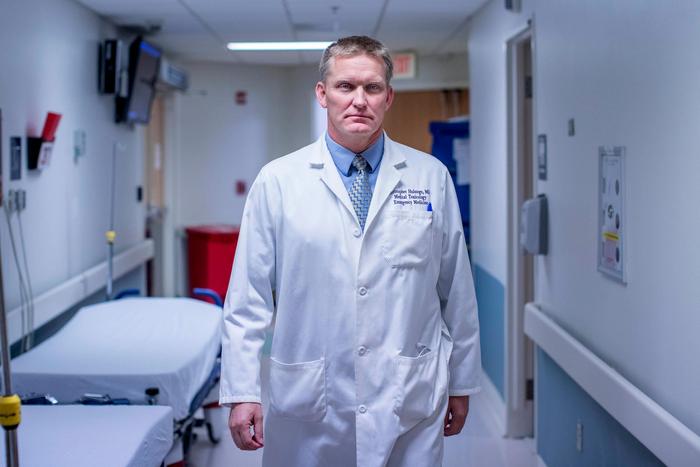
America’s poison centers are fielding increasingly severe cases that are dramatically more likely to lead to severe harm or death in both adults and children, a new study from the University of Virginia School of Medicine reveals.

Credit: Sanjay Suchak | UVA Communications
America’s poison centers are fielding increasingly severe cases that are dramatically more likely to lead to severe harm or death in both adults and children, a new study from the University of Virginia School of Medicine reveals.
The number of calls about intentional exposures that resulted in death among adults increased a whopping 233.9% between the beginning of 2007 and the end of 2021, the study reveals. “Intentional exposures” include cases such as suicide attempts, use of illegal drugs and incorrect use of medications for reasons other than their intended purpose, such as to get high.
The severity of unintentional exposures increased as well, with the number resulting in severe harm (such as disfigurement or disability) increasing by 37.4% and the number resulting in death increasing by 65.3%. This spike in serious outcomes occurred even as the total number of calls for unintentional exposures decreased slightly, by .8%. These cases include unintentional medication misuse, such as taking an incorrect dose; workplace and environmental exposures to harmful substances; bites and stings; and food poisoning.
The severity of cases among children was up, too: The number of pediatric intentional exposures resulting in severe harm or death was up by 76.6%, even as the total number of cases declined by 33%. The number of unintentional exposures resulting in severe harm or death was up by 190.1% and 122.7%, respectively.
“As a society, we should be concerned at these trends pertaining to children,” said researcher Christopher Holstege, MD, director of UVA Health’s Blue Ridge Poison Center and chief of the Division of Medical Toxicology at UVA’s School of Medicine. “We need to collaboratively strategize on better delineating the root causes for such severe cases of pediatric poisonings, especially in the realms of mental health and substance use and misuse.”
Troubling Poison Trends
With drug overdose deaths rising around the nation, Holstege and his collaborators – UVA epidemiologist Rita Farah, PharmD, PhD, and Ryan J. Cole, MD – wanted to get a better sense of the outcomes for calls poison centers have received in recent years. So, they reviewed more than 33.7 million poison exposures reported to the 55 poison centers in the United States between Jan. 1, 2007, and Dec. 31, 2021. These calls included almost 8 million unintentional exposures among adults 19 and older, 3.9 million intentional adult exposures, 18.7 million unintentional pediatric exposures and more than 1.6 million intentional pediatric exposures.
The researchers found that calls were increasingly likely to result in severe harm or death as time went on, and this held true across all age groups. Calls about cases that had minor effects, meanwhile, declined.
That aligned with what Holstege expected. “We were not surprised by the study findings. In fact, what prompted us to look at the data on a national level is the increased severity of cases we are seeing at UVA Health’s Blue Ridge Poison Center,” he said. “The cause for this trend is multifactorial: We have experienced a growing mental health crisis in the nation’s youth, and we are finding an increasing number of dangerous novel psychoactive substances such as synthetic opioids and designer benzodiazepines entering society.”
Despite the increasing severity of calls to poison centers, the researchers did not find a consistent, corresponding increase to critical care units. This may have resulted, in part, from the COVID-19 pandemic limiting available healthcare resources, the researchers say.
With poisons centers being called upon to handle increasingly severe cases, they may need to rethink how they allocate resources, the researchers note. For example, they may need to have more toxicologists available to field complex cases that go beyond the expertise of the poison specialists who answer calls.
“Poison centers are an integral part of the medical management team as we see an increase in the severity of cases of poisoning,” Holstege said. “Poison centers are staffed with clinical toxicologists who provide free expert recommendations on a vast array of toxicologic emergencies to the public and to professionals who call. Involving toxicologists early can save lives and reduce the length of hospital stay.”
Findings Published
The researchers have published their findings in the scientific journal Clinical Toxicology. The authors have no financial interest in the work.
To keep up with the latest medical research news from UVA, subscribe to the Making of Medicine blog.
MORE FROM THE BLUE RIDGE POISON CENTER: Free book on poisonous plants available for download.
Journal
Clinical Toxicology

