

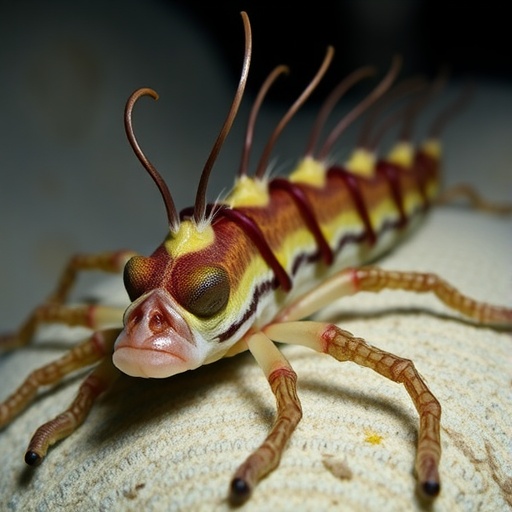
In an unprecedented collaboration between scientists and the online community, a newly discovered deep-sea chiton has been officially named through a public naming competition, highlighting the intersection of modern taxonomy, social media engagement, and deep-sea biodiversity exploration. The Senckenberg Ocean Species Alliance (SOSA), working alongside progressive scientific publisher Pensoft and renowned science communicator Ze Frank, has unveiled the deep-sea mollusk’s scientific name: Ferreiraella populi. This announcement, published in the open-access Biodiversity Data Journal, underscores a transformative approach to species discovery by directly involving the public in the crucial process of scientific nomenclature.
This discovery journey began with an episode from Ze Frank’s popular “True Facts” YouTube series, which has educated millions on the strange and fascinating creatures inhabiting our planet. Featuring the genus Ferreiraella, the rare chiton immediately captured public imagination. Chitons, members of the class Polyplacophora, are distinctive mollusks bearing eight articulated shell plates and a unique radula— a specialized rasping organ used to graze over substrates. The deep-sea species described here is particularly intriguing as it is endemic to sunken wood ecosystems situated more than 5,500 meters beneath the ocean’s surface within the Izu-Ogasawara Trench, an extreme and scarcely explored habitat.
The public naming contest attracted an astounding turnout; over 8,000 name suggestions poured in from an eager, global online community. From this deluge of creativity, the research team selected the Latinized epithet “populi,” meaning “of the people,” chosen independently by eleven participants, symbolizing collective ownership and shared curiosity in the discovery process. This move towards crowd-sourced taxonomy breaks new ground by democratizing the traditionally insular practice of scientific naming, inviting the lay public to contribute meaningfully to the scientific narrative.
The genus Ferreiraella itself is a rare lineage, specialized for life on deep-sea wood-falls, a niche ecosystem where terrestrial trees that sink to ocean depths provide both shelter and nutrients for a specialized and mostly cryptic fauna. The new species’ habitat is characterized by darkness, high pressure, and low temperatures—conditions strikingly different from the typical sunlit world most marine biology studies focus on. Discoveries such as F. populi illuminate how wood-fall ecosystems function as biodiversity hotspots in the abyssal zone, supporting communities adapted to extreme environments, with evolutionary adaptations rarely seen in shallow-water species.
Morphologically, chitons defy simple classification due to their combination of features reminiscent of both gastropods and armored insects. Their eight shell plates confer flexibility and protection, allowing them to conform tightly to irregular surfaces or curl into a ball as a defense mechanism. This remarkable combination enables them to survive abrasive substrates like wood-falls and evade predation in abyssal settings. Moreover, studies revealed a fascinating symbiotic relationship where miniature worms inhabit areas near the chiton’s tail, subsisting on waste products, demonstrating intricate ecological interdependencies within these deep-sea habitats.
Taxonomic classification, governed by strict international codes such as the ICZN for animals, requires adherence to binomial nomenclature— a two-part Latin name consisting of genus and species. The authors’ choice of Ferreiraella populi not only satisfies these conventions but also embraces a spirit of transparency and public engagement. Traditionally, species names derive from physical traits, geographic locations, mythological references, or eponyms honoring people. The choice here transcends these norms by embedding the species within a social context, reinforcing the importance of inclusive science outreach and public participation.
Recent years have seen a troubling trend of marine extinction events occurring before many species are even formally documented. Deep-sea invertebrates, like chitons, remain some of the most understudied taxa despite their ecological significance. The accelerated description and naming of F. populi, only two years after its discovery, contrast with the often decades-long process of taxonomic formalization. SOSA’s mission to streamline scientific workflows while embracing digital communication methods presents a paradigm shift, essential for timely conservation efforts in the face of emerging threats such as deep-sea mining and climate change impacts.
The involvement of Pensoft Publishers, noted for pioneering semantic enrichment in scientific literature, ensures that this research is freely accessible and integrated within global biodiversity data infrastructures. Such open-access dissemination democratizes knowledge and facilitates cross-disciplinary collaborations essential for advancing marine biology. Simultaneously, the humorous yet informative True Facts series offers a novel educational medium, blending science communication with entertainment to reach broader audiences and stimulate interest in obscure marine taxa.
This groundbreaking public engagement and scientific description not only add a vital species to the catalogue of life but also amplify awareness about the vast unexplored diversity lurking in the ocean’s depths. Deep-sea wood-fall ecosystems, once considered marginal, are gaining recognition as vital reservoirs of evolutionary innovation and biodiversity. By bridging science, public participation, and media, the Ferreiraella populi case sets a benchmark for how future species discoveries can integrate societal involvement, enhancing both scientific understanding and conservation advocacy.
In summary, the unveiling of Ferreiraella populi embodies a modern synthesis of taxonomy, ecology, and social science. It emphasizes interdisciplinary collaboration and illustrates how conservation biology can benefit from integrating public engagement through innovative platforms. As vast portions of oceanic biodiversity remain hidden beneath crushing pressures and perpetual darkness, such initiatives herald a hopeful era for marine science—where discovery, naming, and preservation become collective endeavors that resonate far beyond academic circles.
Subject of Research: Deep-sea chiton species discovery and public participation in taxonomy
Article Title: Ocean Species Discoveries 28–30 — new species of chitons (Mollusca, Polyplacophora) and a public naming competition
News Publication Date: 6-Feb-2026
Web References:
- Biodiversity Data Journal article: https://doi.org/10.3897/BDJ.14.e180491
- Senckenberg Ocean Species Alliance: https://sosa.senckenberg.de/
- Pensoft Publishers: https://pensoft.net/
- Ze Frank’s True Facts YouTube series episode: https://www.youtube.com/watch?v=G7HkBBJO7ZU
References:
- SOSA, Chen C, Frank H, Kraniotis L, Nakadera Y, Schwabe E, Sigwart JD, Trautwein B, Vončina K (2026) Ocean Species Discoveries 28–30 — new species of chitons (Mollusca, Polyplacophora) and a public naming competition. Biodiversity Data Journal 14: e180491. https://doi.org/10.3897/BDJ.14.e180491
Image Credits: © Senckenberg Ocean Species Alliance
Keywords: Deep-sea chiton, Ferreiraella populi, taxonomy, biodiversity, public naming competition, deep-sea ecosystems, wood-fall habitats, mollusks, Polyplacophora, marine conservation, scientific communication


