

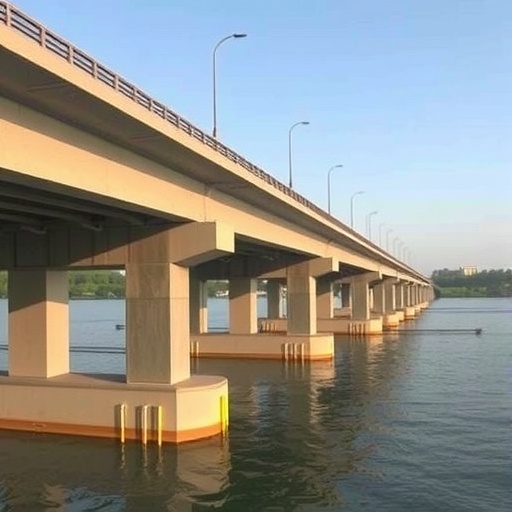
In the realm of civil engineering, the seismic resilience of structures has taken center stage, particularly as urban populations grow and the frequency of seismic events rises globally. Recent advancements in this field have led to the exploration of innovative methodologies and materials that enhance the durability and safety of infrastructures during earthquakes. A groundbreaking study led by Zhang, Wu, and Qian focuses on an unprecedented approach to bridge design that promises to revolutionize how engineers conceptualize and implement seismic-resistant structures.
The team’s research centers on prefabricated, assembled, and self-centering bridge piers. These piers are engineered to mitigate damage during seismic events while ensuring that the bridges themselves remain intact and functional. Traditional bridge design often leaves structures susceptible to significant damage or even collapse when faced with the forces of an earthquake. Conversely, the new design paradigm aims to provide a safety net against such catastrophic failures through innovative engineering solutions.
A key highlight of this research is the introduction of a damage transfer configuration within the bridge piers. Damage transfer is a strategic design method that allows for the controlled dissipation of seismic energy across the structure. By carefully distributing the forces exerted during an earthquake, these piers can prevent localized damage, which is often the precursor to failure in more conventional designs. This not only protects the bridge but also minimizes repair costs and downtime, making infrastructure more reliable and resilient.
Moreover, the self-centering feature of these bridge piers is significant. Traditional piers often experience permanent deformation post-event, necessitating extensive repairs. In contrast, the self-centering mechanism effectively restores the structure to its original position after the seismic forces subside. This capability is achieved through the integration of advanced materials and design techniques that enable the pier components to flexibly absorb and rebound from stress, akin to a spring. This functionality dramatically reduces the likelihood of severe structural damage and enhances the longevity of the infrastructure.
In addition to design innovations, the research incorporated rigorous testing methodologies to ascertain the efficacy of the prefabricated, self-centering bridge piers. The experimental setups included both static and dynamic testing, simulating various seismic conditions to evaluate how these piers behave under stress. The results were promising, revealing that the new piers outperformed conventional designs in key metrics of stability and resilience. Such findings underscore the necessity of adopting forward-thinking design philosophies in modern engineering practices.
One of the study’s co-authors emphasized the crucial role that collaboration among civil engineers, material scientists, and urban planners must play in advancing these designs from theory to practical application. Specific focus on how these new piers integrate with existing infrastructure is vital for engineering teams aiming to enhance urban resilience comprehensively. A holistic approach that considers not only the structural integrity of individual bridges but also their interaction with surrounding infrastructure is essential for sustained community safety.
The implications of this research extend beyond mere engineering improvements; they touch upon urban planning and policy. With the looming threat of climate change and the increasing unpredictability of natural disasters, cities must adapt their infrastructure development strategies. By adopting self-centering and prefabricated technologies, municipalities can significantly enhance their resilience against emergencies, ultimately safeguarding citizens and reducing economic losses.
Importantly, this innovative bridge design is aligned with global sustainability goals. The incorporation of prefabricated components can lead to reduced construction waste and shorter building timelines, supporting both environmental and economic objectives. Fast-tracked construction means fewer resources consumed and a quicker return to normalcy in the wake of disaster. For local governments looking to bolster their climate resilience efforts, these findings present a viable path forward.
As cities increasingly embrace smart technologies and data analytics, the adaptability of these new bridge designs can dovetail with digital infrastructure. Incorporating sensors and real-time data collection into the self-centering piers could provide continuous monitoring during seismic events. Such integration would empower engineers and city planners to make informed decisions regarding emergency responses and maintenance protocols.
On the research front, the study opens numerous avenues for exploration. Future investigations may delve deeper into optimizing materials for even lighter and more resilient designs or adapting the core principles of the self-centering concept for other types of infrastructures, such as buildings and retaining walls. As researchers build on this foundation, the potential for transformative breakthroughs in earthquake engineering appears limitless.
The results of this research are set to be published in a forthcoming issue of the journal “Earthquake Engineering and Engineering Vibration.” The team anticipates that their findings will not only contribute to scholarly discourse but also inform policy and best practices in civil engineering, particularly within earthquake-prone regions across the globe. While the study itself is a monumental step forward, the broader conversation about building resilient urban environments is just warming up.
In conclusion, the pioneering work of Zhang, Wu, Qian, and their colleagues represents a significant leap toward ensuring that infrastructure can withstand the rigors of natural disasters. Given the increasing unpredictability of seismic activity worldwide, the urgency of implementing more resilient designs cannot be overstated. The self-centering, prefabricated bridge piers explored in this research showcase how innovation in engineering can effectively address the challenges posed by environmental change and urbanization. The future of bridge design is here, and it holds the promise of saving lives and resources in the face of adversity.
Through collaborations, continued research, and adaptation of innovative technologies, the civil engineering community shows great potential in reshaping the infrastructure landscape. The journey towards resilient urban environments has just begun, and studies like this one are crucial milestones along the way. As advancements continue to emerge, it is imperative that the lessons learned from research translate into practical applications to build a safer, more resilient future for all.
Subject of Research: Seismic behavior of prefabricated, assembled, self-centering bridge piers with a damage transfer configuration.
Article Title: Seismic behavior of prefabricated, assembled, self-centering bridge piers with a damage transfer configuration.
Article References: Zhang, J., Wu, J., Qian, Y. et al. Seismic behavior of prefabricated, assembled, self-centering bridge piers with a damage transfer configuration. Earthq. Eng. Eng. Vib. 24, 861–874 (2025). https://doi.org/10.1007/s11803-025-2341-5
Image Credits: AI Generated
DOI: July 2025
Keywords: seismic resilience, bridge design, prefabricated structures, self-centering technology, damage transfer, civil engineering


