

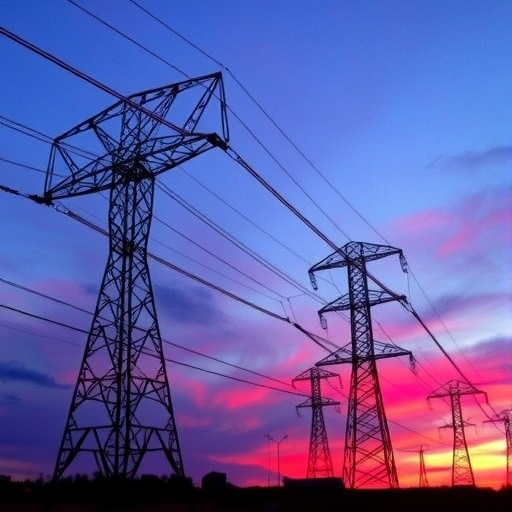
In groundbreaking research conducted by a team led by L. Tian, significant advancements have been made in understanding the seismic response of transmission tower-line systems. This study, published in the esteemed journal “Earthquake Engineering and Engineering Vibration,” reveals findings from extensive shake table tests and numerical investigations. The implications of this work extend far beyond academic theory; they resonate with practical applications that could enhance infrastructure resilience against catastrophic seismic events.
Seismic events pose a serious risk to transmission networks, which are vital for energy distribution across vast regions. A common type of fault movement, known as strike-slip fault rupture, presents unique challenges in how structures react to horizontal displacements. The team’s research aimed to systematically investigate these challenges, focusing on the interaction between transmission towers and their supporting lines during such movements. This research is timely, given the increasing frequency of earthquakes globally, exacerbated by factors such as climate change and urbanization.
The researchers utilized advanced shake table testing to simulate real-world seismic conditions. This methodology allowed them to gradually increase the intensity and complexity of simulated earthquakes, capturing the dynamic responses of both towers and lines as they attempted to withstand these forces. This innovative approach marks a significant departure from earlier studies that often relied solely on theoretical models without validating them through physical testing.
In addition to the physical experiments, the team also developed sophisticated numerical models to further analyze the behavior of transmission systems under seismic stress. These models incorporated various parameters, such as tower height, material strength, and fault displacement characteristics, providing a comprehensive understanding of the seismic response mechanisms. The integration of experimental data with numerical analysis not only improved accuracy but also allowed for the exploration of scenarios that would be impractical or impossible to recreate physically.
One of the key findings of their research points to the role of horizontal displacements in the failure of transmission systems. The analysis demonstrated that even moderate levels of strike-slip displacement could lead to significant structural failure. This insight is critical, as it challenges the prevailing assumption that only vertical displacements are of primary concern during seismic events. Such revelations could lead to a fundamental shift in how engineers design and retrofit transmission networks.
This work also emphasizes the importance of real-time monitoring and assessment of infrastructure. The researchers propose that integrating advanced sensor technology into transmission systems can provide valuable data during seismic events, enabling quick assessments of potential damage. This proactive approach to infrastructure management could mitigate risks and facilitate more timely responses by utility companies and emergency services.
Moreover, the findings highlight the necessity for revised engineering standards and regulatory frameworks that specifically address the unique challenges posed by strike-slip fault movements. Current design paradigms may not adequately account for these lateral forces, which could inadvertently compromise the integrity of critical energy infrastructure during seismic events. The research team advocates for a collaborative effort between engineers, policymakers, and university researchers to develop guidelines that reflect these new insights.
Further extending the implications of their study, Tian and colleagues discuss how their findings could influence urban planning and disaster preparedness strategies. As cities grow and energy demands increase, ensuring that transmission systems are resilient to seismic disruptions becomes paramount. By advocating for a holistic approach that includes infrastructure upgrades, emergency preparedness drills, and community awareness campaigns, the researchers aim to foster safer urban environments.
The economic implications of improving infrastructure resilience cannot be overstated. The costs associated with repair and recovery after seismic incidents can be staggering, impacting not only utility providers but also local economies and communities. By investing in research-backed engineering solutions, governments and utility companies can save themselves significant costs down the line, all while ensuring the safety and reliability of energy supply.
In addition to its structural implications, this research also serves as a clarion call for interdisciplinary collaboration across the fields of engineering, geology, and urban planning. Understanding the complex interactions among these disciplines can lead to more sustainable and resilient practices. Engaging a broad range of stakeholders, including community members whose lives are directly affected by infrastructure decisions, will be crucial in implementing the necessary changes on the ground.
As Japan, California, and other earthquake-prone regions continually face the threat of seismic events, this research highlights the urgent need for innovation and adaptability in engineering practices. The lessons learned from these shake table tests and numerical investigations carry the potential to not only protect infrastructure but also save lives during an earthquake. This convergence of knowledge and technology provides a light at the end of the tunnel for communities grappling with the unrelenting reality of seismic hazards.
As the findings from this research continue to ripple through the academic community and beyond, the hope is that they will inspire further studies into the effects of earthquakes on various types of infrastructure. The emphasis on practical, test-based research provides a model that can be emulated in other areas facing similar challenges. Ultimately, the work by Tian and his colleagues exemplifies the role of scientific research in shaping a safer, more prepared world by addressing pressing global challenges head-on.
The study’s impact is already evident as discussions begin within engineering circles about modifying design standards. Utility companies are now more inclined to reassess their infrastructure and invest in innovative technologies and designs driven by this robust body of research. This intentional shift towards resiliency-focused engineering could pave the way for the next generation of transmission systems that withstand the tests of nature.
In conclusion, the ongoing advancements in understanding seismic responses within the context of transmission systems provide not only a scientific breakthrough but also a vital resource for practical engineering applications worldwide. The fusion of empirical testing and numerical modeling in this study could serve as a template for future research aimed at mitigating disaster risk and enhancing infrastructure longevity. As communities brace for the unpredictable forces of nature, this research shines as a beacon of hope, showcasing the critical importance of sound engineering, preparedness, and resilience in our ever-evolving world.
Subject of Research: Seismic response of transmission tower-line systems under strike-slip fault rupture.
Article Title: Shake table tests and numerical investigations on the seismic response of transmission tower-line systems under strike-slip fault rupture.
Article References:
Tian, L., Yang, M., Liu, J. et al. Shake table tests and numerical investigations on the seismic response of transmission tower-line systems under strike-slip fault rupture.
Earthq. Eng. Eng. Vib. 24, 1049–1066 (2025). https://doi.org/10.1007/s11803-025-2350-4
Image Credits: AI Generated
DOI:
Keywords: Seismic response, transmission towers, strike-slip fault, infrastructure resilience, shake table testing.


