

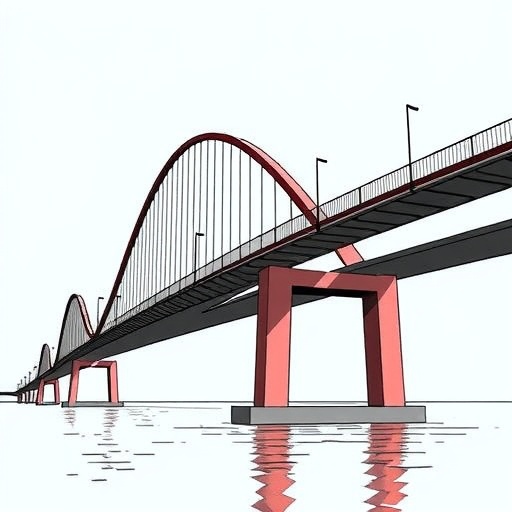
In the forthcoming issue of Earthquake Engineering and Engineering Vibrations, researchers M. Rashid and M. Nishio unveil groundbreaking insights into the seismic fragility surfaces of curved bridges. This study is essential as curved bridges comprise a significant portion of contemporary infrastructure, yet they pose unique challenges when it comes to seismic performance. Earthquakes represent a catastrophic risk to such structures, raising the need for more refined measures to evaluate their vulnerability and implement effective engineering solutions.
Understanding how seismic forces act on curved bridges is crucial in developing effective design strategies. Earthquakes generate complex ground motions that can impact structures in varied ways, depending on the shape and orientation of the bridge. This complexity can lead to varying responses based on the bridge’s alignment relative to the incoming seismic waves. The research highlights the importance of recognizing these nuances, as they directly influence the fragility of these structures during seismic events.
The innovative aspect of Rashid and Nishio’s research lies in their development of optimal intensity measure-based seismic fragility surfaces. Traditional methods often assess fragility using generic parameters that do not fully capture the dynamic interactions of curved bridges during an earthquake. By focusing on intensity measures tailored to specific seismic excitation directions, their model paints a more precise picture of potential vulnerabilities, significantly enhancing our ability to forecast failure points during seismic incidents.
One of the key contributions of this research is its emphasis on understanding how sensitivity to excitation direction can affect the fragility of curved bridges. The study meticulously evaluates various seismic intensity measures, comparing their efficacy in predicting bridge response. By applying advanced statistical techniques, the researchers determined which parameters yielded the most accurate fragility surfaces. This process involved extensive data analysis, replicating different seismic scenarios and assessing how each affected the structural integrity of the bridge.
In practice, the findings suggest that engineers should adopt a more tailored approach when designing and assessing curved bridges in seismically active regions. Implementing performance-based design methodologies that incorporate the directional sensitivity of seismic loads can lead to more resilient structures. This approach not only enhances safety but also aligns with the evolving standards of earthquake-resilient engineering practices.
Moreover, the model developed by Rashid and Nishio provides a framework for retrofitting existing bridges to withstand seismic forces more effectively. Structures that may have been initially designed without considering these complexities can be evaluated against the new fragility surfaces, offering insights into necessary reinforcements or design alterations. This is particularly pertinent in urban settings where aging infrastructure needs urgent attention to mitigate potential disaster risks.
The implications of their research extend beyond theoretical models and into real-world applications. By improving the way engineers assess seismic fragility, communities can implement more strategic investments in infrastructure resilience. This research not only influences engineering practices but also serves as a call to action for policymakers to ensure that modern structures meet the challenges posed by increasingly frequent seismic events.
Furthermore, the inter-disciplinary nature of this study opens avenues for collaboration between civil engineering, urban planning, and disaster management fields. A multi-faceted approach is crucial for building infrastructure that is not only strong and stable but also capable of withstanding the unpredictable nature of earthquakes. Coordinated efforts can result in an integrative framework of resilience, ultimately leading to safer public spaces.
As cities continue to expand and populations increase, the pressures on existing infrastructure will only intensify. Predicting how such structures will react under stress conditions becomes paramount, and this research is a step in the right direction. Deepening our understanding of the interplay between bridge design, seismic forces, and environmental factors is vital for future projects aimed at safeguarding communities against natural disasters.
Education is another key outcome of Rashid and Nishio’s work. By disseminating their findings within academic circles and professional forums, they aim to raise awareness among engineers about the critical factors influencing seismic fragility. This shared knowledge will empower engineers to adopt better practices and innovations in the design and retrofitting of curved bridges across the globe.
In summarizing their findings, Rashid and Nishio argue that the persistence of traditional engineering practices without incorporating these new insights could lead to catastrophic failures in the face of seismic events. The urgency of reevaluating seismic design protocols is crucial for regions that face heightened earthquake risks. This research represents a clarion call for the engineering community to evolve, and for new methodologies to come to the forefront of design strategies.
As the conversation around infrastructural resilience continues to grow, this study ignites necessary examination into how we construct and maintain our bridges. Developing an even more nuanced understanding of seismic forces will ultimately influence not just today’s infrastructure but set the stage for tomorrow’s standards in engineering. Ultimately, as the field of seismic engineering progresses, bridging the gap between theory and its practical applications will be essential for developing safe, resilient, and sustainable infrastructure.
The research embodies a commitment to prioritizing public safety through improved engineering practices. As communities adapt and evolve in the face of climate change and natural disasters, integrating advanced scientific research into everyday practices will be paramount. Continued exploration and innovation in this field are crucial, ensuring that as we build for the future, we are not building merely for today’s needs, but for generations to come.
Subject of Research: Seismic fragility of curved bridges.
Article Title: Optimal intensity measure-based seismic fragility surfaces for curved bridges considering their sensitivity to seismic excitation direction.
Article References: Rashid, M., Nishio, M. Optimal intensity measure-based seismic fragility surfaces for curved bridges considering their sensitivity to seismic excitation direction. Earthq. Eng. Eng. Vib. 24, 509–526 (2025). https://doi.org/10.1007/s11803-025-2310-z
Image Credits: AI Generated
DOI: April 2025
Keywords: Seismic fragility, curved bridges, intensity measure, seismic vulnerability, engineering practice.


