

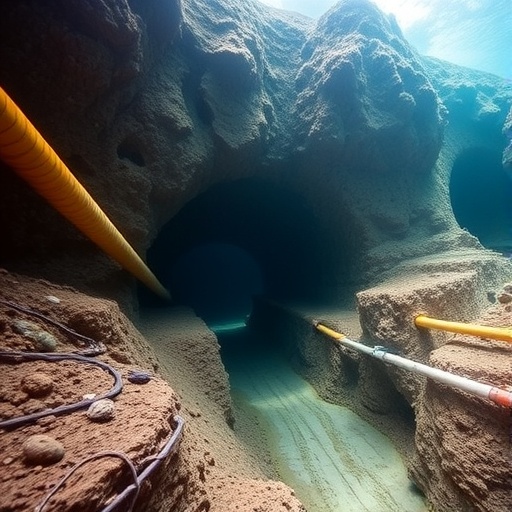
In an ambitious leap toward securing subsea tunnel infrastructures, researchers have unveiled groundbreaking experimental insights into the interplay between groundwater chemistry and flow velocities—key determinants in the effective sealing of these critical underwater passageways. This pioneering study addresses a challenge that has long confronted engineers and geoscientists alike: how to mitigate water ingress and ensure the structural longevity of tunnels running beneath ocean floors or other large water bodies.
Subsea tunnels represent engineering marvels, facilitating transport and utility connections where bridges are impractical or impossible. Their subaqueous placement, however, exposes them to relentless hydrogeological pressures that threaten their integrity through seepage and erosion. Central to preventing such damage is the ability to seal tunnel linings effectively, a task that hinges on a profound understanding of the physical and chemical dynamics of surrounding groundwater.
The research deployed a series of meticulously designed laboratory experiments simulating the subsurface environments in which these tunnels dwell. By manipulating variables such as groundwater ionic composition and flow velocity within scaled physical models, the scientists were able to replicate the complex conditions found in real-world scenarios. This approach facilitated a clearer observation of how different chemical constituents affect the sealing materials’ performance and how flow rates influence the transport and deposition of sealing agents.
One remarkable revelation from this study is the nuanced role groundwater chemistry plays in the sealing process. Variations in concentrations of key ions, including calcium, magnesium, and sulfate, markedly influence the precipitation of sealing compounds. The researchers demonstrated that certain ionic milieus accelerate the curing and hardening of sealants, while others retard them, potentially compromising the seal’s reliability over time. This chemical sensitivity underscores the critical need for site-specific analyses during subsea tunnel design.
Flow velocity emerged as another vital parameter with profound implications for sealing efficacy. The experiments revealed that higher flow rates can disrupt the formation of compact, impermeable layers by washing away reactive sealing components before they can solidify. Conversely, slower flow velocities favored more consistent deposition and curing of sealing materials, thereby enhancing tunnel waterproofing. These findings suggest that engineering solutions must delicately balance flow conditions to optimize seal formation.
Moreover, the study advances the understanding that the interdependence of chemical makeup and hydraulic dynamics is not straightforward. Instead, it reveals a complex feedback loop where flow velocities influence ion transport and reactions, which in turn modify the flow patterns through localized clogging or permeability changes. This intricacy challenges the conventional one-factor-at-a-time design philosophy prevalent in current tunnel engineering.
A pivotal aspect of this research lies in its experimental methodology. The team employed advanced fluid dynamics measurement techniques, including tracer tests and real-time chemical analysis, to capture transient behaviors that have eluded observation in past studies. These approaches facilitated a dynamic view of groundwater-tunnel interactions, highlighting temporal variations that can precipitate sudden seal failures.
Crucially, the researchers also translated their findings into practical engineering recommendations. One of the key suggestions includes tailoring the chemical composition of injection grouts or sealants to match the expected groundwater chemistry, thereby exploiting favorable ion interactions to enhance sealing robustness. Additionally, they propose controlling borehole pumping rates during construction to maintain optimal velocities that encourage stable seal formation.
This investigation further posits that monitoring technologies capable of detecting shifts in groundwater chemistry and flow before and after tunnel construction are imperative. Integrating such real-time surveillance could act as an early warning system, facilitating preemptive maintenance and minimizing the risk of catastrophic water ingress.
Beyond immediate engineering frameworks, the study’s implications extend to environmental stewardship. Subsea tunnels interact with delicate marine and groundwater ecosystems; understanding chemical and flow dynamics aids in mitigating unintended ecological impacts by informing design choices that preserve natural water chemistry balance.
From a broader perspective, the findings contribute to the growing body of literature emphasizing interdisciplinary collaboration in subterranean infrastructure projects. Drawing upon hydrogeology, chemistry, fluid mechanics, and materials science creates a holistic outlook, essential for devising solutions to the multifaceted problems presented by underwater construction.
This research represents a significant stride toward mastering the environmental challenges posed by subsea tunnels. As urbanization and economic imperatives drive the expansion of underwater transit networks worldwide, insights like these are invaluable in ensuring the durability, safety, and environmental compatibility of such ventures.
Looking ahead, the team advocates for further studies incorporating in-situ experiments within operational subsea tunnels to validate and refine their laboratory results. They also highlight the potential benefits of integrating machine learning algorithms to predict site-specific sealing performance, enhancing decision-making under complex, variable real-world conditions.
Ultimately, this work not only elevates the scientific discourse surrounding subsea tunnel construction but also stands to influence design standards and construction protocols across the globe. It exemplifies how targeted experimental research can translate into actionable strategies that safeguard critical infrastructure beneath our seas.
As infrastructure development continues to push boundaries beneath aquatic surfaces, understanding the chemistry and physics of groundwater interactions with engineered sealing systems will be paramount. This study charts a promising path forward, balancing scientific rigor with practical applicability to confront one of subsea engineering’s most persistent challenges.
Subject of Research: Groundwater chemistry and flow velocities related to subsea tunnel sealing engineering applications
Article Title: Sealing of subsea tunnels: experimental investigation of groundwater chemistry and flow velocities for engineering applications
Article References: Zhou, B., Xue, Y., Gong, H. et al. Sealing of subsea tunnels: experimental investigation of groundwater chemistry and flow velocities for engineering applications. Environ Earth Sci 85, 66 (2026). https://doi.org/10.1007/s12665-025-12795-z
Image Credits: AI Generated
DOI: https://doi.org/10.1007/s12665-025-12795-z


