

The important role of the Southern Ocean in global biological processes and the carbon cycle has been confirmed anew by a study published in Science this week that, for the first time based on field evidence, reveals the underappreciated role of inorganic Zinc particles in these cycles.

Credit: Wiida Fourie-Basson
The important role of the Southern Ocean in global biological processes and the carbon cycle has been confirmed anew by a study published in Science this week that, for the first time based on field evidence, reveals the underappreciated role of inorganic Zinc particles in these cycles.
The Southern Ocean plays the greatest role in global phytoplankton productivity, which is responsible for absorbing atmospheric carbon dioxide. In these processes, Zinc, present in trace quantities in seawater, is an essential micronutrient critical to many biochemical processes in marine organisms and particularly for polar phytoplankton blooms.
When phytoplankton blooms perish, Zinc is released. But to date scientists were puzzled as there was an observed disjunct between Zinc and Phosphorus, another nutrient essential for life in the oceans, even though both nutrients are co-located in similar regions in phytoplankton. Instead, a strong (but inexplicable) coupling between Zinc and dissolved Silica is often seen.
Prof. Alakendra Roychoudhury, a specialist in environmental and marine biogeochemistry at Stellenbosch University (SU) and a co-author on the article, says they can now, for the first time, explain with confidence the biogeochemical processes driving the oceans’ Zinc cycle.
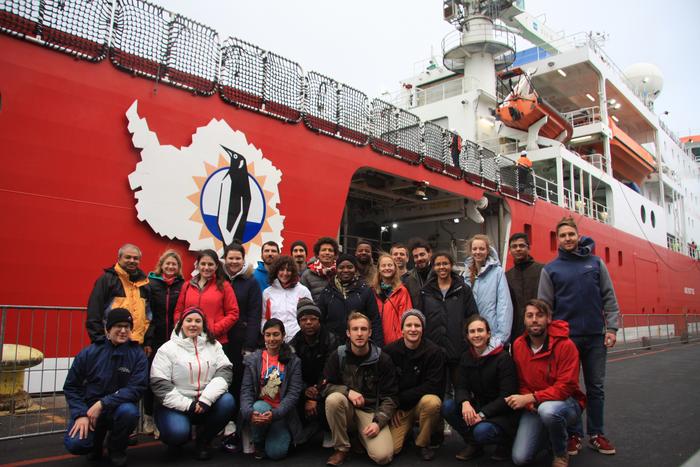
Since 2013, Roychoudhury’s research group in SU’s Department of Earth Sciences have joined three expeditions of South Africa’s polar research vessel, the SA Agulhas II. Crossing the vast Southern Ocean on its way to Antarctica in both summer and winter, the team collected sea water samples from the surface and deep ocean, as well as sediments.
Dr Ryan Cloete, co-first author on the paper and currently a postdoctoral fellow at the Laboratory of Environmental Marine Sciences (LEMAR) in France, participated in two of these expeditions: “Studying the Southern Ocean is so important as it acts as a central hub for global ocean circulation. Processes occurring in the Southern Ocean are imprinted on water masses which are then transported to the Atlantic, Indian and Pacific Oceans,” he explains.
Working with researchers from Princeton University, the Universities of Chicago and California Santa Cruz, as well as the Max Planck Institute for Chemistry, the samples were subjected to detailed particle by particle analysis, using X-ray spectroscopic techniques at a synchrotron facility, which allowed them to study the samples at atomic and molecular level.
Unravelling the drivers of the global Zinc cycle in our oceans
In summer it seems that higher productivity leads to a greater abundance of Zinc in the organic fraction of the surface ocean, which can readily become available for uptake by phytoplankton. But the researchers also found high concentrations of Zinc associated with debris derived from rocks and earth, and from atmospheric dust, present in these samples.
In the open ocean, the interplay between Zinc’s association or dissociation from particles is pivotal for replenishing dissolved Zinc to support marine life.
Cloete explains their findings: “Due to poor growing conditions in winter, Zinc particles are literally ’scavenged’ by inorganic solids such as silica, abundantly available in the form of diatoms, as well as iron and aluminum oxides. Diatoms are microalgae – unicellular organisms with skeleton made of silica – thereby explaining the strong association between Zinc and Silica in the oceans.”
In other words, when Zinc is bound to an organic ligand it is easy for uptake by marine life such as phytoplankton. Zinc in a mineral phase, however, is not easy to dissolve and will therefore not be easily available for uptake. In this form, particulate Zinc can form large aggregates and sink to the deep ocean, where it becomes unavailable for uptake by phytoplankton.
Implications for changing climate
This understanding of the global Zinc cycle has important implications in the context of warming oceans, warns Roychoudhury: “A warmer climate increases erosion, leading to more dust in the atmosphere and consequently more dust being deposited into the oceans. More dust means more scavenging of Zinc particles, leading to less Zinc being available to sustain phytoplankton and other marine life.”
Cloete says their novel approach to studying the oceanic Zinc cycle now opens the door to investigating other important micronutrients: “Like Zinc, the distribution of Copper, Cadmiun, and Cobalt could also experience climate-induced changes in the future.”
For Roychoudhury, the findings reaffirm the Southern Ocean’s global influence in regulating the climate and the marine food web: “The earth system is intricately coupled through physical, chemical and biological processes with self-correcting feedback loops to modulate variability and negate climate change. Our findings are a prime example of this coupling where biochemical processes happening at the molecular level can influence global processes like the warming of our planet.”
Journal
Science
Method of Research
Data/statistical analysis
Subject of Research
Not applicable
Article Title
Biogenic-to-lithogenic handoff of particulate Zn Impacts the Zn-cycle in the Southern Ocean
Article Publication Date
14-Jun-2024
COI Statement
The authors declare that they have no competing interests.

