

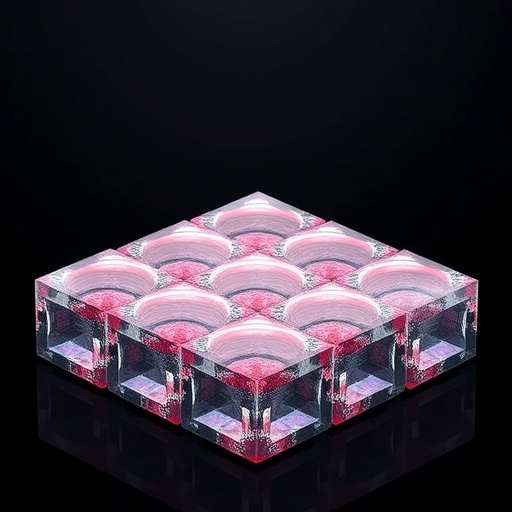
In a groundbreaking development that pushes the boundaries of quantum physics and materials science, researchers from the University of Würzburg’s Cluster of Excellence ctd.qmat have successfully demonstrated the Kardar-Parisi-Zhang (KPZ) universality class in a two-dimensional quantum system. This remarkable achievement marks the first experimental validation of the KPZ framework—a cornerstone equation in non-equilibrium statistical physics and growth phenomena—beyond one-dimensional systems, heralding a new era of understanding for dynamic processes that govern a wide variety of physical, biological, and even computational systems.
The KPZ equation, introduced in 1986 by physicists Mehran Kardar, Giorgio Parisi, and Yi-Cheng Zhang, provides a universal description of surface growth phenomena by capturing the intrinsic randomness and nonlinearity inherent in such systems. Its applicability spans from crystal growth and flame propagation to population dynamics and the optimization algorithms driving machine learning. However, experimental confirmation of KPZ universality in two dimensions has long been elusive, primarily due to the formidable challenges of observing and measuring complex, rapidly evolving processes simultaneously in space and time.
The researchers overcame these challenges by engineering a tailor-made gallium arsenide (GaAs) semiconductor device, intricately layered with mirror structures to confine and manipulate polaritons—a peculiar quantum hybrid of photons and excitons. When cooled to near absolute zero temperatures of around −269.15°C and excited with a finely tuned laser pulse, this system produces polaritons which exist fleetingly, decaying within a few picoseconds but exhibiting dynamic growth and interactions that mirror the KPZ framework’s predictions.
By utilizing advanced molecular beam epitaxy, the team achieved atomic-level precision in fabricating their semiconductor sample, controlling the thickness and optical properties of multiple layers to form an ultra-high finesse microcavity. This allowed photons to be trapped and strongly coupled with excitons in the quantum film layer, creating polaritons that exhibit nonequilibrium growth dynamics. Crucially, the researchers developed a method to spatially and temporally map the polariton distributions, generating a high-resolution profile of their evolution over both space and time, thus enabling a direct comparison with the KPZ universality scaling laws.
Siddhartha Dam, a postdoctoral scientist involved in the project, emphasized the experiment’s technical sophistication: “Our ability to track polaritons’ positions with micrometer and picosecond resolution represents an enormous leap forward. Capturing the complex interplay of stochastic growth in two dimensions was previously thought nearly impossible due to the ultrafast nature and microscopic scale of these processes. Our work validates the KPZ equation as a fundamental description of real quantum matter out of equilibrium.”
The theoretical framework underpinning this experiment was proposed by Professor Sebastian Diehl from the University of Cologne, who conceptualized the use of driven polariton quantum fluids as a fertile ground to explore KPZ physics. The 2015 theoretical insights predicted that KPZ scaling could manifest in such nonequilibrium quantum systems, but experimental proof remained out of reach until advances in materials growth and ultrafast optical measurements made the present study possible.
This new experimental realization not only confirms the universality of KPZ scaling in two dimensions but also establishes a platform for exploring a myriad of nonequilibrium quantum phenomena critical for future quantum technologies. Understanding how quantum matter behaves far from thermal equilibrium is fundamental to the development of quantum devices, including sensors, simulators, and potentially quantum computers.
The technical feat hinges on the creation of a polariton condensate confined between carefully engineered mirrors, which reflect light back and forth within the GaAs layer to increase interaction time and enhance measurement sensitivity. The polaritons created are neither purely light nor matter but exhibit hybrid characteristics enabling unique growth dynamics ideal for probing KPZ universality. The researchers could measure how the ‘surface’ formed by the polariton population evolves, from initial fluctuations to the complex spatial correlations that reveal underlying scaling laws.
This breakthrough builds on earlier experimental verifications of the KPZ universality class in one-dimensional settings performed in Paris in 2022. Extending these findings to two spatial dimensions is a monumental step because many real-world growth processes occur in 2D or 3D environments rather than idealized 1D substrates. Demonstrating KPZ scaling for systems with two-dimensional spatial variability charts new territory for non-equilibrium physics.
The implications are profound: by verifying KPZ universality in 2D quantum systems, the work provides physicists and material scientists a vital touchstone for interpreting the behavior of complex, noisy systems. Such insights cut across disciplines, influencing models of epidemic spread, forest fire growth, bacterial colony expansion, and convergence behavior in computational algorithms. KPZ universality effectively serves as a unifying thread tying together diverse phenomena driven by growth and fluctuations.
Researchers employed a suite of cutting-edge measurement techniques, including time-resolved photoluminescence imaging and precise spatial correlation analysis of emitted light as polaritons radiate out of the cavity. These methods revealed the characteristic scaling exponents and height fluctuations predicted by the KPZ equation, providing empirical confirmation that goes far beyond theoretical or numerical models. The towering “spatial correlations” shown in the visualization capture not just static snapshots but the evolving dynamic growth landscape.
Looking forward, the Cluster of Excellence ctd.qmat aims to leverage these findings to probe deeper into quantum matter’s topological and dynamical properties under non-equilibrium conditions. This progress lays the foundational groundwork for the exploration of rich quantum phase transitions and the engineering of novel quantum materials with bespoke properties tuned for next-generation technologies.
In sum, this experimental milestone in demonstrating KPZ universal scaling in two-dimensional systems reconciles decades of theoretical prediction with laboratory reality, opening a window into the unpredictable and fascinating behavior of growing quantum systems. It confirms that the KPZ universality is not merely a mathematical curiosity but a tangible principle governing the evolution of complex natural and artificial worlds alike.
Subject of Research: Not applicable
Article Title: Observation of Kardar-Parisi-Zhang universal scaling in two dimensions
News Publication Date: 9-Apr-2026
Web References: http://dx.doi.org/10.1126/science.aeb4154
Image Credits: © think-design | Jochen Thamm
Keywords: KPZ universality, polaritons, quantum matter, non-equilibrium systems, gallium arsenide, molecular beam epitaxy, two-dimensional scaling, quantum dynamics, surface growth, ultrafast optics, semiconductor microcavity, quantum materials


