

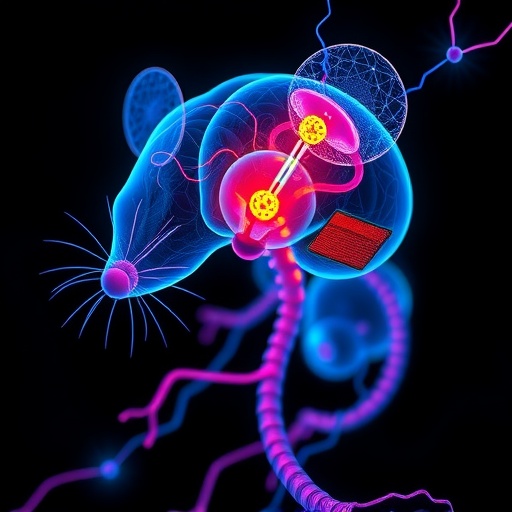
In the vast and intricate communication network of the brain, information transmission is typically conceived as rapid electrical impulses coursing through neuronal pathways. However, this conventional view only scratches the surface of the brain’s signaling complexity. Beyond these instantaneous electrical signals exists a secondary, slower communication mode involving chemical messengers. Among these, neuropeptides stand out for their ability to modulate neural circuits over extended periods, influencing behaviors and emotional states subtly yet profoundly. A groundbreaking study led by researchers at the Institute for Neurosciences (IN), a collaborative entity of the Spanish National Research Council (CSIC) and Miguel Hernández University of Elche (UMH), has uncovered a previously elusive molecular mechanism controlling the release of oxytocin in the brain, a discovery that deepens our understanding of social behavior regulation.
Oxytocin, often heralded as the “love hormone,” is intricately involved in social bonding, emotional regulation, and affiliative behaviors across mammalian species. Contrary to classical neurotransmitters such as glutamate and GABA, which are released promptly at synaptic junctions, oxytocin is categorized as a neuropeptide, capable of release from neuronal compartments like the soma and dendrites—regions traditionally not associated with neurotransmitter secretion. This unconventional release mode facilitates a more diffuse and sustained hormonal influence across broad brain areas, but until now, the molecular machinery orchestrating this process remained a mystery.
Dr. Sandra Jurado, leading the Synaptic Neuromodulation Laboratory at IN CSIC-UMH, highlights the novelty of this finding: “While we understood that oxytocin is released from compartments other than axonal terminals, the regulatory mechanisms behind this somatic and dendritic release were obscure. Our research zeroed in on this slow, sustained secretion process that appears critical in setting the brain’s social tone.” This slower release pathway likely primes neural networks, modulating social responsiveness rather than triggering immediate behavioral responses.
Central to this discovery is the protein SNAP-47, a member of the SNARE (Soluble N-ethylmaleimide-sensitive factor Attachment Protein Receptor) family. SNARE proteins are renowned for their role in mediating the fusion of vesicles with cellular membranes, a fundamental step in neurotransmitter release. However, unlike other SNAREs such as SNAP-25 and SNAP-23 which facilitate rapid, efficient synaptic transmission, SNAP-47 operates on a markedly slower timescale. Beatriz Aznar, the study’s first author, explains, “This slower action aligns perfectly with oxytocin’s mode of brain release—non-pulsatile and sustained over time, which supports a basal neuromodulatory state rather than immediate synaptic signaling.”
The hypothalamus, a vital brain region orchestrating neuroendocrine functions, synthesizes oxytocin. From here, oxytocin exerts dual functions: it is transported along axons to the posterior pituitary, releasing into the bloodstream to influence peripheral physiology, and it is also released locally within the brain via somatodendritic mechanisms. The study reveals that SNAP-47 selectively modulates this local, unconventional release without disrupting axonal oxytocin release into circulation, emphasizing a division of labor in oxytocin signaling pathways.
To elucidate the role of SNAP-47, the research team employed a multifaceted experimental approach, combining cultured neuronal models with advanced genetic manipulation techniques in mice. They specifically downregulated SNAP-47 expression in oxytocinergic neurons and monitored the resulting effects on vesicle trafficking and hormone release. These interventions demonstrated a significant impairment in somatodendritic oxytocin release, establishing causality.
The behavioral outcomes associated with SNAP-47 disruption were subtle yet telling. Mice with diminished SNAP-47 in oxytocin neurons still exhibited sociability but showed less prolonged and robust social interactions. This nuanced behavioral modulation underscores the concept that somatodendritic oxytocin release functions not as an on-off switch for social behaviors but rather as a modulating background tone that influences the quality and dynamics of social engagement.
Dr. Jurado emphasizes the implications of these findings: “Our data suggest that this somatodendritic release pathway does not drive overt social behavior independently but fine-tunes neural circuit readiness, thereby influencing social motivation and anxiety. This basal oxytocin tone could be critical in setting thresholds for social responsiveness.” Such a mechanism may contribute to individual variability in social behavior and the vulnerability to disorders marked by social deficits.
On a molecular level, SNAP-47’s unique properties shed light on the specialized vesicular machinery operating within neuronal somata and dendrites. Traditional fast synaptic transmission relies on SNARE complexes optimized for speed and precision. In contrast, SNAP-47’s slower kinetics suggest a mechanism adapted for prolonged hormonal release, capable of delivering neuromodulatory substances like oxytocin over extended time frames, influencing neuronal networks more diffusely rather than discrete synapses.
This discovery opens new research avenues exploring the molecular landscape surrounding SNAP-47. Understanding the complementary proteins and signaling cascades interacting with SNAP-47 will be vital in constructing a comprehensive model of somatodendritic neuropeptide release. Moreover, deciphering how this system integrates with classical neurotransmission remains a frontier for future exploration.
Importantly, these findings bear relevance beyond basic neuroscience. Oxytocin’s role in neuropsychiatric conditions such as autism spectrum disorder, social anxiety, and schizophrenia is a subject of considerable interest. The delineation of discrete release pathways introduces potential therapeutic targets aimed not merely at increasing oxytocin levels but at modulating its spatial and temporal release patterns in the brain, refining treatment strategies.
Funding bodies including the Spanish State Research Agency, Generalitat Valenciana’s Prometeo Programme, and the Severo Ochoa Programme for Centres of Excellence supported this innovative research. Their investment underscores the critical importance of fundamental neuroscience in unveiling mechanisms with translational potential.
As Dr. Jurado reflects, “Unraveling the molecular underpinnings of neuropeptide release enriches our grasp of brain function and social behavior. SNAP-47’s identification as a pivotal player redefines our understanding of oxytocin’s neuromodulatory roles and sets the stage for future breakthroughs in therapeutic interventions targeting social brain circuits.”
This transformative research, published in Communications Biology, signifies a paradigm shift in neuroscience, accentuating the complexity of hormonal communication within the brain and highlighting the nuanced orchestration of social behaviors at a molecular level.
Subject of Research: Animals
Article Title: SNAP-47 mediates somatic oxytocin dynamics in hypothalamic neurons
News Publication Date: 2-Feb-2026
Web References: 10.1038/s42003-025-09442-5
Image Credits: Mª Pilar Madrigal
Keywords: Oxytocin, Hormones, Life sciences, Behavioral neuroscience, Neurochemistry, Neuroscience, Social neuroscience


