

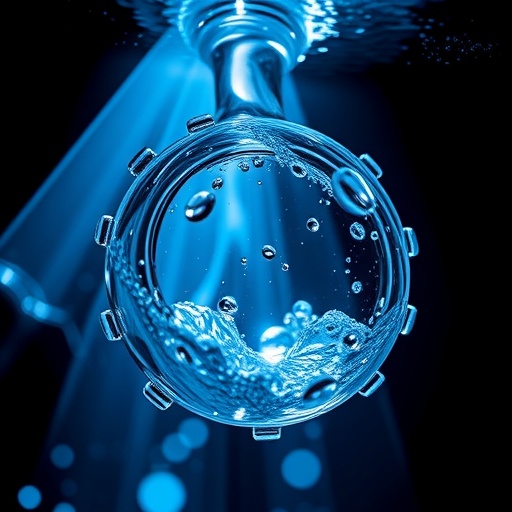
In a groundbreaking advancement in our understanding of water’s enigmatic nature, researchers at Stockholm University have unlocked definitive evidence of a liquid-liquid critical point in supercooled water. Utilizing cutting-edge x-ray laser technology at facilities in South Korea, the team has pinpointed this pivotal state at approximately -63 degrees Celsius under pressures reaching 1000 atmospheres. This discovery sheds light on the anomalous thermodynamic properties of water that have puzzled scientists for centuries, offering a crucial piece to the complex puzzle of water’s behavior in extreme conditions.
Water, the most vital substance for life on Earth, exhibits properties that starkly contrast with those of most other liquids. Unlike typical substances that uniformly contract and increase in density as temperature decreases, water behaves counterintuitively. For instance, water achieves its maximum density not at the freezing point but at a relatively warm 4 degrees Celsius. Beyond this temperature, as water cools further, it begins to expand, a phenomenon that defies classical understanding of liquid behavior. This exceptional feature is the reason ice floats on liquid water, underpinning a vast array of ecological and environmental processes.
Upon supercooling—cooling water below its normal freezing point without transition into solid ice—water continues to defy expectations. Instead of contracting, its volume increases progressively, with this expansion accelerating as temperatures drop further. Additionally, properties such as heat capacity and compressibility display peculiar trends, signaling the presence of complex molecular rearrangements. These anomalies have fueled decades of theoretical debate and speculation surrounding the underlying mechanisms driving such behavior, with the existence of a critical point long hypothesized but never experimentally confirmed until now.
The recent experiments revolutionize this field by capturing water’s behavior on an unprecedented timescale using ultra-short x-ray pulses. This technique allows the researchers to observe the transient liquid state moments before crystallization becomes inevitable. By probing these fleeting moments, the team was able to witness the disappearance of the liquid-liquid phase transition, marking the emergence of a new critical state. This critical point represents a condition where two distinct liquid phases cease to exist as separate entities, merging into a single, highly unstable supercritical phase.
Fundamentally, water can exist in two macroscopic liquid phases differentiated by how its molecules hydrogen bond under various temperature and pressure regimes. One phase is characterized by low density with an open, tetrahedral hydrogen bond network, while the other exhibits a denser, more collapsed structure with distorted bonding. At the critical point, the boundary between these two structures vanishes, leading to intense fluctuations that permeate a broad range of temperatures and pressures, extending all the way to conditions found naturally on Earth’s surface.
These fluctuating states cause water to behave as if trapped in indecision, constantly shifting between low-density and high-density arrangements. This dynamic instability is responsible for many of water’s extraordinary attributes, such as its unusually high heat capacity, anomalous compressibility, and its ability to sustain diverse forms of life. In effect, ambient water exists as a supercritical fluid—a state that combines properties of both liquids and gases—making it uniquely suited to its role as the solvent of life.
Another surprising insight from this study concerns the kinetic dynamics near the critical point. As water approaches this state, molecular movement slows dramatically, indicating a glass-like behavior where the system is increasingly confined and destabilized. This phenomenon is likened metaphorically to a gravitational black hole, representing a basin of no return where water’s molecular configuration becomes trapped in persistent fluctuations, unable to escape the critical influence.
The experimental journey into this critical domain was facilitated by the study of amorphous ices—solid forms of water with no long-range order that mimic liquid states under extreme conditions. These previously well-studied but enigmatic forms provided a natural pathway to access the supercooled critical regime. This approach has inspired researchers to explore other glassy materials and unconventional states of matter with new experimental techniques made possible by advancements in x-ray laser technology.
The research collaboration involving Stockholm University, POSTECH University and PAL-XFEL in South Korea, Max Planck Society and Johannes Gutenberg University in Germany, and St. Francis Xavier University in Canada underscores the international effort required to unveil such complex phenomena. Key contributors including Aigerim Karina, Robin Tyburski, Iason Andronis, and Fivos Perakis played instrumental roles in designing and conducting the experiments, analyzing data, and interpreting the profound implications of the findings.
The discovery of the supercooled liquid-liquid critical point not only validates long-standing theoretical models that have sought to elucidate water’s anomalies but also opens new avenues for investigating the impact of these molecular behaviors in broader scientific fields. From the biochemistry of cellular hydration to geological processes involving deep earth water, and even climatological models predicting atmospheric water dynamics, this research forms a crucial foundation for future interdisciplinary exploration.
As the scientific community grapples with these revelations, the implications extend beyond pure research. Understanding supercooled water’s critical behavior could revolutionize technologies reliant on water’s unique properties, from cryopreservation and ice formation control to improving industrial processes where precise management of water’s thermodynamic states is essential. The question now ignites: Is water’s singular supercriticality at ambient conditions a serendipitous coincidence tied to life’s emergence, or does it hold deeper, yet undiscovered secrets critical to our existence?
The years ahead promise exciting developments as researchers seek to unravel how these critical molecular fluctuations influence not just physical chemistry but also biological function, earth sciences, and climate dynamics. This landmark study fundamentally reshapes our conceptual framework of water and challenges scientists to rethink its role from a simple solvent to a dynamic and pivotal medium harboring complex phase behaviors.
Subject of Research:
Not applicable
Article Title:
Experimental evidence of a liquid-liquid critical point in supercooled water
News Publication Date:
26-Mar-2026
Web References:
10.1126/science.aec0018
References:
You, S., Ladd Parada, M., et al. (2026). Experimental evidence of a liquid-liquid critical point in supercooled water. Science.
Image Credits:
POSTECH University, South Korea
Keywords
Water anomalies, supercooled water, liquid-liquid critical point, x-ray lasers, hydrogen bonding, supercritical fluid, molecular fluctuations, amorphous ice, phase transition, thermodynamics, molecular dynamics, high-pressure water


