

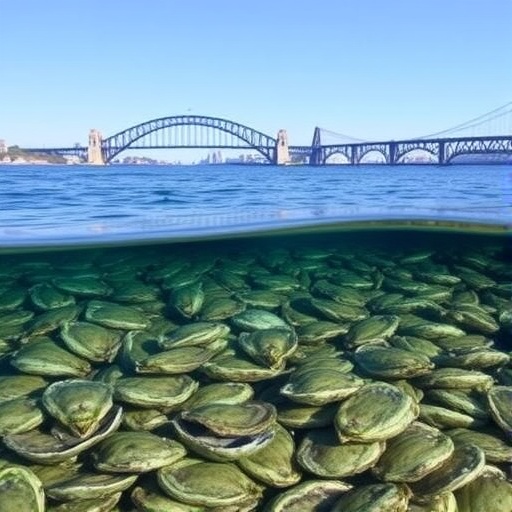
New Groundbreaking Insights into Oyster Reef Geometry Revolutionize Restoration Strategies
Oyster reefs, often described as “ecosystem engineers,” are pivotal to coastal environments. Despite their crucial role in maintaining biodiversity, stabilizing shorelines, and enhancing water quality, these natural structures have been severely depleted worldwide. Until recently, efforts to restore oyster habitats primarily focused on creating artificial reefs without a comprehensive understanding of the intricate spatial characteristics governing natural reef success. However, a pioneering study led by Dr. Juan Esquivel-Muelbert from Macquarie University, published in Nature, unveils the secret architectural blueprints that maximize oyster recruitment and survival, fundamentally reframing restoration approaches.
At the core of this research lies the revelation that oyster reefs are not mere chaotic accumulations of shells but highly sophisticated three-dimensional constructs. These reefs exhibit complex geometric configurations evolved over millennia, optimizing conditions for juvenile oysters to settle, grow, and resist predation. Utilizing high-resolution 3D photogrammetry, the research team meticulously mapped surviving Sydney rock oyster (Saccostrea glomerata) reefs around Sydney’s estuaries, capturing fine-scale spatial complexity and structural variability rarely quantified before.
The study’s innovative methodological framework combined detailed field measurements with computational modelling, enabling the researchers to engineer 16 distinct concrete tile designs. Each tile mimicked various structural nuances observed in natural reefs, particularly focusing on different ridge quantities and heights to emulate habitat complexity. These artificial substrates were then deployed in three Sydney estuaries—Brisbane Water, the Hawkesbury River, and Port Hacking—both inside and outside predator-proof cages to isolate the effects of predation pressure on oyster survival.
Results from long-term monitoring revealed that neither the most complex nor the tallest artificial habitats fostered the highest juvenile oyster recruitment or survival. Instead, a specific range of geometric characteristics, including multiple small microhabitats with minimal exposure to predators and environmental stressors, were critical to maximizing oyster resilience and reef persistence. This nuanced understanding dispels the simplistic assumption that increasing habitat complexity or surface area alone guarantees restoration success, emphasizing that juvenile oysters require protective refuges tailored by natural reef architecture.
Juvenile Sydney rock oysters face formidable threats from predators such as fish and crabs, as well as ecological stresses like desiccation and overheating. The discovered architectural blueprint provides these vulnerable recruits with niches that mitigate these risks, enhancing their establishment and long-term survival. Dr. Esquivel-Muelbert emphasizes that restoration efforts must prioritize these spatial configurations to effectively catalyze reef regeneration, highlighting the need to move beyond rudimentary shell piling towards architecturally-informed habitat design.
This research carries profound implications, particularly given that approximately 85% of Australia’s historical oyster reefs, which once spanned extensive coastal territories, have been lost since European settlement. Historical anthropogenic pressures, including overharvesting, dredging, and shell destruction for lime production, have drastically diminished these keystone ecosystems. The loss of oyster reefs has ripple effects, degrading habitat complexity for a multitude of marine species and weakening coastal resilience against erosion.
Professor Melanie Bishop, a senior co-author and coastal ecologist, underscores the cultural and historical significance of oyster reefs, noting their integral role in early colonial infrastructure through the usage of crushed shells in mortar. The ecological and cultural heritage embedded within these reefs further amplifies the urgency of developing restoration strategies that honor their intricate natural form.
Collaborating scientists, including Professor Joshua Madin from the Hawaiʻi Institute of Marine Biology, stress that nature’s evolutionary refinement offers a universal architectural rule set for reef persistence. By decoding these patterns, scientists and conservationists can harness an evidence-based blueprint facilitating faster reef growth and improved stability globally, not limited to Sydney or oyster species alone.
This paradigm shift in oyster reef restoration, grounded in sophisticated spatial ecology and experimental validation, bridges a critical knowledge gap in marine conservation. It provides a replicable framework to engineer artificial habitats that closely mimic natural complexity, reinforcing ecosystem services and biodiversity. As coastal habitats face mounting pressures from climate change and human activity, such innovative, nature-inspired solutions are invaluable to sustaining marine ecosystems.
Ultimately, this study advances our scientific comprehension of oyster reefs from simplistic resource patches to dynamic, architecturally intricate ecosystems. It offers a tangible pathway to restore these “ecosystem engineers” effectively, ensuring their continued role in sustaining marine life, protecting coastlines, and fostering resilient ocean environments worldwide.
Subject of Research: Animals
Article Title: The natural architecture of oyster reefs maximizes recruit survival
News Publication Date: 18-Feb-2026
Web References: http://dx.doi.org/10.1038/s41586-026-10103-8
Image Credits: Dr Juan Esquivel-Muelbert
Keywords: oyster reef restoration, Sydney rock oyster, Saccostrea glomerata, 3D photogrammetry, habitat complexity, predator protection, ecosystem engineers, artificial reefs, spatial ecology, marine conservation


