

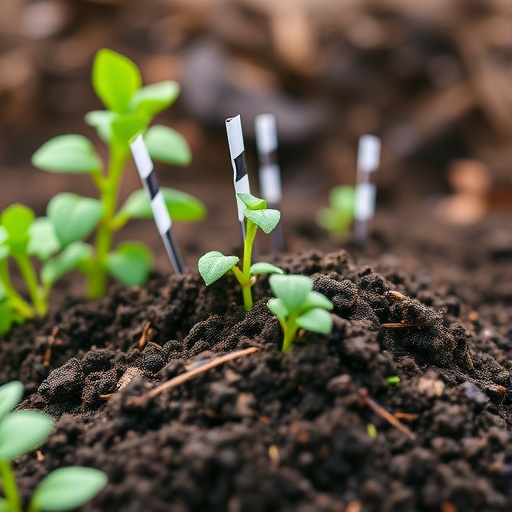
Scientists have unveiled groundbreaking insights that promise to transform the practice of composting by drastically reducing harmful air pollutants while simultaneously enhancing the nutrient profile of organic fertilizers. This pioneering research aggregates findings from a comprehensive meta-analysis encompassing 135 global studies and over 1,600 experimental observations, providing an unprecedented synthesis of the complex interplay between compost management methods, gaseous emissions, and fertilizer quality. It delivers actionable guidance for farmers, waste management professionals, and policymakers striving to adopt climate-smart, sustainable agricultural practices that mitigate environmental harm.
Composting, a time-honored technique for recycling organic waste into valuable soil amendments, faces significant challenges stemming from its potential to emit potent greenhouse gases such as methane (CH4) and nitrous oxide (N2O), as well as odorous and toxic substances including ammonia (NH3), hydrogen sulfide (H2S), and volatile organic compounds (VOCs). These emissions not only exacerbate air pollution and global warming but also degrade the nutrient content and agronomic efficacy of the final compost product. The newly published study in Environmental and Biogeochemical Processes advances our understanding of how strategic interventions during composting can suppress these emissions while boosting nutrient retention.
The extensive meta-analytical approach entailed analyzing worldwide datasets that describe the effects of various compost control measures, categorized into biological, chemical, physical, and mechanical interventions. Biological strategies comprised microbial inoculants designed to modulate microbial communities, whereas chemical measures included amendments such as biochar and gypsum that interact directly with the chemical environment of the compost. Physical methods involved enhanced aeration systems and the addition of bulking agents to optimize oxygen diffusion and moisture balance. Mechanical solutions focused on mixing techniques and novel electric field applications to disrupt emission pathways and accelerate decomposition.
Significantly, these interventions were shown to elevate composting temperatures by approximately 48 percent, a thermal increase that is pivotal for pathogen inactivation as well as for expediting the conversion of complex organic substrates into stable humic substances. Elevated temperatures also create less conducive conditions for methanogenic archaea, microbes responsible for methane generation under anaerobic pockets within compost piles. This thermal effect, combined with disciplinary strategies, resulted in remarkable reductions in emissions: methane levels fell by around 69 percent, nitrous oxide by 83 percent, ammonia by 78 percent, and carbon dioxide by 78 percent as well, reflecting an overall suppression of gaseous losses from the system.
Nutrient dynamics, a critical factor determining the agronomic value of compost, were positively influenced by these management tactics. Retention of nitrogen, indispensable for plant growth, surged by nearly 89 percent, indicating that less nitrogen was lost as volatilized ammonia or denitrified nitrous oxide. Additionally, the humic acid content—an index of compost maturity and soil health benefits—increased by about 29 percent, signaling enhanced organic matter stabilization. The germination index, an assay reflecting phytotoxicity and compost stability, improved by 73 percent, underscoring the production of safer, more effective fertilizers through these optimized composting protocols.
Among all tested amendments, biochar—the carbonaceous residue obtained from pyrolyzing biomass—stood out as the most potent technology for harmonizing emission mitigation with nutrient preservation. Its intricate porous matrix acts as a physical adsorbent for ammonia and nitrous oxide while fostering microbial environments that favor nutrient stabilization. The study elucidated biochar’s capacity to balance compost chemistry by reducing gaseous nitrogen losses and promoting compost maturation, making it an indispensable tool for future organic waste recycling initiatives.
The researchers emphasize that the compost feedstock—whether manure, food waste, sewage sludge, or agricultural residues—significantly influences emission profiles and nutrient retention rates. Different substrates vary in carbon-to-nitrogen ratios, moisture content, and microbial consortia, necessitating tailored compost management schemes that optimize operational parameters for each type of input. This insight challenges the conventional one-size-fits-all approach and highlights the need for precision composting strategies that consider waste heterogeneity and local environmental conditions.
Crucially, the study not only underscores composting’s role in closing nutrient loops and improving soil fertility but also frames it as a strategic environmental technology capable of decoupling organic waste handling from climate change drivers. Organic waste streams worldwide are burgeoning, and without effective recycling pathways, they pose escalating threats to landfills, water bodies, and atmospheric quality. Enhanced composting practices thus emerge as indispensable for transforming waste liabilities into agronomic assets while curbing greenhouse gas emissions across the agricultural sector.
The synergistic potential of combining diverse mitigation approaches also emerged from the analysis. For example, coupling optimized aeration regimes with chemical amendments such as biochar and gypsum could amplify reductions in gas emissions and nutrient losses beyond levels achievable by individual interventions alone. Such integrative composting systems warrant further exploration to develop cost-effective, scalable solutions that accommodate varying climatic and operational contexts globally.
Looking forward, the authors advocate for broadening the scope of empirical studies to encompass diverse geographies and climatic zones. Such data expansion will enrich meta-analytical models and facilitate the development of globally applicable composting guidelines that remain sensitive to regional environmental and socio-economic realities. Moreover, exploring emerging technologies like electric field application offers promising avenues for innovation in reducing noxious emissions and improving compost quality.
By delivering a rigorous, evidence-based assessment of diverse composting management strategies, this study equips stakeholders with a scientifically vetted roadmap to enhance both environmental sustainability and agricultural productivity. Its revelations propel composting from a traditional waste management technique to a dynamic component of climate-smart agriculture, embodying the intertwined goals of emission reduction, resource efficiency, and soil health enhancement essential to global food security.
This meta-analytical research acts as a clarion call for the adoption of intelligent composting protocols that prioritize emission control without compromising nutrient cycling. As the world grapples with intensifying climate challenges and growing demands for sustainable agriculture, these findings highlight a pragmatic pathway to harness organic waste for ecological and economic benefit. Implementing these strategies has the potential to revolutionize organic fertilizer production, reducing the environmental footprint of farming operations while fostering resilient, fertile soils capable of sustaining future generations.
Subject of Research: Not applicable
Article Title: Synthesis of air pollution patterns and nutrient composition during organic fertilizer production: a meta-analytical study
News Publication Date: 27-Jan-2026
Web References: https://doi.org/10.48130/ebp-0025-0022
References: Abdellah YAY, Gao J, Shi Z, Shi X, Liu W, et al. 2026. Synthesis of air pollution patterns and nutrient composition during organic fertilizer production: a meta-analytical study. Environmental and Biogeochemical Processes 2: e005 doi: 10.48130/ebp-0025-0022
Image Credits: Yousif Abdelrahman Yousif Abdellah, Jianou Gao, Zhaoji Shi, Xiaofei Shi, Wei Liu, Chengmo Yang, Katharina Maria Keiblinger, Xinyue Zhao, Elsiddig A. E. Elsheikh, Shahid Iqbal, Shanshan Sun, Dong Liu, & Fuqiang Yu
Keywords: Air pollution, Additive effects, Fertilizers, Metaanalysis


