
Monday, December 29, 2025
Science
No Result
View All Result
  • Login
  • HOME
  • SCIENCE NEWS
  • CONTACT US
  • HOME
  • SCIENCE NEWS
  • CONTACT US
No Result
View All Result
Scienmag
No Result
View All Result
Home Science News Technology and Engineering

Scientists develop innovative maleic acid-treated bacterial cellulose gel enhancing bone repair

April 15, 2024
in Technology and Engineering
Reading Time: 3 mins read
0
Scientists Develop Innovative Maleic Acid-Treated Bacterial Cellulose Gel Enhancing Bone Repair
66
SHARES
597
VIEWS
Share on FacebookShare on Twitter
ADVERTISEMENT

The field of bone tissue engineering (BTE) was a promising avenue for addressing bone injuries and defects by constructing artificial scaffolds with bionic functionalities. Due to its unique 3D network structure, impressive mechanical properties, and excellent biocompatibility, BC has emerged as a captivating area of research in the realm of scaffold fabrication.

Scientists Develop Innovative Maleic Acid-Treated Bacterial Cellulose Gel Enhancing Bone Repair

Credit: Co-Innovation Center for Efficient Processing and Utilization of Forest Resources, College of Chemical Engineering, Nanjing Forestry University, China, hcx@njfu.edu.cn

The field of bone tissue engineering (BTE) was a promising avenue for addressing bone injuries and defects by constructing artificial scaffolds with bionic functionalities. Due to its unique 3D network structure, impressive mechanical properties, and excellent biocompatibility, BC has emerged as a captivating area of research in the realm of scaffold fabrication.


The 3D printing was a precise technique for constructing intricate structures in damaged tissues or organs, which has been widely applied in bone tissue engineering field. However, the application of BC for 3D printing faces certain limitations that require attention, such as its dense 3D network structure, which impedes cellular penetration and weakens cell attachment. Besides, the tightly entangled fibers within BC may pose challenges for its extrusion as a bio-ink during the printing process, which will also limit the research has been conducted on the application of BC in 3D printing.


Maleic acid (MA) has emerged as a promising candidate for acid treatment of cellulose, primarily due to its eco-friendly nature and mild reaction conditions. In our previous work, it proved that MA solution with different concentration showed various effects on BC physicochemical properties and osteogenesis. While, the MA-mediated modification for BC was a kind of reversible reactions including ester reaction (forward reaction) and ester hydrolysis reaction (backward reaction). Hence, it is necessary to balance the volume of added MA solution in order to ensure the forward reaction for BC modification, which will gain deeper insights into the MA mediated modification process and unlock the full potential of modified BC in bone tissue engineering field.


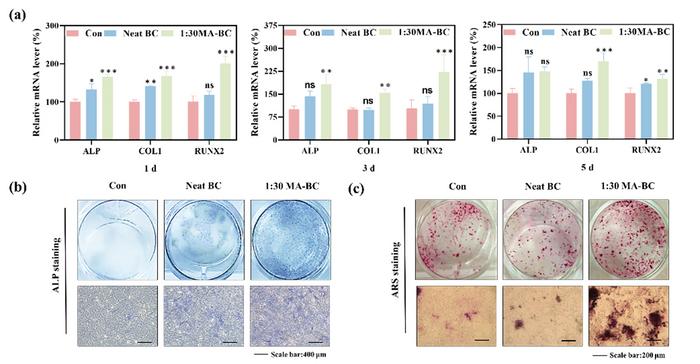
According to Xucai Wang, the investigator who led the study, this provides a new idea for the research of bacterial cellulose in bone tissue engineering. “The esterification process introduced carboxyl groups and hydrophobic properties to BC, thereby enhancing its suitability as a bio-ink for tissue engineering scaffolds. Additionally, the 1꞉30 MA-BC dispersion exhibited excellent biocompatibility, increased osteogenic gene expression, and increased mineralized nodule formation in vitro compared to the neat BC dispersion.” Also, the authors expect this work to provided valuable insights into the potential application of MA-BC dispersions in bone tissue engineering, particularly in facilitating proliferation and differentiation of osteocyte.


See the article:

DOI

Original Source URL

https://www.sciencedirect.com/science/article/pii/S236996982400032X   

Journal

Journal of Bioresources and Bioproducts


Journal

Journal of Bioresources and Bioproducts

DOI

10.1016/j.jobab.2024.04.001

Method of Research

Experimental study

Subject of Research

Cells

Article Title

Constructing Osteo-Inductive Bio-Ink for 3D Printing Through Hybridization of Gelatin with Maleic Acid Modified Bacterial Cellulose by Regulating Addition Volumes of Maleic Acid Solution

Article Publication Date

4-Apr-2024

COI Statement

The authors declare no conflict of interest.

Share26Tweet17
Previous Post

PolyU harnesses GeoAI technologies to enable sustainable urban development

Next Post

Multi-objective nitrogen management in food system

Related Posts

blank
Technology and Engineering

Neonatal ICU Exposures Affect Newborn Brain Development

December 29, 2025
blank
Technology and Engineering

Eco-Friendly Zinc Oxide from Palm Leaves for Amoxicillin Degradation

December 29, 2025
blank
Technology and Engineering

Maternal Low Sodium, Postnatal Diuretics Harm Metabolism, Breathing

December 29, 2025
blank
Technology and Engineering

Measuring Body Composition in Full-Term Infants Reviewed

December 29, 2025
blank
Technology and Engineering

Acoustic Machine Learning for Ball Bearing Fault Detection

December 29, 2025
blank
Technology and Engineering

Diffusion Models Revolutionize Underwater Object Detection

December 29, 2025
Next Post
graphical abstract

Multi-objective nitrogen management in food system

  • Mothers who receive childcare support from maternal grandparents show more parental warmth, finds NTU Singapore study

    Mothers who receive childcare support from maternal grandparents show more parental warmth, finds NTU Singapore study

    27594 shares
    Share 11034 Tweet 6897
  • University of Seville Breaks 120-Year-Old Mystery, Revises a Key Einstein Concept

    1005 shares
    Share 402 Tweet 251
  • Bee body mass, pathogens and local climate influence heat tolerance

    656 shares
    Share 262 Tweet 164
  • Researchers record first-ever images and data of a shark experiencing a boat strike

    524 shares
    Share 210 Tweet 131
  • Groundbreaking Clinical Trial Reveals Lubiprostone Enhances Kidney Function

    500 shares
    Share 200 Tweet 125
Science

Embark on a thrilling journey of discovery with Scienmag.com—your ultimate source for cutting-edge breakthroughs. Immerse yourself in a world where curiosity knows no limits and tomorrow’s possibilities become today’s reality!

RECENT NEWS

  • Rebalancing Strategies for Blended English Teaching in China
  • Tourism’s Impact on Wild Predator-Prey Dynamics
  • Soil Microbial Cooperation Drives Dryland Tree Growth
  • Planck Simulator Reveals Duality Breaking!

Categories

  • Agriculture
  • Anthropology
  • Archaeology
  • Athmospheric
  • Biology
  • Blog
  • Bussines
  • Cancer
  • Chemistry
  • Climate
  • Earth Science
  • Marine
  • Mathematics
  • Medicine
  • Pediatry
  • Policy
  • Psychology & Psychiatry
  • Science Education
  • Social Science
  • Space
  • Technology and Engineering

Subscribe to Blog via Email

Success! An email was just sent to confirm your subscription. Please find the email now and click 'Confirm Follow' to start subscribing.

Join 5,194 other subscribers

© 2025 Scienmag - Science Magazine

Welcome Back!

Login to your account below

Forgotten Password?

Retrieve your password

Please enter your username or email address to reset your password.

Log In
No Result
View All Result
  • HOME
  • SCIENCE NEWS
  • CONTACT US

© 2025 Scienmag - Science Magazine