

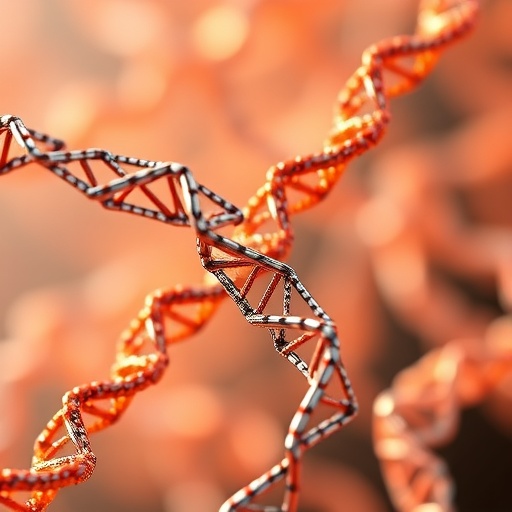
In a groundbreaking development that challenges long-standing assumptions in molecular self-assembly, researchers at New York University have revealed that DNA can be programmed to form intricate three-dimensional structures without relying on the conventional “sticky ends” hydrogen bonding mechanism. This revolutionary finding, detailed in a recent publication in Nature Communications, redefines the fundamental principles that have driven DNA nanotechnology since its inception.
Traditionally, DNA nanotechnology capitalizes on the hydrogen bonding properties of base pairs, particularly exploiting so-called sticky ends—single-stranded overhangs that bind complementary sequences—to guide the self-assembly of DNA nanostructures. This approach has enabled scientists to create remarkably complex architectures, building from simple units. However, this new research overturns the necessity of sticky ends, instead demonstrating that the geometric shape and interface design of DNA tiles alone can drive their assembly. This mechanism mimics the precision of jigsaw puzzles, where the fitting together of shapes negates the need for adhesive glue.
Simon Vecchioni, a research scientist in NYU’s Department of Chemistry and a key contributor to the study, explains that this research leverages the power of interface shape complementarity. By tailoring how the edges of each DNA tile interact—specifically through planar, flat interfaces capable of π–π stacking interactions—the team created programmable DNA architectures that spontaneously organize into complex three-dimensional forms. This assembly guided purely by shape and stacking forces marks a paradigm shift in molecular design strategies.
The concept draws inspiration from the late Professor Ned Seeman, who pioneered structural DNA nanotechnology by illustrating that DNA could assemble into 3D crystalline arrays when sticky ends promoted interaction and cohesion. Seeman’s discoveries opened the door to programmable materials constructed via base pairing specificity. Yet, the NYU team has taken these foundational concepts further by revealing that hydrogen bonding is not an exclusive requirement for ordered DNA assembly—a surprising insight that broadens the toolkit for nanoscale construction.
This research demonstrates the creation of stacked DNA triangular motifs, which assemble into an extensive array of unprecedented 3D architectures distinguished by unique twist angles, rotational symmetries, and inversions. The fascinating complexity they achieve emerges not from new chemical linkages but solely from the interplay of geometric constraints and molecular stacking forces. By manipulating the spatial arrangement of the tiles’ flat interfaces, the researchers achieved a rich library of programmable DNA-based materials.
One of the most intriguing aspects of the study is its exploration of handedness in DNA helices. Natural DNA predominantly adopts a right-handed double helix configuration, but synthetic variants of left-handed DNA—idenitified as “mirror DNA”—can also be engineered. The NYU team showed they could selectively modulate interactions between these chiral forms by engineering the stacking interfaces, effectively programming whether right-handed and left-handed DNA units attract, segregate, or form complex layered structures together.
Vecchioni likens this achievement to enabling molecular communication between mirrored biological worlds. The ability to intercalate left- and right-handed DNA in the same structure opens new avenues for delving into mirror-image biomolecular systems, a domain that has long sparked scientific debate concerning the origins of homochirality in life and the possibility of mirror life forms. This breakthrough proposes a novel method for gleaning information across these chiral domains.
Senior scientist Ruojie Sha highlights how this approach mirrors natural computation processes: by inputting defined tile geometries and interfaces into the system and allowing spontaneous assembly, the material self-organizes into the energetically favored configurations. This data-driven discovery method promises a powerful framework for designing increasingly sophisticated nanoscale materials by exploiting intrinsic physicochemical rules rather than external programming.
The implications of creating such complex, multiplexed DNA architectures are vast. DNA crystals inherently comprise a high water content and porous network, making them excellent candidates for hosting biomolecules and facilitating their diffusion. This characteristic positions them as promising platforms for biosensing technologies, drug delivery vehicles, and other biomedical applications where molecular transport and interaction control are critical.
The research was accomplished through a collaborative effort involving other NYU chemists including Karol Woloszyn, Andrew Horvath, Mara Jaffe, Lara Perren, Joe Rueb, Samyra Mahiba, Yoel P. Ohayon, and James W. Canary, along with Nataša Jonoska from the University of South Florida. Funding was generously provided by the U.S. National Science Foundation, Department of Energy, and NASA, reflecting the project’s multifaceted scientific impact.
This study heralds a new chapter in DNA nanotechnology, illustrating that simple molecular shapes can encode extraordinary structural complexity when guided by fundamental physical forces like π–π stacking. As researchers explore further applications in optical, electronic, and biomedical fields, the ability to program DNA into large-scale 3D materials without traditional sticky ends unfurls expansive horizons for the design of next-generation functional nanomaterials.
Subject of Research: DNA Nanotechnology and Self-Assembly of 3D DNA Architectures without Sticky Ends
Article Title: Blunt-force assembly of programmable DNA architectures using π–π stacking
News Publication Date: 24-Feb-2026
Web References:
https://www.nature.com/articles/s41467-026-69973-1
http://dx.doi.org/10.1038/s41467-026-69973-1
References:
Seeman, N.C. “Structural DNA Nanotechnology,” PubMed: 10511701.
Image Credits: Simon Vecchioni
Keywords
DNA, DNA Nanotechnology, Self-assembly, π–π Stacking, Molecular Architecture, Crystallography, Mirror DNA, Chiral DNA, Nanomaterials, Structural DNA, DNA Crystals, Biomolecular Engineering


